

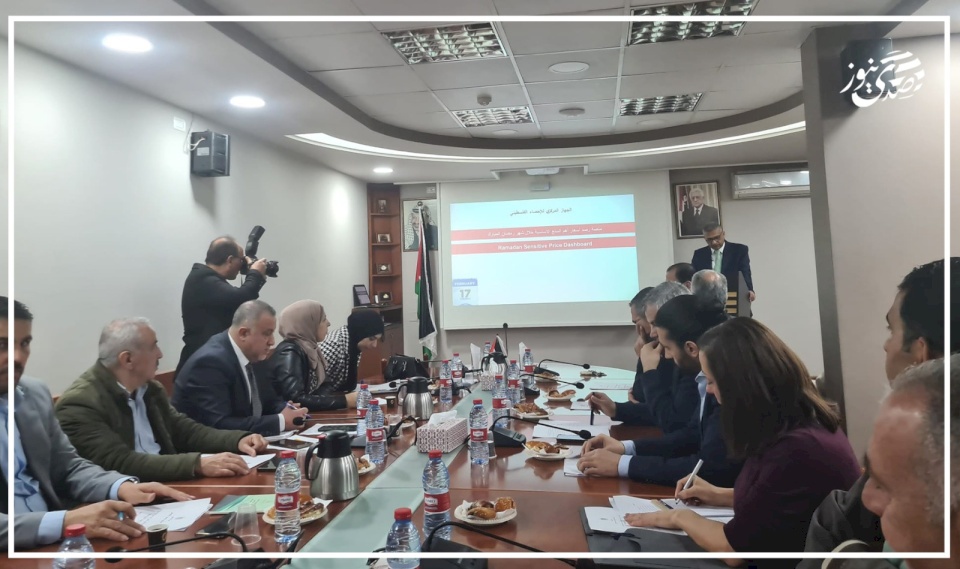
Ramadan Preparations: Mandatory Price List and Launch of Price Monitoring Platform, Referral of Olive Oil Adulteration Promoters to Prosecution
Special SadaNews - The Ministry of National Economy confirmed that the indicative list of goods it issues for the holy month of Ramadan is legally binding for traders, and not just for guidance.
Ibrahim Al-Qadi, Director General of the General Administration for Consumer Protection, told "SadaNews": It is not true that the indicative list issued by the Ministry of National Economy regarding basic commodities during the holy month of Ramadan is merely a guiding list for citizens and not legally binding for traders. He indicated that the ministry has the ability to compel traders to adhere to the prices in accordance with the Competition Law and the Prevention of Monopoly Practices, which was ratified by President Mahmoud Abbas last year, in addition to Law No. 27 of 2018 concerning consumer protection.
Al-Qadi noted that the official authorities based on the available laws last year referred several traders to the public prosecution and then to the courts, which imposed heavy fines on some of them, reaching up to three thousand dinars in some cases, warning traders in various governorates against violating the law during the current month of Ramadan, which coincides with difficult economic conditions faced by citizens.
It is worth mentioning that the Competition Law aims to encourage competitive behavior among enterprises, ensure investment freedom, enhance it, and prevent monopolies and exclusion in the Palestinian market.
The law also includes the necessary legal and administrative interventions to address any disruption resulting from anti-competitive practices by taking actions regulated pursuant to the provisions of this law.
As for Law No. (27) of 2018 regarding the amendment of the Consumer Protection Law No. (21) of 2005, it is a Palestinian legislation that tightens penalties on commercial fraud and price manipulation, imposing penalties of up to 10 years in prison and significant fines on those who sell spoiled or adulterated goods or refuse to trade food commodities.
In a different context, Al-Qadi pointed out that the Ministry of National Economy has monitored significant quantities of adulterated oils in the markets, noting that the source of these quantities is the Israeli market and that seven traders have been referred to the public prosecution, adding that the ministry continues to follow up with various official entities to regulate the market.
He pointed out that despite the Cabinet's decision to allow the import of quantities of olive oil up to five thousand tons from abroad, only limited quantities (400-500) tons have been imported due to the availability of supply in the market.
The Palestinian Central Bureau of Statistics today, Tuesday, launched an electronic platform to monitor the price movements of a number of essential commodities during the holy month of Ramadan, in a step aimed at enhancing transparency and providing immediate indicators reflecting the reality of prices in the Palestinian markets, in coordination with the Ministry of National Economy and the Consumer Protection Association.
The bureau explained that the launch of the platform aligns with its policy to provide accurate data that serves decision-makers, institutions, and individuals, especially in light of the increasing demand for some commodities during the holy month and its impact on Palestinian families' spending.
The platform aims to highlight the developments in the prices of selected commodities that see increased demand during Ramadan and compare them with the indicative price issued by the Ministry of National Economy, allowing for monitoring traders' compliance with the set prices.
The platform also provides a series of weekly data derived from the Palestinian markets to measure changes in prices as they occur and to monitor any increases or disparities throughout the month.
 Follow the latest Sada News via Google News
Meeting Between Aoun and Trump Expected Alongside 'Experimental Areas'

Gaza Health Warns of Collapse of Oncology Services Due to Depletion of Treatments and Susp...

The Occupation Demolishes a House in the Town of Sa'ir near Hebron

Israel Reveals Details of Secret Iranian Nuclear Facility in Mount Fas

A Mother, Her Child, and Her Three Daughters Martyred in Israeli Shelling on Gaza City

US Military Ends Latest Round of Strikes on Iran

Trump: Iran Will Pay the Price for Killing American Soldiers
