

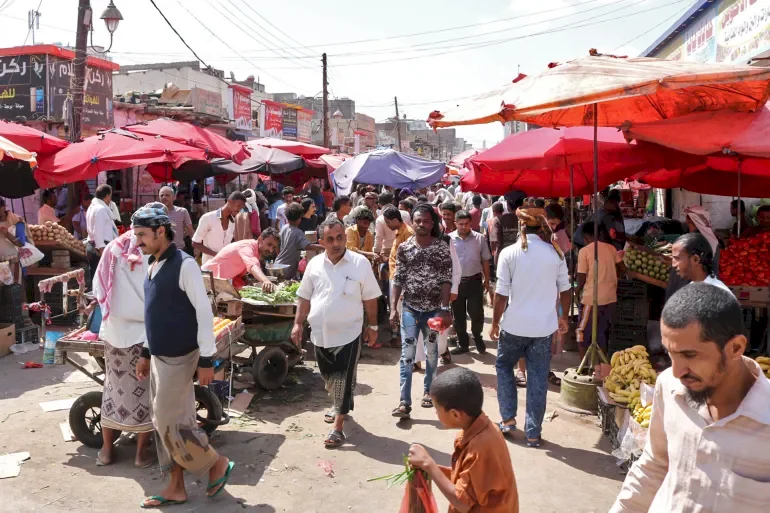
"A Salary with No Value, If It Exists".. How Do Yemenis Manage Their Living Conditions?
SadaNews - As evening approaches, Abdul Wahed Yahya does not end his workday at the Ministry of Health in the temporary capital, Aden; instead, he begins a second shift at a nearby popular restaurant, which extends until midnight, in an attempt to earn extra income to alleviate the burden of living expenses that his government salary can no longer cover.
Abdul Wahed, the archive manager at the Ministry of Health, receives a monthly salary of 73,000 Yemeni rials (about $40), while supporting a family of nine.
He tells Al Jazeera Net that the salary "lasts only a few days against the requirements of life," and when asked what he can afford with that amount, he replies, "It is only enough to buy a bag of rice and a can of oil."
About ten years ago, his salary was equivalent to nearly $300, sufficient to cover his family's basic needs. However, today, with the continuous collapse of the local currency and rising prices, the salary has become a number with no real value. This situation has compelled him - as he says - to borrow two million Yemeni rials from relatives and friends over the past years, without being able to repay it so far.
Despite the long working hours between two jobs, Abdul Wahed confirms that his earnings barely cover daily necessities, leaving him unable to save or pay off debts. This suffering is not unique to him; it extends to thousands of government employees in Yemen whose salaries have eroded due to years of war and the ongoing economic crisis.
Consequences of the Conflict
This suffering reflects the broader repercussions of the conflict on state employees. Since the outbreak of the war in 2015, government employees have become one of the most affected groups, as the role of the state has diminished and its financial system has disintegrated. In light of the continued political division and the absence of a comprehensive settlement, the government salary has ceased to be a stable income; it has turned into an indicator of the depth of the economic crisis in a country with diverse authorities and differing financial policies.
This reality has led to severe disparities in the conditions of employees across different controlled areas. In areas under the control of the Houthi group, salaries of hundreds of thousands of employees have been halted or paid intermittently, while salaries in government-controlled areas have lost a significant part of their value due to the collapse of the local currency and rising prices. In both cases, salaries can no longer provide the minimum standards for living stability.
As purchasing power erodes and poverty widens, thousands of employees have found no choice but to seek alternative sources of income outside governmental jobs and seek individual projects and initiatives. Meanwhile, employees in vital sectors, especially education, remain captive to low wages and the absence of alternatives, reflecting the extent of the existing economic imbalance.
Harsh Stories
In daily life, this suffering takes the form of more severe personal stories, such as that of Amin Abdul Salam, a government employee displaced from an area controlled by the Houthi group to Aden, spending his day working at the health education office in the city, while his mind is preoccupied with calculating the cost of living in a reality that offers no real alternatives for income.
Amin confirms to Al Jazeera Net that since his displacement from Sanaa, where he worked at the Ministry of Health, he has not received any salary for nearly three years, leaving severe repercussions on the living and psychological stability of families that relied solely on the government salary for their income.
He adds that the lives of thousands of displaced employees have become closer to a "struggle for survival" than to a normal living, amid salary cuts and the absence of any stable income sources, noting that many have been forced to borrow or minimize their needs to the bare minimum, including daily meals.
A Gloomier Reality
In areas under the control of the Houthi group, the situation appears even more dire. Teacher Youssef Ali Hassan, from Dhamar governorate, encapsulates the reality of his colleagues by saying: "The salary is not sufficient," explaining to Al Jazeera Net that what they receive is not a salary in the true sense, but half salary sometimes issued every two months.
Youssef adds that this amount, which does not exceed 30,000 Yemeni rials, is spent within a few days on basic essentials, followed by the battle of debts and waiting for humanitarian aid. Under pressure from need, many families have been forced to send their children to the labor market early or to rely on remittances from relatives abroad to cover daily living expenses.
While there are no recent and accurate statistics on the number of state employees in Yemen, a 2014 civil service report indicated that the total number of employees was about 1.2 million, including 472,000 civil employees, 653,000 military and security personnel, and approximately 125,000 workers in economic units, in addition to around 125,000 retirees.
Unofficial estimates indicate that about one million government employees are concentrated in Sanaa and other areas controlled by the Houthis, with many suffering from interrupted or completely cut salaries for years. Meanwhile, the number of employees in government-controlled areas does not exceed 200,000, who receive their salaries on a nearly regular basis.
In contrast, the figures reveal the extent of the living gap in government-held areas, as government employees earn an average salary ranging from $60 to $100 monthly, depending on the exchange rate, while economic estimates suggest that the cost of living for a middle-class family exceeds this amount by several folds.
Economic experts believe that the situation faced by the Yemeni employee today is the result of cumulative collapses in the economic structure, which have rendered wages incapable of covering the minimum living requirements, transforming government salaries into symbolic income that does not protect from poverty.
Amid this reality, the Yemeni rial has witnessed a slight improvement in recent months against foreign currencies in the temporary capital, Aden, and other government-controlled provinces.
This improvement has been accompanied by a limited drop in the prices of goods and food supplies, particularly after the government formed technical committees to oversee prices, which have fallen by up to 40%. However, this situation remains fragile unless followed by sustainable and radical reforms.
Official Explanation
In this context, Fares Al-Najjar, the economic advisor in the office of the Yemeni presidency, confirms to Al Jazeera Net that the deterioration of government employees' conditions in recent years is due to the accumulation of three main factors:
The collapse of the value of the Yemeni rial in all areas, whether under Houthi control or the government, which has directly impacted the prices of goods and services, which have risen at a pace that exceeds any potential increases in wages.
The rise in annual inflation rates, which have ranged between 25% and 47% since the outbreak of the war, leading to an almost total erosion of the purchasing power of salaries.
The irregular payment of salaries, as there are no fixed commitments in Houthi-controlled areas, while the government faces difficulties in fulfilling payment obligations due to limited resources.
Al-Najjar adds that these factors combined have made government salaries closer to a "symbolic salary," pushing an increasing number of civil and military employees below the poverty line, while about 21 million Yemenis are in need of humanitarian assistance, including 19 million who suffer from food insecurity.
He also clarifies that the halt of oil and gas exports, which constituted about 70% of state resources, alongside weak revenue collection and chronic distortions, such as dual employment and fictitious payrolls, have contributed to complicating the salary crisis.
Regarding wages and salaries, Al-Najjar notes that the wage bill - according to the 2024 budget - reached about 998 billion Yemeni rials, equivalent to approximately $611 million. However, he stresses that this figure does not reflect the actual size of the crisis, especially given the salary arrears that have accumulated to around one trillion rials or more, increasing the living pressures on employees and transforming government salaries from a source of relative stability to an incomplete burden that does not cover the minimum essential needs.
Despite the bleak scene, Al-Najjar points out that the government has implemented some financial and monetary reforms to improve revenues and regulate monetary policy, indicating there are signs of relative improvement. However, he affirms that restoring the government salary to its role - as a minimum standard for living security - is contingent upon broader stability in public finance and the continuation of reforms; otherwise, the salary will remain just a number that erodes with the end of each month.
Source: Al Jazeera
 Follow the latest Sada News via Google News
Saudi Arabia condemns the Houthi threats to navigation and pledges to protect its ships

Houthi Movement Announces Ban on Maritime Navigation Against Saudi Arabia

Earthquake of 5.5 Magnitude Hits Western Iran

To Enhance His Support for "Increasing Children"... Vance Announces the Birth of His Fourt...

Death of a Mosque Imam in Armed Attack in Southeastern Iran

Rubio Reveals Circumstances Surrounding the Death of an American Soldier in Iraq

Reliable Threat.. US Embassy in Jordan: Evacuation of International Airport and Port in Aq...
