

Why Does Netanyahu Fear the Second Phase of the Gaza Agreement?
SadaNews - The second phase of the ceasefire agreement in the Gaza Strip, which the Washington administration is pushing toward and is being discussed at the upcoming summit between Netanyahu and Trump in Florida on Monday, involves additional withdrawals from the Gaza Strip and southern Lebanon without disarming the Islamic Resistance Movement (Hamas) and Hezbollah, a condition that the far-right within the Israeli government absolutely rejects.
Hence, Israeli Prime Minister Benjamin Netanyahu, who is wanted by the International Criminal Court for alleged war crimes in Gaza, fears the second phase of U.S. President Donald Trump's plan in the region because it represents a direct threat to the stability of his right-wing coalition rather than a security challenge.
Any commitment from Netanyahu to this step could lead to the disintegration of the coalition, as far-right parties consider the withdrawal a dangerous concession that grants Hamas a political achievement without a military resolution and undermines the narrative of restoring deterrence that Netanyahu has adopted since the war began.
Netanyahu's Maneuvering
In contrast, Netanyahu is avoiding confrontation with Trump, especially in light of reported American political and personal support for him, in exchange for passing the plan. Therefore, he is trying to maneuver between American pressures and internal rejection by delaying the second phase or tying it to strict security conditions or demanding political and security compensation.
His fears are further heightened amid coalition tensions and the stalled Haredi recruitment law, along with increasing possibilities of heading to early elections for the Knesset, making the second phase not just a political obligation but a danger that could hasten his government's end.
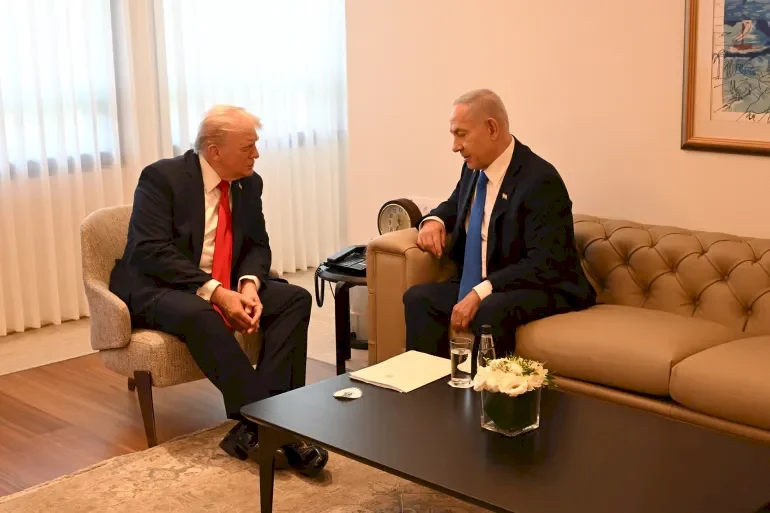
The expected meeting between Trump and Netanyahu comes at an extremely sensitive time, both internally and regionally. Military analyst at "Yedioth Ahronoth," Ron Ben-Yishai, states, "For Netanyahu, the second phase of the Gaza agreement represents a central concern, not only because of its security implications but primarily due to its internal political repercussions that could threaten the survival of his ruling coalition."
For his part, Jonathan Lis, the political correspondent for "Haaretz," remarked that Netanyahu leads a fragile coalition that primarily relies on far-right parties, which firmly reject any withdrawal from the Gaza Strip or a reduction of the Israeli military presence there.
These parties, according to the Israeli journalist, see the second phase as a strategic concession that gives Hamas a political and military victory without disarming it.
He added that any commitment from Netanyahu to Washington regarding withdrawal or redeployment of forces could drive his far-right partners to exit the coalition, which would mean losing the parliamentary majority and slipping towards early elections that the Israeli prime minister cannot guarantee favorable outcomes from.
Precedent without Resolution
Military analyst at "Haaretz," Amos Harel, states that from the perspective of the right-wing establishment, the second phase constitutes a dangerous precedent, as it practically means an Israeli withdrawal without achieving a decisive victory or dismantling the military capabilities of Hamas and Hezbollah.
This scenario, according to him, contradicts the narrative that Netanyahu has adopted since the beginning of the ongoing war, which is based on restoring deterrence and preventing the repetition of future attacks. He adds that accepting this equation would be used internally as a political weapon against him and presented to the Israeli public as a failure to achieve the war's objectives.
American Pressures
Meanwhile, Israeli writer Pinhas Anabari argues that Netanyahu understands that entering into a direct confrontation with Trump is not a realistic option, especially given reports about the American president's readiness to provide him with a political umbrella that could go as far as pushing for a pardon or dropping his corruption charges.
However, Anabari added in his article on the "Zman Yisrael" website that responding fully to American demands could explode his internal crisis, so Netanyahu is trying to maneuver by not publicly rejecting Trump's plan while simultaneously seeking to defer or dilute the second phase or tie it to strict security conditions.
So, will Netanyahu avoid confrontation with Trump to maintain his political survival, even at the expense of his declared security conditions?
Military analyst Harel believes that the awaited meeting between the American president and the Israeli prime minister does not foreshadow a public confrontation between them, as each has a direct interest in cooperation; Trump needs Netanyahu to push the second phase of his Gaza plan and present it as a central achievement of his policies in the region, while Netanyahu recognizes that any confrontation with him could negatively impact his fragile internal political situation.
He noted that the disagreement with Trump is more dangerous than the disagreement with his predecessor Joe Biden, which drives Netanyahu to seek a political compensation in return for the concessions required of him in Gaza, despite dwindling chances of successfully convincing Trump to freeze the second phase, even with the danger of Hamas maintaining military control in the area.
Harel pointed out that Israeli army officers speak of almost complete American control over the events, with direct coordination with the U.S. Central Military Command and continuous pressures to fulfill Israeli commitments.
A Time-Buying Attempt
For her part, Israeli broadcaster Nahama Dweik, in an article published in "Israel Hayom," states that these pressures come amid rising tensions within the ruling coalition and the stalled legislation of the Haredi recruitment law, along with increasing discussions about the possibility of heading to early elections.
She adds, "In such an atmosphere, Netanyahu sees that any controversial step, such as starting withdrawals from Gaza or Lebanon, could hasten the collapse of his government, and thus he will seek to maneuver and stall to buy time."
Dweik estimates that during his meeting with Trump, Netanyahu will attempt to push toward prioritizing the disarmament of Hamas and Hezbollah, or at least obtaining political or security compensation in exchange for initiating the second phase, be it through American guarantees or open support to continue his operations in Gaza and Lebanon.
However, it is established - according to her - that Netanyahu, despite his attempts to navigate and bargain, will not head into a direct confrontation with the American president but will seek to manage the disagreement calmly, driven by a primary concern to preserve his coalition and prevent the second phase from becoming the spark that politically brings him down.
 Follow the latest Sada News via Google News
Washington Investigates Possible Russian Role in Iranian Attacks on Its Sites

Mossad Chief Visited Washington to Discuss Iran and Its Nuclear Program

Report: Washington Informed Israel It Is Preparing to Intensify Attacks on Iran and Use St...

Organization of Islamic Cooperation Condemns Nauru's Decision to Open an Embassy in Occupi...

Video:: Nablus: Settlers Evict Tubasi Family from Their Home in Jaloud and Take Over It

Netanyahu: I Intend to Form a Broad National Unity Government

Syrian Foreign Minister Meets with Yasser Abbas in Damascus
