

New York Times: What are Israel's Goals in Controlling the West Bank?
SadaNews - The New York Times discussed how the idea of establishing a Palestinian state in the West Bank is gradually eroding, village by village, olive grove by olive grove, in light of the escalating Israeli settlement and the violence associated with it.
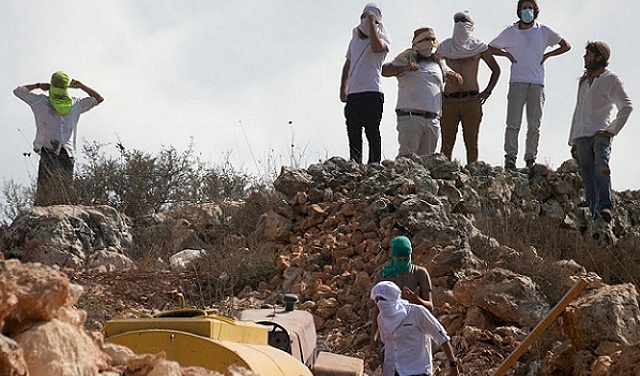
The newspaper's lengthy report focuses on the suffering of Palestinian farmers who face daily confrontations with extremist settlers seeking to impose control over the land by force, often under the watch or indirect protection of the Israeli army.
The report, co-authored by Michael D. Shear, Daniel Berenholak, Lian Abraham, and Fatima Abd al-Karim, tells the story of seventy-year-old farmer Rizq Abu Na'im, whose family land and livelihood have been repeatedly attacked by settlers driving their sheep into olive groves, taking water, destroying crops, and breaking into homes at night.
The report documents, based on data, maps, and court orders, how Israeli state control is expanding over lands that have been Palestinian for decades.
With new roads being constructed and illegal outposts being established that later transform into permanent settlements, Palestinians are gradually being pushed to abandon their land.
The article sets these local facts within a broader political context, explaining that what is happening in the West Bank is part of a conflict that has been ongoing since 1948 and has significantly accelerated after the October 7, 2023 attack, since the far-right Israeli government adopted a systematic settlement expansion policy aimed at undermining the two-state solution, something Israeli officials have expressed openly.
Systematic Policy
The report indicates that violence is not limited to land confiscation but includes killings, harassment, and physical assaults, in addition to closing villages, erecting barriers, demolishing homes, and accountability under military law, all within a reality of constant fear and lack of justice.
The report also documents, based on data, maps, and court orders, how Israeli control is expanding over lands that have been Palestinian for decades, and how roads and walls are used to isolate villages, restrict the movement of residents, and separate farmers from their lands.
The article points out that free Palestinian presence in the West Bank is now threatened like never before, and that the ongoing changes on the ground may be irreversible, putting the future of the Palestinian state and the desired peace at risk.
Al-Mughayer is not an exceptional case - according to the newspaper - but is one of a number of Palestinian villages in the middle of the West Bank that have faced increasing attacks from settlers in recent months.
The report documents how a systematic policy is being used to empty Palestinian villages of their populations in the West Bank, through gradual isolation, violence, and expansion of settlements, using the village of Al-Mughayer as a clear example of this pattern.
This village, which was once a vibrant Palestinian community north of Jerusalem - as the report states - has become surrounded by settlements, while its residents are pushed into smaller spaces, being separated from their lands and livelihoods.
Al-Mughayer is not an exceptional case - according to the newspaper - but is one of a group of Palestinian villages in the central West Bank that have faced increasingly frequent attacks from settlers, the highest rate since the United Nations began documenting these violations, leading to partial or complete displacement of residents from several Palestinian communities since 2022.
Harassment and Attacks
The newspaper's report highlighted the use of military barriers as a tool to isolate villages, with the center of the village of Al-Mughayer being intermittently closed, restricting residents’ access to hospitals, schools, and agricultural lands, despite Israel's justification for these measures as related to security.
The report explains a recurring pattern throughout the West Bank, beginning with the establishment of illegal outposts, often in the form of tents or trailers, followed by escalated settler attacks, and then military orders to evacuate Palestinians and erect barriers separating villages from their surroundings.
Over time, these outposts transform into official settlements recognized by the government, while the Palestinian villages opposite them begin to disintegrate due to school closures, home demolitions, and farmers being deprived of their lands.
Attacks in the West Bank have become almost daily over the past two years, peaking in October, with an average of 8 incidents per day, the highest level since the United Nations began documenting these violations 20 years ago.
The report highlights that this campaign has accelerated since Israeli Prime Minister Benjamin Netanyahu returned to power in 2022, and its intensity has increased following the outbreak of the war, with about 130 new outposts established during 2024 and 2025, an unprecedented number compared to previous decades.
The report surveys another aspect of settlement expansion, which is the widespread destruction of Palestinian infrastructure, with more than 1500 Palestinian facilities demolished in 2025, including the village of Eastern Al-Ma'arjat, where Bedouin residents were forced to flee after a violent attack by settlers supported by soldiers destroyed the village, leaving its residents living in tents without basic means of life.
The report points to an unprecedented rise in harassment and attacks by extremist settlers against Palestinians in the West Bank, clarifying that these attacks have become almost daily over the last two years, peaking in October at an average of 8 incidents per day, the highest level since the United Nations began documenting these violations 20 years ago.
This escalation - according to the newspaper - coincided with the olive harvest season, a critical period spanning only a few weeks upon which thousands of Palestinian farmers rely to secure their annual source of livelihood.
Turning Point
The report recounts the incident involving brothers Yusuf and Abdul Nasir Fandi in the village of Hawara while they were working in their olive grove, when they were beaten by armed and masked settlers, before the Israeli army intervened to prevent Palestinians from entering their land later under a military order prohibiting harvest for a whole month.
The report highlights how military orders and land classification are used as central tools to deprive Palestinians of their lands, even when they have official ownership documents.
The report transitions to the bloody confrontations, spotlighting the killing of Palestinian-American youth Saifullah Maslat during a clash with settlers near the town of Sinjil, alongside the killing of another Palestinian youth, amid conflicting accounts between eyewitnesses and the Israeli army.
The war in Gaza has marked a turning point in the nature of relations on the ground, according to residents' testimonies, where what was once limited friction has become a constant threat, amidst the expansion of outposts and a decline in Palestinians' ability to move, work, and remain on their lands.
The newspaper notes that the number of Palestinian casualties in the West Bank over the past three years has surpassed 1200 people, nearly double the number of victims in the previous decade, according to United Nations data, reflecting a sharp increase in violence levels.
The report returns to the village of Al-Mughayer where farmer Rizq Abu Na'im's family suffered a violent nighttime attack by masked settlers, resulting in injuries to several family members, including a child, with explicit threats to force them to leave.
Despite the absence of the army during the attack, Israeli forces later declared the area "a closed military zone," effectively displacing the family and tightening their isolation.
The report indicates that the war in Gaza constituted a turning point in the nature of the relationship on the ground according to testimonies from residents, where what was once limited friction has become a constant threat, amidst the expansion of outposts and a decline in Palestinians' ability to move, work, and remain on their lands, deepening fears of a gradual emptying of the West Bank of its Palestinian population.
Source: New York Times
 Follow the latest Sada News via Google News
Morocco Hosts Formative Exercise for International Stabilization Force in Gaza

Sheikh Holds Meeting with Security Leaders to Follow Up on Current Developments

Hebrew Channels: The Likelihood of Israel's Participation in the Attack on Iran is Increas...

Netherlands Sets September Deadline for Ban on Settlement Products

12 Martyrs in Gaza Strip since Dawn Today

A Series of Important Decisions Taken.. The Cabinet Discusses Developments in the Deterior...

Organizations of the Temple Prepare for the Largest Raid on Al-Aqsa on What is Called the...
