

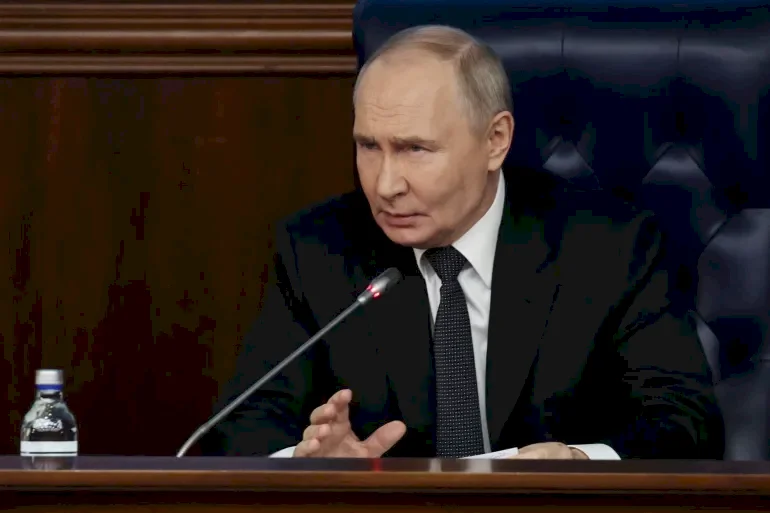
Putin's Threats to Respond to Asset Freezes Shake EU Capitals
SadaNews - The debate in Europe is no longer limited to how to use frozen Russian assets, but rather how to avoid a Russian response that may target Western companies and banks still operating in Russia.
This is the atmosphere hanging over European capitals, according to the Financial Times, as Moscow's threats of retaliation escalate if Brussels uses those assets to fund Ukraine.
The European Union had agreed last week to keep around 210 billion euros (about 246 billion dollars) of Russian sovereign assets frozen indefinitely as part of a plan to finance a loan of 90 billion euros (106 billion dollars) to Kyiv over the next two years, aimed at supporting its financial capacity and enhancing Europe's role in the peace talks led by the U.S.
Moscow Threatens Harsh Retaliation
The Financial Times quoted European officials stating that Russia has promised "the harshest possible response" if its sovereign assets are used to fund Ukraine, a threat that has raised concerns in countries including Belgium, Italy, and Austria.
Although Moscow has not yet revealed the nature of its forthcoming steps, officials familiar with the plans said that the Kremlin has already considered options for confiscating the remaining Western assets within Russia.
Last month, Russian President Vladimir Putin described the European plans as "theft of property," a description that reflects Moscow's readiness to move from threats to action, according to the newspaper.
Belgium in the Eye of the Storm
These threats come as EU leaders gather in Brussels for a critical summit dedicated to deciding on funding for Ukraine over the next two years.
The Financial Times notes that Belgium is still resisting pressures to approve the 90 billion euro loan, as the bulk of the frozen Russian assets are held there.
Belgian Prime Minister Bart De Wever stated that the risk of Russian retaliation against his country is "extremely high," calling on the other 26 EU countries to provide "financial and legal guarantees" to share the burden.
According to officials involved in the negotiations, Brussels demands "unlimited guarantees in terms of scope and duration," which other capitals have described as "impossible."
In this context, Ukrainian President Volodymyr Zelensky is set to attend the summit in an attempt to personally convince De Wever. A senior European diplomat, quoted by the Financial Times, said: "This is an existential issue for Ukraine... and Belgium has to join."
Euroclear in the Crosshairs
The Central Bank of Russia has already filed a lawsuit seeking compensation worth 18 trillion rubles (229 billion dollars) in a Moscow court against Euroclear, which holds approximately 185 billion euros (217 billion dollars) of Russian sovereign assets, with the first session scheduled for mid-January.
Belgian officials believe that Euroclear will be "the first victim" of any Russian response, as about 17 billion euros (around 20 billion dollars) of its clients' assets are still held within Russia and at risk of confiscation.
De Wever told the Belgian parliament this month: "Using the frozen assets at Euroclear could have harmful consequences for this country and for Europe as a whole."
Western Companies Under Russian Control
According to research from the Kyiv Economics Institute, which the Financial Times relied on, the value of Western companies' assets in Russia reached 127 billion euros (approximately 149 billion dollars) by 2024.
Moscow has already confiscated or frozen assets of 32 Western companies, causing losses of at least 57 billion dollars.
Natalia Shapoval, director of the institute, stated that the assets, investments, and profits of companies still operating in Russia are "effectively under the control of the Russian state," noting that these companies are forced to "relinquish their investment rights."
Under a decree signed by Putin last September, Russia is now able to confiscate foreign companies through a "rapid nationalization" mechanism in response to what it describes as "hostile actions," including the freezing of Russian assets in Europe.
European Banks Stuck and Profits Frozen
The Financial Times notes that 2,315 foreign companies are still active in Russia, including branches of major banks like Austria's Raiffeisen and Italy's UniCredit, which have made substantial profits during the war but are unable to transfer them abroad.
Foreign companies made about 19.5 billion dollars in profits in Russia last year, while UniCredit CEO Andrea Orcel told the Italian Senate that the bank does not plan to withdraw despite having 3.5 billion euros (4.1 billion dollars) of "trapped" capital inside Russia, adding: "If the bank is nationalized, that is a legal violation, and I will maintain a permanent claim against the Russian state."
Russian Pressure Tactics
The Financial Times highlights that Russia has frozen the assets of Western investors within what are known as "Type C" accounts, from which funds cannot be withdrawn. Estimates suggest that the value of these accounts has significantly increased since March 2023.
Economic expert Alexandra Prokopenko indicated that these accounts represent "one of Moscow's winning cards," adding: "If Europe moves against Russian reserves, Russia can simply redirect funds from Type C accounts to the budget," providing it with direct revenue at a time it is struggling with a deficit and high defense spending.
Prolonged Legal Battles
The Financial Times warns that Moscow may also resort to a wave of lawsuits in international courts, with dozens of oligarchs and Russian companies having already filed lawsuits worth at least 62 billion dollars, according to an analysis by the organization "Friends of the Earth."
Prokopenko stated: "The aim is not to win, but to create risks, raise costs, and prolong disputes to hinder the use of Russian assets."
In contrast, legal advisors to the European Commission believe that Russia does not have a strong legal basis to challenge the use of its sovereign assets, considering the risks to be "exaggerated."
Risky European Gamble
The Financial Times emphasizes that Germany, the main supporter of the plan to use the frozen assets, sees this path as the only option to fund Ukraine without increasing debts.
An European diplomat stated: "If the plan fails, it will be a catastrophic signal for Ukraine, and Europe will fail as a geopolitical player."
Between the Russian threat, European divisions, and legal risks, Europe stands before an unprecedented test: using sovereign assets from an adversarial state that could change the rules of international finance or open wide the door to long-term economic retaliation.
 Follow the latest Sada News via Google News
Due to "Hazardous and Counterfeit Products".. Europe Fines "AliExpress" $627 Million

Gasoline Prices Exceed $4 Again in America Amid Resumed War

What was the financial reward for Spain after winning the World Cup?

Gold Stabilizes Amid US Interest Rate Outlook

Oil Prices Climb 2% Amid Escalating Attacks Between the US and Iran in the Middle East

Israel Increases Gas Supplies to Egypt by 26% to Reach 1.2 Billion Cubic Feet Per Day

Expectations of a Delay in European Interest Rate Hike Amid War Risk Preparedness
