

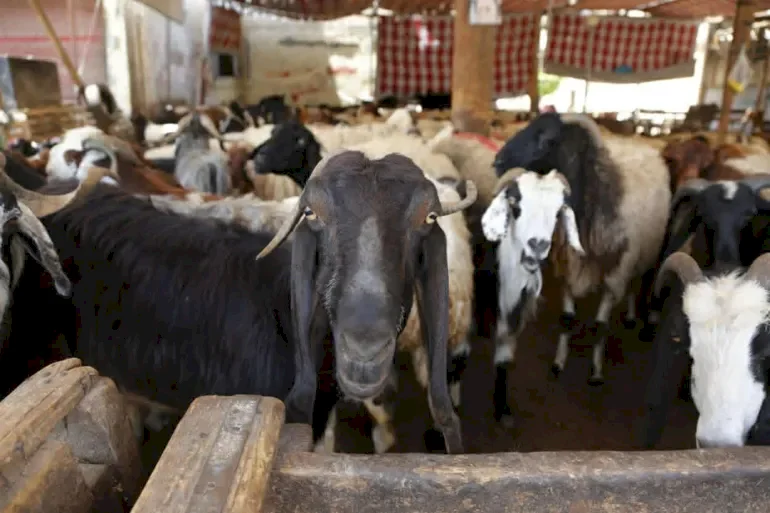
As Eid al-Adha Approaches.. Learn about the Prices of Sacrifices in 9 Arab Countries Including Palestine
SadaNews - The state of sacrifice markets this season varied in several Arab countries, with relative abundance in supply and varying price increases, amid increasing pressures resulting from rising feed, transportation, energy, and veterinary care costs, in addition to the impact of regional tensions on import and shipping routes.
The data quoted by Al Jazeera Net from traders, breeders, consumers, and officials in several Arab countries show that markets are witnessing a clear change in buyer behavior this year, with more families opting for lower-cost sacrifices, or participating in a single sacrifice, or postponing their purchase decision until the last days before the holiday, in anticipation of price reductions or new offers.
Palestine
Prices for sacrifices in Palestine are considered the highest among Arab countries, with the price of a live sheep ranging between 48 and 50 shekels, making the price of a 55-kilogram sheep approximately 2750 shekels (950 dollars).
Meanwhile, the price of a live calf ranges between 29 and 30 shekels, meaning that a calf weighing 450 kilograms costs around 13500 shekels (4,669 dollars).
Jordan
The sacrifice markets in Jordan are witnessing an abundance of locally and imported sheep, but prices are expected to rise by up to 10% compared to last year, according to official and professional estimates.
The Jordanian Ministry of Agriculture states that the rise in local meat prices is mainly due to increased feed costs, noting that it has taken measures to restrict the export of sheep to Gulf countries to maintain the abundance of the local market and control prices before Eid al-Adha.
For his part, Zaal Al-Kawalit, head of the Livestock Breeders Association, says the price of local sheep averages about 5.5 dinars (7.75 dollars), meaning that the price of a 50-kilogram sheep is about 275 dinars (388 dollars).
Al-Kawalit adds that breeding costs have risen due to increased prices of corn, soy, energy, veterinary care, and labor, noting that the past years of drought have negatively affected pastures and breeders' willingness to raise sheep.
He confirms that the market does not suffer from a scarcity of sacrifices, with local, Romanian, and Syrian sheep available, indicating that rising shipping and insurance costs and increased global demand for Romanian sheep have pushed their prices up, with the price of Romanian sheep reaching about 6 dinars (8.46 dollars) per kilo.
However, meat trader Samir Al-Masrouh confirms that there is self-sufficiency and a clear abundance in the local market, noting that prices have risen by about 10% compared to previous years.
Meat trader Nabil Abu Saqr states that buyer behavior has not changed significantly, except for a slight decrease in demand, explaining that many families are delaying purchases until the last days before Eid, believing that prices will drop as traders seek to sell their surplus sheep.
For his part, Mahmoud Al-Awran, president of the Jordanian Farmers Union, believes that some price increases are "unjustified," suggesting that some "crisis merchants" are behind the significant increases seen in the market.
Al-Awran indicates that prices have risen by more than 30% and 40% in some cases, although the natural increase resulting from production and energy costs should not exceed 10 to 15%.
Egypt
Egypt's sacrifice markets are witnessing a noticeable rise in prices this season, driven by increased feed, energy, transportation, veterinary care, and labor costs, in addition to import disruptions from Sudan due to the ongoing war there.
Mohamed Salah, a sheep trader in Giza, states that feed prices have risen by more than 30% this year, especially soybeans and corn.
Salah, who has been in the sheep trade for over 12 years, adds that the increases are not limited to feed but also include prices for periodic vaccinations and veterinary medicines by about 15%, in addition to daily labor wages, where a worker's daily pay has increased from 100 pounds (1.88 dollars) last year to 200 pounds (3.75 dollars) this season.
Veterinarian Mohamed Emad confirms that prices of veterinary services and examination and follow-up fees have risen due to increased operational costs, noting that meat prices have also risen by about 20%, with the price per kilo reaching about 470 pounds (8.8 dollars) after being between 380 pounds (7.1 dollars) and 400 pounds (7.5 dollars) about two months ago.
The Ministry of Agriculture had previously announced the offering of more than 158,000 heads of calves, sheep, and camels, in addition to 165,000 tons of meat and its products, aiming to increase supply and control prices.
The ministry also provided about 15,000 heads of what is locally known as "local sacrifices" at reduced prices, set at 190 pounds (3.56 dollars) for a kilo of cattle, 160 pounds (3 dollars) for buffalo, 220 pounds (4.13 dollars) for sheep, 240 pounds (4.5 dollars) for goats, and 200 pounds (3.75 dollars) for camels.
However, Mohamed Abdel Azim, who usually buys his sacrifice from the Ministry of Agriculture's outlets, tells Al Jazeera Net that the quantities offered this year were very limited, explaining that the booking was closed within just a few hours due to high demand.
A source in the International Transport and Logistics Division of the Cairo Chamber of Commerce indicates that the recent fuel price hike has raised the prices of meat and sacrifices by at least 15%, due to increased transportation costs for feed and livestock.
Algeria
Chalali Al-Haj, head of the Agriculture Chamber for the Ain Defla region (138 km west of the Algerian capital) and a member of the Farmers Union, states that the primary factor affecting livestock breeding costs in Algeria is the cost of feed, especially since breeders are still facing rising costs despite some government measures aimed at alleviating burdens.
The same speaker explains that prices for other feeds remain high, reflecting on the fattening and overall production costs, and thus on breeding costs.
Regarding the impact of rainfall and improved pastures, Chalali Al-Haj sees that recent precipitation has contributed to the return of vegetation and the abundance of natural pastures, allowing breeders to rely more on grazing and reducing some of the breeding costs compared to the previous years marked by drought.
Concerning the supply of sacrifices, Fadi Tamim, the national coordinator of the Consumer Protection Organization, clarifies that the markets are experiencing this season an abundance of livestock heads, countered by a stagnation in sales due to a significant number of families registering through the platform for importing sacrifices within the program of importing one million heads of sheep.
Tamim states that this initiative is intended for families that usually perform the sacrificial ritual, but have reduced their participation in recent years due to significant increases in the prices of local products.
However, he notes that the quantities of imported goods remain limited compared to the demand, representing – according to Tamim's estimate – only a third of market needs.
Regarding prices, the same speaker mentions significant increases compared to last year’s season, explaining that the prices of some sheep, which ranged between 90,000 and 100,000 dinars (about 677 and 753 dollars) during last year's Eid al-Adha, have risen this year to between 140,000 and 150,000 dinars (1054 and 1129 dollars), with a difference that can reach up to 30,000 dinars (226 dollars) depending on the weight of the sacrifice.
Tamim states that Algerian authorities have set a ceiling price for imported sacrifices at 50,000 dinars (376 dollars), which has contributed to limiting the impact of transportation and import costs on the final price for consumers.
The Algerian market is currently experiencing stagnation in the sale of sacrifices, despite increased movement of citizens between markets and close monitoring of prices, in light of a noticeable rise impacting purchasing decisions among many families.
An employee, Amin, tells Al Jazeera Net that he will not purchase a local sacrifice this year due to the significant price hike, considering it "excessive and not reflective of purchasing power," adding that he registered himself on the platform for imported sacrifices as it is more suitable for his monthly income.
Ammar, a resident of Algiers, confirms to Al Jazeera Net that he resorted to an alternative option to reduce costs, as he agreed with his brother and brother-in-law to buy a calf and share it, explaining that this option is much cheaper than buying three rams at high prices reaching 130,000 dinars (978 dollars).
Morocco
In the sacrifice market in Temara, located on the outskirts of the Moroccan capital, Rabat, the dust of the square mixes with the smell of wool and hay, while anticipation dominates the atmosphere. Despite official reassurances of an abundance of sheep heads, the supply in this popular market remains modest.
One livestock trader tells Al Jazeera Net that the situation will change as Eid al-Adha approaches. He adds, "In the next few days, the market will be filled with trucks coming from Nador, Beni Mellal, Qalaat al-Sraghna, and other cities," but some citizens anticipate that traders are employing a drip-feed policy on supply to maintain high prices.
One market visitor points to a sheep of the "Sardi" breed and asks about the price, to which the trader replies: 6500 dirhams (about 650 dollars), prompting him to turn away and leave with a puzzled expression, as the price does not encourage negotiation or purchase.
This temporary stagnation is explained by the fact that a large segment of government employees postpones purchases until salaries are disbursed, while many are betting that increased supply will force traders to lower prices in the final days before the holiday.
In stark contrast, major commercial markets offer a different experience, with one in the capital Rabat displaying the most sought-after breeds for Eid al-Adha in Morocco, such as
 Follow the latest Sada News via Google News
Soaring Oil Prices Burn the Pockets of the Palestinian Citizen "The Poor"

Millions of Dollars in Losses.. "SadaNews" Reveals Shocking Figures for Traders from Pales...

The Problem of Shekel Overcrowding Worsens.. Fuel Station Owners Threatened with Closure o...

The Palestinian Economy at a Crossroads: 4 Files Awaiting Resolution

National Economy: Referral of 6 Violators to Prosecution and Seizure of 76 Tons of Violati...

Israel's Foreign Currency Reserves Rise to $238.7 Billion

Exchange Rates of Currencies Against the Shekel on Wednesday (July 8)
