
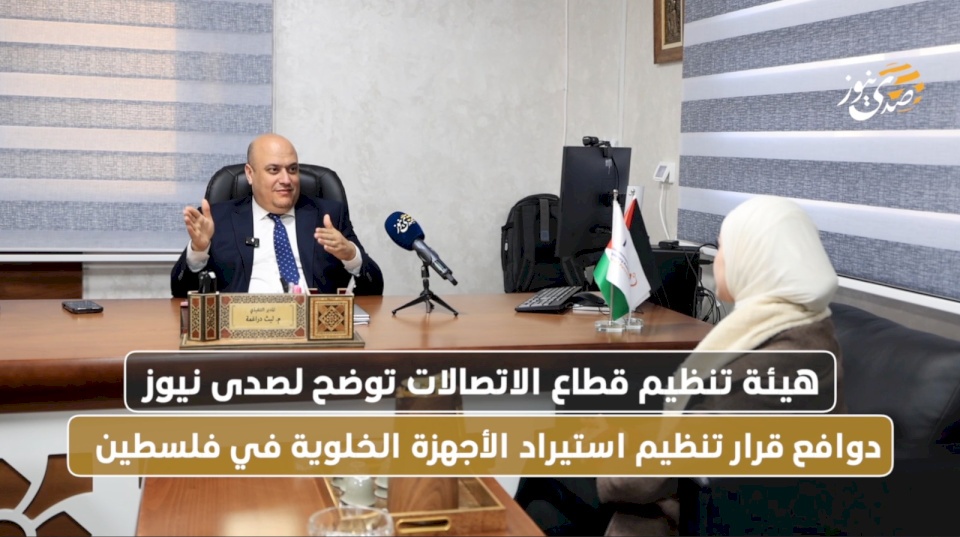
Telecommunications Regulatory Authority Clarifies to SadaNews the Background of the Decision to Regulate the Mobile Phone Market in Palestine (Video)
Exclusive to SadaNews: In a special interview with SadaNews, Laith Draghmah, the Executive Director of the Telecommunications Regulatory Authority, revealed the background of the recent decision which stipulated that the importation of mobile phone devices is limited to individuals holding a communications equipment import license issued by the authority.
Market Regulation and Import Control
Draghmah told SadaNews that the decision is part of the ongoing campaigns led by the authority to regulate the telecommunications sector in various fields, explaining that the goal is to control the entry of mobile and smart devices into Palestine through licensed importers only, thus ensuring that this profession is practiced within legal and regulatory frameworks.
He added that there are several reasons that drove the authority to adopt this approach, the most prominent being the urgent need to regulate the market and control the process of entering and registering devices, in order to protect the rights of three essential parties: the government through taxes, the licensed companies, and the consumer citizens.
Draghmah emphasized that the citizen is the most important party in this equation, stressing the need to ensure the rights of consumers and subscribers both before and after the sale, by providing maintenance services and guaranteeing the financial rights related to the devices they pay for. He clarified that these devices are not simple or cheap, but represent a real investment for the citizen, especially when using high-end phones for telecommunications, internet, and broadband services.
600,000 Devices Registered in 6 Months
Draghmah pointed out during his conversation with SadaNews that there is a third party that needs protection, which is the licensed companies committed to the terms of the licenses issued by the authority. He revealed that over the past six months, more than 600,000 registered mobile devices have been introduced to the authority, while other devices entered through illegal means.
He explained that last month alone, the authority carried out more than 27 campaigns to control the market, resulting in the confiscation of more than 4,000 unregistered devices. He affirmed that registering devices with the authority means they meet international specifications and standards, ensuring optimal use for citizens and enhancing their confidence that these devices have undergone worldwide testing and standards.
Dealing with Non-Compliant Entities
In response to a question from SadaNews regarding how the authority deals with entities that do not comply with rectifying their status before the specified deadline, Draghmah said that the goal was to give companies a good opportunity to obtain what is called the non-exclusive agency or authorized non-exclusive distributor, to ensure that devices meet standards and provide the best level of service to citizens.
He added that this step also aims to prevent what he described as "price wars" that arise as a result of manipulation of invoices and financial rights, stressing that non-compliant entities have more than six months to communicate with global providers and manufacturers to obtain non-exclusive agencies or distribution certificates.
Draghmah clarified that among the goals of the decision is to open new exhibitions for companies, create job opportunities, expand market share, in addition to reducing reliance on the Israeli market. He stated: "Our goal is for Palestine to have independence in services, devices, and equipment, and to import directly from the parent companies."
Market Share in Favor of Palestine
Draghmah concluded his remarks by affirming that market share should be calculated in favor of the State of Palestine, not as part of the Israeli entities. He pointed out that there are many devices used in Palestine that do not have any Palestinian agent or non-exclusive distributor, even though their market share exceeds 20%.
He confirmed that all these shares are registered in favor of the primary suppliers, and that the authority will take legal action against non-compliant companies, after giving them more than six months to rectify their status, emphasizing that the first and final goal is to protect licensed companies, Palestinian citizens, and the rights of the state.
 Follow the latest Sada News via Google News
Soaring Oil Prices Burn the Pockets of the Palestinian Citizen "The Poor"

Millions of Dollars in Losses.. "SadaNews" Reveals Shocking Figures for Traders from Pales...

The Problem of Shekel Overcrowding Worsens.. Fuel Station Owners Threatened with Closure o...

The Palestinian Economy at a Crossroads: 4 Files Awaiting Resolution
Fuel Crisis in the West Bank: Supply Disruption or Liquidity Shortage?

Government Contact Center Issues Clarifying Statement Regarding the Establishment of a Gov...

Exchange Rates of Currencies Against the Shekel Today, Wednesday (July 22)..
