

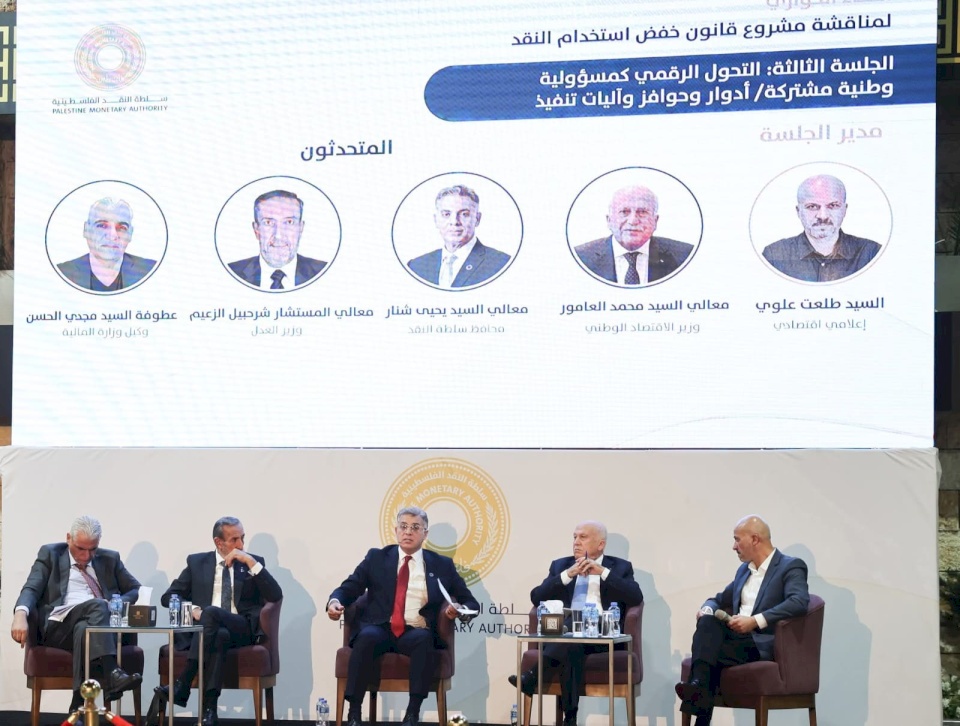
Palestinian Monetary Authority Organizes an Expanded Dialogue Meeting to Discuss the Draft Law on Reducing Cash Usage
SadaNews - The Palestinian Monetary Authority organized a dialogue meeting to discuss the legal framework and economic implications of the draft law aimed at reducing cash usage, with extensive participation from representatives of ministries and official institutions, as well as representatives from the economic, financial, legal, and political sectors, alongside representatives from civil society organizations and specialized experts.
The meeting was opened by the Governor of the Monetary Authority, Yahya Shanar, who emphasized the importance of this dialogue meeting in the preparations for drafting economic legislation that aligns with global financial developments.
Shanar explained that the Palestinian banking sector, despite the challenges it faced in recent years, has maintained its stability and operational capacity thanks to the advanced digital financial infrastructure established by the Monetary Authority as part of a comprehensive strategic vision aimed at enhancing efficiency and security, keeping pace with the shift to a digital economy, and providing welfare for citizens.
The governor pointed out that the draft law on reducing cash usage represents an important regulatory step to address the challenges of cash transactions and to enhance transparency and protect citizens and merchants, without affecting regular cash transactions. He also confirmed the Monetary Authority's commitment to involving various sectors in drafting the project and to publishing the draft law on the platforms of the Ministry of Justice and the Monetary Authority, to allow the public to express their observations and concerns, believing that the success of any economic legislation depends on community partnership.
The dialogue program included three main sessions that covered several key themes related to the law. In the first session, moderated by Tareq Al-Masri from the Independent Commission for Human Rights, an in-depth review of the draft law’s provisions was conducted with an analysis of their compatibility with existing legislation and the legal implications, with participation from Ahmad Dhabalh, the Deputy Minister of Justice, Fadi Abbas, the head of the Bar Association, and Mahmoud Al-Alauna, the Assistant Dean of the Faculty of Law and Public Administration at Birzeit University, who provided comprehensive readings of the legal and legislative aspects involved.
The second session, chaired by economic expert Mueed Afana, was dedicated to examining the economic and financial implications of implementing the law and the readiness of the technical infrastructure. The session featured participation from Mohammed Mansara, Deputy Governor of the Monetary Authority, Maher Al-Masri, Chairman of the Banks Association, Maha Abu Shousha representing the private sector, and financial expert Mohammed Salama. The speakers offered insights into the law's impact on the economic cycle, the efficiency of financial transactions, and the level of community awareness.
In the third session, moderated by economic journalist Talaa Al-Ali, the focus was on digital transformation as a shared national responsibility, and on the role of official and financial sectors in developing an advanced digital framework. This session included participation from the Minister of National Economy Muhammad Al-Amour, Minister of Justice Sharhabil Al-Za'eem, Governor of the Monetary Authority Yahya Shanar, and Majdi Al-Hassan, Deputy Minister for Finance and Planning, who reviewed the Monetary Authority's efforts and plans aimed at enhancing electronic payment services and digital readiness in Palestine.
The meeting also featured interventions from attendees from various sectors, where their opinions and observations regarding the provisions of the draft law and its practical applications were discussed, contributing to enriching the debate and expanding participation in formulating the final recommendations.
The meeting concluded with a set of recommendations, the most notable of which included:
* Adopting a gradual transitional period for the implementation of the law, considering the specificities of different sectors.
* Reviewing the ceiling for cash transactions in accordance with the nature of economic activities.
* Implementing the national strategy for financial inclusion and enhancing access to financial and banking services.
* Reducing fees associated with electronic payments, and providing accessible digital payment solutions at reasonable costs.
* Strengthening the protection of financial data and ensuring that access and processing permissions are limited to maintain banking confidentiality.
* Enhancing the readiness of the digital infrastructure and launching a national awareness and training program targeting merchants, citizens, and digitally marginalized groups.
* Incorporating the proposed amendments to the draft law and submitting them to the esteemed Cabinet.
Participants emphasized that the success of the transition to a digital economy requires ongoing partnership between the Monetary Authority and both the public and private sectors, taking into account the needs of citizens, stressing that the law regulates large transactions and does not target daily ordinary transactions.
 Follow the latest Sada News via Google News
Soaring Oil Prices Burn the Pockets of the Palestinian Citizen "The Poor"

Millions of Dollars in Losses.. "SadaNews" Reveals Shocking Figures for Traders from Pales...

The Problem of Shekel Overcrowding Worsens.. Fuel Station Owners Threatened with Closure o...

The Palestinian Economy at a Crossroads: 4 Files Awaiting Resolution

Exchange Rates of Currencies Against the Shekel on Tuesday (July 21)

Inflation Expectations in Israel Stabilize at 1.5%

Ministry of Economy Announces the Opening of Import Application Submissions for Commodity...
