

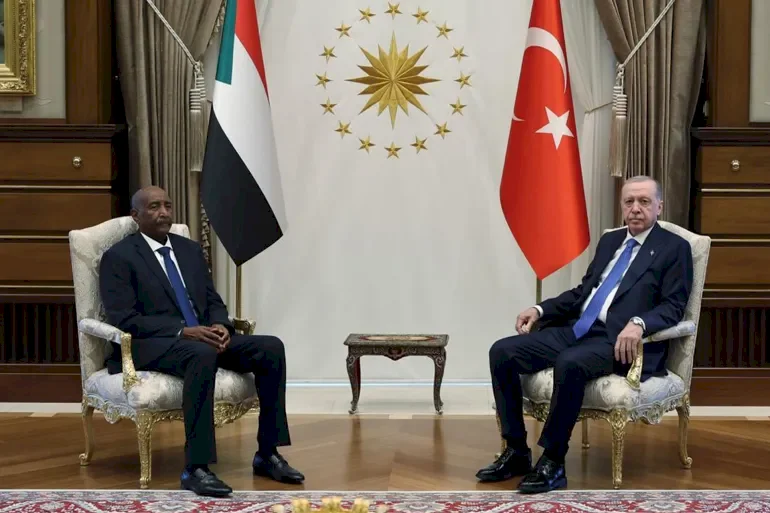
Sudanese Foreign Minister in Turkey.. Are Relations Heading Towards Strategic Cooperation?
SadaNews - After days of the visit of the Advisor to the Head of the Sudanese Transitional Sovereignty Council for Political Affairs and Foreign Relations, Amjad Farid, to Turkey, Foreign Minister Mohiuddin Salem begins today, Tuesday, a two-day visit to Ankara, where observers expect the activation of several previous agreements and the establishment of a Supreme Council for Strategic Cooperation between the two countries.
In the past two years, the head of the council, Abdel Fattah al-Burhan, has visited Turkey several times, the last of which was in June, followed by visits in April and December, during which he held consultations with President Recep Tayyip Erdoğan focusing on political coordination, security and military cooperation, and trade exchange.
For the past five days, Farid has been holding meetings with Turkish parliamentary and political leaders, the most notable of whom are the head of the Constitutional Affairs Committee in the parliament Murad Alp Arslan, the head of the National Defense Committee in the parliament, General Hulusi Akar, and Amir Yasin, Vice President of the Foreign Relations Department and a member of the Central Committee in the Turkish Justice and Development Party.
Joint Cooperation
Farid clarified - in posts on the X platform - that he renewed Khartoum's appreciation for Turkey's supportive positions towards Sudan, and discussed the necessity of classifying the Rapid Support Forces as a terrorist organization, which he deemed essential to cut off their funding and external armament sources and to prevent their supporters from evading accountability.
He added that he reviewed with Turkish leaders the interventions of some small countries in the region through investment in the context of political and security instability in Sudan and the Horn of Africa, and what this represents as a threat to regional and international security, prolonging conflicts, and undermining prospects for peace and stability.
For his part, General Hulusi Akar expressed Ankara's desire to contribute to restoring peace and stability in Sudan and to support reconstruction efforts, and affirmed its commitment to stand by the Sudanese people during this critical phase, according to Farid.
Official sources revealed to Al Jazeera Net that the previous phase witnessed cooperation in the fields of training, logistical support, technical and defensive assistance based on previous agreements and memoranda of understanding.
According to sources who requested anonymity, there is ongoing cooperation and exchange of visits by high-level military and diplomatic delegations, in addition to ministerial visits to collaborate in the fields of mining and agriculture. It is expected that Mohiuddin Salem's visit will enhance relations in all areas.
Strategic Importance
In her view, Professor of International Relations at Turkish universities Miada Kamal al-Din believes that the visit of the Sudanese Foreign Minister to Ankara holds strategic significance in light of the conditions Sudan is going through, sending a message that Sudan is not diplomatically isolated and has regional allies like Turkey who support its people's choices and its legitimate institution.
According to Miada's remarks to Al Jazeera Net, Ankara has extensive regional communication channels, and Khartoum views it as a reliable partner capable of playing a positive role in supporting the stability of the Sudanese state and its legitimate institutions.
She expected that discussions between the Sudanese minister and his Turkish counterpart Hakan Fidan would focus on several vital issues, primarily:
Despite the announced diplomatic nature, the security and military file will be present to enhance the capabilities of the Sudanese army in facing threats, given the expertise and advanced military technologies that Turkey possesses.
Plans for the reconstruction of Sudan and the infrastructure damaged by war, as Turkish investment companies have the technical readiness and experience for a strong contribution in the post-conflict phase.
Building on the outcomes of the recent 16th Joint Economic Committee meeting to facilitate trade exchange, agricultural cooperation, and the development of the energy and mining sector.
The regional file through exchange of views on geopolitical tensions in the Horn of Africa and the security of the Red Sea, as the strategic perspective of both countries aligns on the necessity of maintaining stability in the region.
It was also officially announced - according to Miada Kamal al-Din - that arrangements have been made to sign a memorandum of understanding for cooperation between the Diplomatic Academy of the Turkish Ministry of Foreign Affairs and the Diplomatic Institute of the Sudanese Ministry of Foreign Affairs to enhance the capabilities of diplomatic cadres and coordinate positions.
Multiple Agreements
As for security expert Ibrahim Abdul-Qadir, he believes that the implementation of agreements signed between Sudan and Turkey since Erdoğan's visit to Khartoum in December 2017 - during which 21 agreements and memoranda of understanding were signed - is sufficient to elevate their relations to a new stage.
He told Al Jazeera Net that the military cooperation agreement signed in 2011 focused on training, qualification, maintenance, and the development of military defense industries technology, where Turkish experts contributed to the development of Sudanese industries, and cooperation continued after the outbreak of the war, granting the Sudanese army a qualitative advantage in military capabilities.
The security expert also mentioned a previous agreement to establish a high-level strategic cooperation council, another pertaining to the security of the Red Sea, joint defense, and the establishment of a dock for the maintenance and qualification of civilian and military ships in the Red Sea, as well as collaboration concerning police to enhance security aspects, but Khartoum was "hesitant, therefore, many of these agreements were not translated into action, requiring political will from Sudan and decisiveness in its options."
Historical Specificity
Observers see that Sudanese-Turkish relations are characterized by historical specificity, and the prospects for cooperation are broad and growing, yet reaching the stage of full strategic alliance is governed by a balanced and cautious transformation, taking into account regional complexities.
According to experts, Sudan's desire to rebuild its institutions and support its national security is met with Turkey's desire to expand its economic and geopolitical influence in Africa and the Red Sea, thus increasing the convergence of the two countries.
Conversely, there are complexities and constraints that make direct alliances subject to regional balance, as Ankara - according to analysts - has followed a "zero problems" policy in recent years and sought to improve relations with major regional powers, and any open or direct military alliance in Sudan may provoke the sensitivities of these powers, which Turkey is keen to avoid.
The Turkish foreign policy in the African continent - according to the same sources - tends toward a "comprehensive and deep partnership" model, relying on technical, military, and economic support rather than signing binding mutual defense treaties that are politically costly.
Sudan also seeks to maintain balanced relations with multiple regional and international powers without being tied to a single axis, yet observers note that the relationship between Khartoum and Ankara is heading toward a close strategic partnership that achieves the interests of both parties without causing regional polarization.
Source: Al Jazeera
 Follow the latest Sada News via Google News
Sudanese Foreign Minister in Turkey.. Are Relations Heading Towards Strategic Cooperation?

German Flights to Damascus and Aleppo... Negotiations to Resume Cairo Routes

Power Crisis Sparks Protests and Civil Disobedience in Tripoli

On the Eve of Zelensky's Visit to America.. Russia Announces the Interception of More Than...

Occupation forces carry out explosive operations in towns in southern Lebanon

Saudi Arabia: Interception and Destruction of Drones Coming from Iraqi Territory

Among them 1,600 in 24 hours.. Ukraine announces the death and injury of 1.4 million Russi...
