

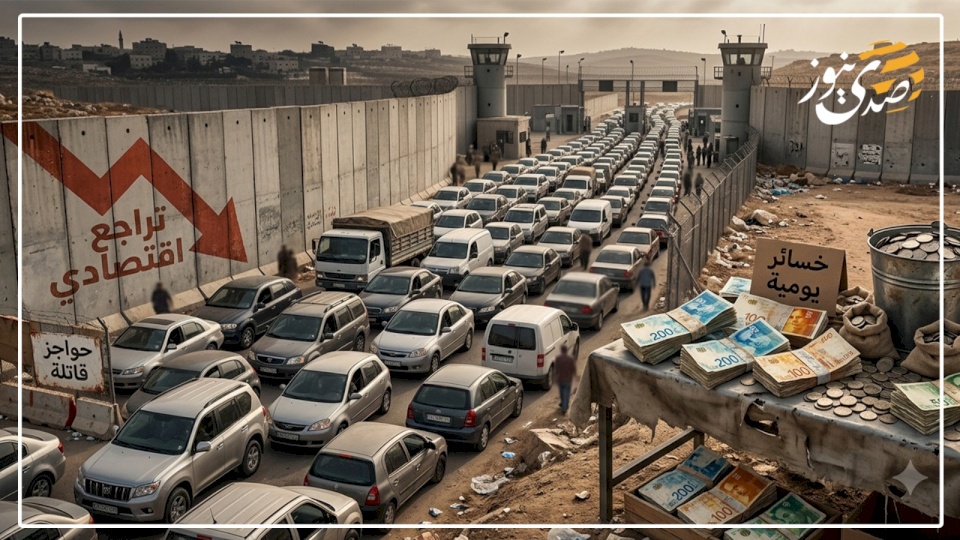
Analysts: The Occupation's Measures in the West Bank Will Radically Change the Features of the Palestinian Economy
SadaNews Exclusive: With the Israeli occupation accelerating steps to impose the status quo in the West Bank, whether through land confiscation, expanding settlements, attacking or demolishing facilities, relocating Palestinians from certain areas, and targeting their sources of livelihood through arson and theft, along with Israel's ongoing restrictive measures on the Palestinian economy—such as withholding clearance funds, not allowing workers, threatening to cut banking relations, and severing the ties of Palestinian cities, towns, and villages with checkpoints and gates—the occupation is moving forward with unprecedented strikes against the Palestinian economy. Analysts confirm to "SadaNews" that the realities on the ground mean the occupation is seriously aiming to radically change the features of the Palestinian economy, tightening the noose around the lives of Palestinians within the framework of a political assault aimed at "resolving the conflict."
Radical Change
Economic expert Dr. Thabit Abu Al-Rous says that the occupation measures on the ground will radically change the features of the Palestinian economy, turning it into a "dead cash economy," meaning that the continued failure to transfer paper shekels from Palestinian banks to Israeli ones, along with the constant threat of cutting banking relations, diminishes the shekel's value as a digital currency in foreign trade, isolating the economy from the global financial system and international compliance.
On another note, Dr. Abu Al-Rous indicates that Israeli measures contribute to the transition to a locally fragmented economy, meaning that policies of closure and military checkpoints dismantle the concept of a unified Palestinian economy, contributing to the emergence of economies of isolated small cantons, where each governorate and city has its independent economy, forcing each region to rely on narrow local supply chains.
Expansion of the Black Market
Dr. Abu Al-Rous also predicts that these measures will contribute to the expansion of the black (informal) economy, noting that the paralysis affecting the banking sector and official institutions force traders and companies to resort to unlicensed exchange networks, remittances, and tax evasion, which means reducing the role of regulatory institutions in tracking financial movements—something that "Israel" aims to achieve.
He finds that the current state makes the Palestinian economy hostage to settlement economies by imposing new crises in areas governed by the Palestinian Authority and seeking solutions through shopping from settlements.
Government Paralysis
Abu Al-Rous points out that the current data dangerously reflects on key indicators in Palestine, whether on the level of the Palestinian Authority or the citizens by deepening the government financial deficit, which causes paralysis in the authority's ability to meet its obligations. Additionally, the continued withholding of clearance funds—which constitute no less than 65% of general revenues—leads to a chronic financial deficit in the Ministry of Finance, stating that this will have repercussions for years to come, not in the near term. It means that everyone expects that with the end of the clearance crisis, there will be financial relief, but the reality is that the crisis will continue for years due to the absence of a growth trajectory in the Palestinian market.
Expectations of Unprecedented Rise in Poverty and Unemployment Rates
Abu Al-Rous anticipates that the ongoing Israeli measures will lead to an unprecedented rise in unemployment and poverty rates, noting that Israeli measures and the dismissal of approximately 200,000 workers will lead to a continuous rise in unemployment rates. He adds: "The checkpoints, the dismissal of workers, and the rising percentage of university graduates gradually lead to the erasure of the middle class, moving it into the ranks of poor families, and the poor into the extremely poor."
Complications in Supply Chains
Meanwhile, he clarifies that complications in supply chains through complex procedures at crossings, checkpoints, and ports extend the time frame for transporting goods, thus raising shipping costs, negatively impacting prices.
Flight of Investments to City Centers
He also indicated that settler attacks and Israeli measures prompt the flight of private investments from dangerous or politically volatile areas to the center of the governorates, particularly Ramallah.
Abu Al-Rous confirmed that despite government attempts to find alternatives by enhancing the digital economy and promoting electronic payment processes, if there are no political solutions, there will be no economic solutions, because "Israel" continues its aggression and complex economic entanglements across all domains.
Efforts to Impose Forced Separation
For his part, researcher Museif Museif at the Mas Economic Policy Research Institute states that the arbitrary unilateral measures undertaken by "Israel" in the West Bank aim to impose forced separation rather than agreements.
He adds: "The problem is that there is no Palestinian ground or incubator to absorb and deal with this separation because the capabilities of the Palestinian economy are limited and historically tied to the Israeli economy," pointing out that the process of forced economic disconnection has significant and dangerous economic implications across all fields, especially in light of the absence of economic sovereignty and access to natural and financial resources.
Museif explains that the current Israeli measures prevent Palestinian decision-makers from adopting any economic or commercial policies, and the reason is that these policies, if approved under current conditions, could have negative repercussions in case they are halted by the Israeli side, which would stop the economic wheel and plunge the Palestinian economy into an unprecedented state of chaos.
No Exit but Through Political Solutions
Museif asserts that it is impossible to define the identity of the Palestinian economy in the upcoming phase amid the ongoing and accumulated Israeli measures, which come within a large and comprehensive war aimed at targeting all Palestinian components, whether economic or even political. He adds: "There is no exit from the current situation except through political solutions and international and regional intervention that changes the existing situation."
Changing Economic Features
In turn, economic expert Dr. Said Sabri suggests that what is happening today in the West Bank is no longer just transient security measures, but has turned into a structural factor that redraws the features of the Palestinian economy. The figures here convey a message no less significant than the analysis: the GDP of the West Bank shrank by 17% in 2024, while per capita GDP fell by 18.8%, erasing 17 years of economic progress in just 15 months. By the end of 2024, GDP had fallen back to 2014 levels, and per capita GDP had dropped to 2008 levels.
Dismantling the Production Chain
Dr. Sabri points out that this decline is not merely abstract numbers but a direct reflection of the disintegration of the production chain. When Israel revoked work permits from about 200,000 Palestinian workers who were working in its labor market after the October 2023 attack, the Palestinian economy lost approximately $400 million monthly, equivalent to nearly a quarter of the total economic output. At the private sector level, he notes that recent reports indicate that private companies have seen a decline in their businesses by approximately 50% compared to before the war, due to tightened movement regulations and disruptions in supply chains, and rising uncertainty.
As for the geographical dimension of the crisis, it manifests in Area C, which represents over 60% of the West Bank's area and is under complete Israeli control, where Palestinian economic activities face stricter restrictions than those in Areas A and B, thereby entrenching the geographical fragmentation of the Palestinian market instead of its cohesion.
An Aid-Dependent Economy
Dr. Sabri confirms that the natural outcome of all this is a self-sustaining cycle of contraction: loss of income reduces consumption, leading to a decrease in sales, which shortens production, and thus unemployment expands once again. However, the deeper danger, from Sabri's perspective, is not the recession itself but the transformation of the identity of the Palestinian economy from a productive economy, despite its limited resources, into an economy increasingly dependent on aid and remittances.
He clarifies that the real confrontation lies in building a more resilient economy: supporting local production, diversifying markets, enhancing the digital economy, and reducing reliance on pathways that can be disrupted by a single political or security decision.
 Follow the latest Sada News via Google News
Al-Rajoub: Presidential Elections Must Be Held Before Legislative Elections

Council of Ministers Warns of "Explosion of Conditions" Due to Escalating Settler Terroris...

Analysts: The Occupation's Measures in the West Bank Will Radically Change the Features of...

Prime Minister Chairs Meeting to Address Shekel Crisis and Support Electronic Payment

Katz: America Prevents Us from Striking Iranian Energy Facilities, and Airstrikes Launch f...

Video Attributed to Tasnim.. This is How Iran Plans to Assassinate Melania Trump

OCHA: 1,330 Attacks by Settlers in the West Bank Since the Beginning of This Year
