

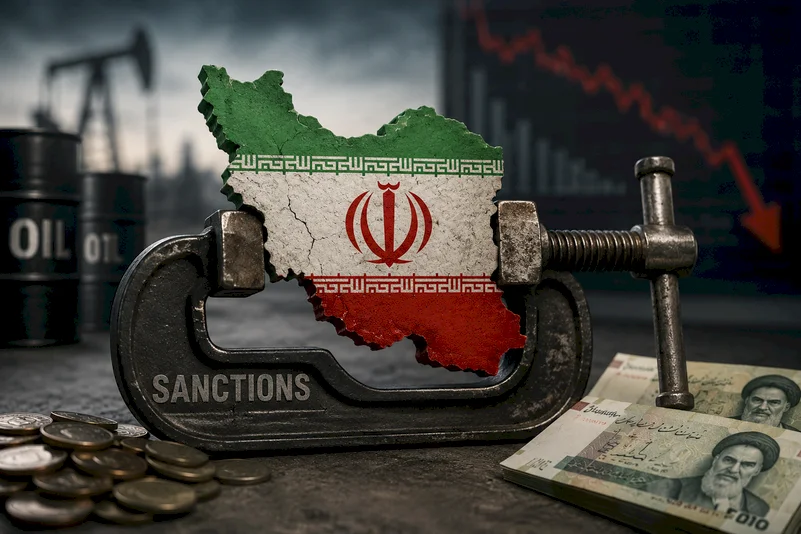
Report: Washington Bets on Sanctions to Weaken Iran More than Bombing
SadaNews - According to a report published by Axios, the administration of U.S. President Donald Trump believes that economic sanctions may be more effective than military strikes in weakening the Iranian regime, despite the fact that the recent U.S. bombing campaign garnered more attention than the financial pressures Washington continues to impose on Tehran.
The report indicates that senior officials in the U.S. administration see that the economic crisis within Iran is rapidly escalating, and that sanctions, along with the naval blockade, represent pressure tools that could eventually push Tehran to make concessions at the negotiating table.
A senior U.S. official told the website that the Iranian leadership "wants the bombing to stop, but they want money more," indicating that the priority for Tehran lies in alleviating economic pressures, releasing frozen funds, and lifting U.S. sanctions.
The report notes that estimates from U.S. intelligence, along with information available from open sources, track signs of deepening economic crisis within Iran, including a fuel shortage despite the country having one of the largest oil reserves in the world.
Another U.S. official added that financial pressures have begun to impact Iran's ability to fund its allies, stating that intelligence has tracked complaints within Iran about difficulties in paying dues to affiliated fighters.
The official also discussed concerns about pressures on the banking sector and the possibility of banks facing large withdrawals, amidst ongoing gasoline shortages and declining liquidity, considering that Iranians "have become more fearful of the U.S. Treasury Department than the Department of Defense."
This comes after Trump announced, following the suspension of U.S. strikes after 13 days of military operations, that Iran requested a meeting to discuss a new agreement, a claim that was denied by Iranian Foreign Ministry spokesman Ismail Baqaei.
Despite Tehran's denial, the report confirmed that communications between the two sides are still ongoing through intermediaries led by Oman, Qatar, and Pakistan, in an attempt to transform the ceasefire into a more stable truce.
According to the report, one of the key issues in these talks revolves around a proposal that grants Iran and Oman a greater role in managing navigation through the Strait of Hormuz, which could provide them with additional revenues, inspired by the model of cooperation existing in the Malacca and Singapore straits.
However, a U.S. official clarified that there is a division within Iran regarding this proposal, while Washington insists that any agreement must include Tehran's relinquishment of its remaining nuclear materials, refusing to grant it economic gains in exchange for threatening international navigation.
The report noted that the Trump administration has reactivated its "maximum pressure" policy, imposing sanctions on more than a thousand individuals, ships, and aircraft, targeting Iranian oil trade, informal financing networks, arms purchases, and the shipping sector.
Conversely, analysts quoted in the report mentioned that the economic war may require a longer time to achieve its goals compared to the military option, and that the ongoing confrontation could impose a political and economic cost on the U.S. administration, especially with rising energy prices.
Nevertheless, White House spokesperson Caroline Levitt emphasized that the U.S. president prefers to reach a diplomatic solution, but "will keep all options on the table" if Iran continues its activities that Washington considers a threat to navigation in the Strait of Hormuz or to its allies.
The report confirms that these estimates reflect the perspective of U.S. officials and sources within the administration, while Iran continues to assert that the sanctions have not prevented it from continuing its oil exports, rejecting the U.S. narrative regarding the impact of economic pressures on its political or military positions.
 Follow the latest Sada News via Google News
Report: Washington Bets on Sanctions to Weaken Iran More than Bombing

Rome Prepares for New Israeli-Lebanese Talks Under American Sponsorship

The occupation announces the interception of a drone near the border with Jordan

Currency Exchange Rates Against the Shekel on Tuesday (July 28)

Weather: Hot conditions today.. and a severe heatwave hits the country tomorrow

Injuries Reported in Attack by Terrorist Settlers on the Bedouin Araira Community North of...

Al-Zaydi Orders Investigation into Targeting Saudi Arabia by Drones Launched from Iraq
