

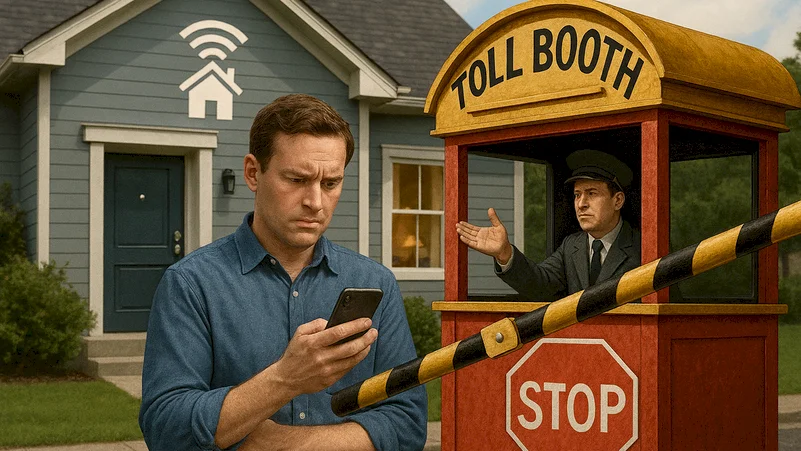
A Smart Home Without Internet!.. It's More Possible Than You Think
SadaNews - The concept of a "smart home" for many is associated with constant connectivity to the Internet and cloud services. However, the reality is that building a smart home that operates locally without relying on the Internet has become a more feasible and practical option than many think.
As reliance on cloud service providers like "Amazon Web Services" and "Cloudflare" increases, smart devices are prone to malfunction during any widespread interruption of these services.
When cloud servers go down, some smart devices may turn into regular devices unable to perform their basic functions, according to a report published by "slashgear" that was reviewed by "Al Arabiya Business".
Why Might You Want a Locally-Operated Smart Home?
A smart home that does not rely on the Internet offers several significant advantages, the most notable of which are:
- Devices continue to operate even when the Internet is down.
- Greater privacy and data protection.
- Reduced reliance on manufacturer servers.
- Full control over devices within the home network.
However, this approach comes with some trade-offs, the most notable being the loss of remote control over the Internet, which is an important feature for devices like smart locks, cameras, and thermostats.
Home Assistant.. The Brain Behind the Local Smart Home
Home Assistant is considered the cornerstone for most smart home systems that operate without Internet connectivity.
This open-source system focuses on local control and privacy protection, making it a preferred option for smart home enthusiasts.
Home Assistant can run on:
- Raspberry Pi 4 or Raspberry Pi 5.
- Home Assistant Green.
- Mini PC, which is the choice preferred by many users due to better performance.
There is also another alternative called "Hubitat," but it is less flexible and capable compared to Home Assistant.
Choosing the Right Devices
For a smart home to function without the Internet, devices must support local control.
Some of the most common technologies include:
Zigbee
The Zigbee technology is an economical and popular choice, known for being:
- Open-source.
- Offering a wide variety of compatible devices.
- Not relying on Wi-Fi.
Z-Wave
Z-Wave technology features:
- Greater connection range.
- Better compatibility between various devices.
- High stability in home environments.
However, it is typically more expensive than Zigbee.
To operate these devices with Home Assistant, users need specific communication modules like:
- Home Assistant Connect ZBT-2 for Zigbee technology.
- Home Assistant Connect ZWA-2 for Z-Wave technology.
Voice Commands Without Cloud Dependency
Even voice assistants can operate locally without sending data to the Internet.
It is now possible to integrate local AI models with the Assist feature in Home Assistant to provide voice commands that operate entirely within the home network without relying on external cloud services.
An Old Technology Comes to the Fore
One of the technologies often overlooked in the world of smart homes is Power Line Communication (PLC), which relies on transmitting data through the existing electrical wiring in the home.
This technology is an extension of home automation ideas that emerged since the 1970s with the X10 system.
Insteon.. A Different Solution for Smart Homes
One of the leading systems utilizing PLC is the "Insteon" platform, which is distinguished by using a dual-network approach that combines:
- RF wireless communication.
- Communication via household electrical wiring.
This design allows devices to communicate with each other even in the absence of a Wi-Fi network, creating a peer-to-peer network inside the home.
Although the company faced a major crisis and declared bankruptcy in the past, it has returned to operation after a community of users purchased and relaunched it.
For those wishing to build a completely local system, it is recommended to use the Insteon USB PLM module instead of relying on the Insteon Hub associated with Internet services.
A More Private Future for Smart Homes
With growing concerns about privacy and cloud service outages, an increasing number of users are turning to build locally-operated smart home systems that grant them full control over their devices and data.
Although this approach does require some additional technical setups, it offers greater independence and ensures that devices continue to operate even in the event of Internet outages or suspension of manufacturer services.
 Follow the latest Sada News via Google News
A Smart Home Without Internet!.. It's More Possible Than You Think

An Important and Profound Lesson from a Vietnamese Proverb About Marital Relationships

This is why hands look older than the face
This is why hands appear older than the face

Oak Trees Outsmart Caterpillars with a Clever Spring Maneuver

9 عادات صباحية يستلهمها الأذكياء والسعداء من جداتهم

Britain Bans Social Media for Those Under 16 Years Old
