

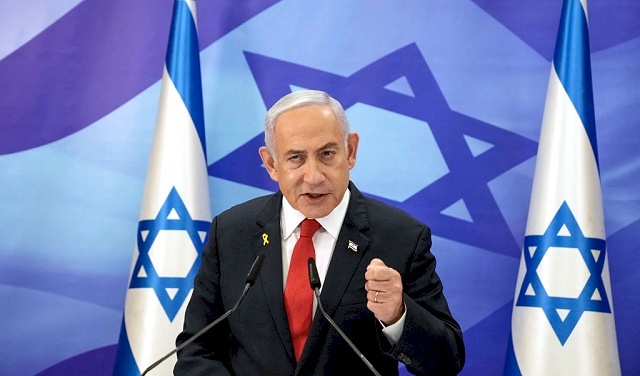
Netanyahu After the US-Iran Agreement: We Have Removed the Threat of Nuclear "Extermination" from Israel
SadaNews - Israeli Prime Minister Benjamin Netanyahu defended the results of the war on Iran on Monday evening, during his first press conference since March and his first public appearance since US President Donald Trump announced reaching a framework agreement with Tehran.
Netanyahu announced Israel's commitment to its military presence in the areas it controlled and occupied during the past period in Gaza, Lebanon, and Syria, considering that the war has removed from Israel what he described as the "threat of nuclear extermination" for years.
Netanyahu's statements came about 19 hours after Trump's announcement of the framework agreement with Iran, amidst rising criticisms within Israel of the agreement and the ability to translate the military achievements that Israel claims to have achieved into political gains.
"We Have Removed the Threat of Nuclear Extermination"
Netanyahu stated that "Iran will not possess nuclear weapons, whether there is an agreement or not," adding that "this will not happen as long as I am Prime Minister of Israel." He continued: "I hear those asking what we have achieved? We have removed the immediate threat of extermination from ourselves," considering that Israel has "saved itself from the threat of nuclear extermination."
He claimed that Iran was nearing possession of nuclear weapons before the outbreak of the war, and that not attacking it would have led to its acquisition of nuclear bombs. He said: "If we had not acted, Iran would have possessed nuclear bombs, and Israeli citizens would have faced a terrible danger of mass death," adding that Israel has "removed this danger for years."
He added that Israel inflicted extensive damage on the Iranian nuclear program, stating that it "eliminated nuclear scientists, struck nuclear facilities, and destroyed missiles and their production facilities." He added that the war caused "enormous damage" to the Iranian economy and to infrastructure that took decades to build, according to his description.
"The Battle Is Not Over"
Despite the announcement of the agreement between the United States and Iran, Netanyahu emphasized that the confrontation with Tehran "is not over yet." He said: "The battle is not over and our struggle is not resolved," adding that Israel "will have to continue to remain on high alert, to be strong and determined, and to defend itself whenever necessary."
He added that this applies "not only to Iran but also to its affiliated arms," referring to Tehran's allies in the region. He stated that Israel will continue to operate against what he described as "Iranian terrorist arms," referring to the military operations it conducted in Gaza, Lebanon, Yemen, and Syria.
Staying in Gaza, Lebanon, and Syria
Regarding regional fronts, Netanyahu announced that Israel would continue its military presence in the areas it controlled during the war. He said: "We have established deep security belts around the State of Israel in Gaza, Lebanon, and Syria," adding: "I want to clarify that we will remain in the security belts as long as it is required to protect our state."
He further stated that his government adopted, after October 7, a principle that prohibits any armed organizations from being stationed "near the Israeli borders." He also claimed that Israel currently controls more than 60% of the area of the Gaza Strip, and that the strip "no longer poses a threat to it," according to his expression.
He addressed the Lebanese front, stating that Israel has managed to significantly weaken Hezbollah, and that the organization "has become a shadow of what it used to be," in his words. He also pointed to the Israeli army's control over central sites during the war, including the Shakif area.
"I Did Not Err"... and the Goal Was Not to Overthrow the Regime
In response to the criticisms directed at his government regarding the outcomes of the war, Netanyahu denied that he had erred in determining its objectives or managing it. When asked about the failure to achieve the goal of overthrowing the Iranian regime, he replied: "Who said I was mistaken?"
He claimed that the objectives of the war were to remove the nuclear threat and the Iranian missile threat, and that Israel has achieved those two goals.
He added that Israel also sought to "create conditions for the Iranian people to remove the ruling regime," considering that the strikes inflicted on Iran created "cracks" within the regime.
He stated that the Iranian economy is going through difficult conditions and that the damage inflicted on Iranian infrastructure is substantial, adding: "No one knows when this regime will fall."
In this context, he accused unnamed parties of attempting to "downplay the achievements" that Israel obtained during the war. He said: "There is an attempt to diminish the significance of the achievements," adding that Israel "emerged from the war stronger and more resilient."
On Trump: We Agree Sometimes and Disagree Sometimes
Netanyahu addressed his relationship with the US president amidst reports of disagreements between them regarding the war and the agreement with Iran. He stated that his relationship with Trump has spanned many years, adding: "Often we see things the same way, and at other times we do not."
He emphasized that his primary responsibility is to "protect Israeli security interests." He stated: "I am responsible for Israel's security interests, and when there is a need for that, I stand firmly in defense of them."
He added that any agreement with Iran must be backed by a credible military threat, considering that the recent war strengthened this threat. He also noted that Israel is not a party to the US-Iran memorandum of understanding, confirming that it will continue to act according to its security interests.
Netanyahu did not address the fate of the stockpile of enriched uranium existing in Iran during the conference, despite the fact that this issue represents one of the central points in the ongoing debate within Israel concerning the agreement.
"I Will Run in the Next Elections"
In the context of internal political matters, Netanyahu confirmed that he intends to run in the next elections. In response to a question regarding his political future, he said: "I will run in the next elections, and I intend to win."
He added that his government will continue to work towards achieving what he described as its security and political goals in the upcoming period.
Bennett: The Government Ends Its Term with a "Historical Failure" against Iran
Meanwhile, former Israeli Prime Minister and head of the "Yamina" party, Naftali Bennett, launched a sharp attack on Netanyahu and his government, considering that the war revealed a gap between the performance of the security institution and that of the political leadership.
Bennett stated that "the people of Israel and the soldiers and all security agencies showed exceptional courage and innovation during the Thousand Day War, which will be taught in history books."
However, he added that "the leadership has disappointed expectations," considering that Netanyahu's government "began with a civil war, continued with the massacre of October 7, and ends with a historical failure against Iran."
 Follow the latest Sada News via Google News
Israeli Anger Over Agreement with Iran: "If We Had Known the Outcomes of the Political War...

Netanyahu After the US-Iran Agreement: We Have Removed the Threat of Nuclear "Exterminatio...

Washington Pressures to Restrict Israeli Operations in Lebanon: "No Withdrawal for Now and...

Haredim Escalate Against Netanyahu: Nursery Law or Dissolution of the Knesset

U.S.-Iran Memorandum of Understanding Signed Electronically

President Abbas Discusses Latest Developments with His Indonesian Counterpart

The Israeli government allocates a budget to fund the terrorist settlement organization "Y...
