

Top News
Washington Pressures to Restrict Israeli Operations in Lebanon: "No Withdrawal for Now and Every Move Will be Scrutinized"
SadaNews - Attention is turning to the Lebanese front following the U.S. announcement of signing a framework agreement with Iran, amid increasing indications that Washington seeks to restrict the military maneuvering margin of Israeli forces in Lebanon, without imposing at this stage an Israeli withdrawal from the areas occupied by the Israeli army in the south since the resumption of the war on Lebanon in early March.
According to Israeli Channel 13 on Monday evening, U.S. Vice President J.D. Vance informed Israeli Prime Minister Benjamin Netanyahu during a conversation described as "tense" at the beginning of the week that Israel should reduce its military operations in Lebanon, as part of the understandings that accompanied the formulation of the agreement with Iran.
The channel reported that sources familiar with the conversation stated that the U.S. side clarified to Israel that "the Israeli army will not withdraw, but from now on every operation will be scrutinized," indicating that Israeli military activities in Lebanon will be subjected to greater scrutiny than before.
The channel noted that Vance requested Netanyahu to reduce the scale of Israeli military deployment in the south, while the Israeli side insisted on its primary demand to continue its presence in the areas controlled by the army during the ground incursion into Lebanese territory.
This comes as a senior American official confirmed in statements reported by Axios and Channel 12 that Israel's withdrawal from southern Lebanon "is not a condition" of the agreement with Iran, adding that "if Hezbollah attacks Israel, it has the right to defend itself and retaliate."
"New 'Restrictions' on Occupation Operations?"
In the same context, Israeli Channel 14 reported that the Israeli army issued, as of Monday morning, new instructions restricting the use of Israeli forces' fire in southern Lebanon, where preemptive or initiative firing is prohibited, contrary to recent practices.
According to the report, the new instructions allow for firing only in the event of spotting a "clear and immediate danger" to Israeli forces, a regulation the channel indicated has now become similar to those applicable regarding "threats within Israeli territories."
Concerning troop deployment, the channel added that Israeli forces fired twice since this morning towards vehicles they claimed posed a danger to the soldiers, in accordance with the new instructions. It noted that these restrictions, along with security concerns in the field, have led Israeli forces to move more slowly between different positions and avoid staying for long periods in fixed locations.
It quoted a senior Israeli officer warning that Hezbollah might try to exploit the period before the agreement officially goes into effect. He stated that "the agreement apparently will officially take effect only on Friday," adding that the party "may attempt to exploit the ceasefire to conduct an operation against Israeli forces."
In parallel, Channel 12 reported that the Israeli army has begun preparing for the possibility of making adjustments to its troop deployment in southern Lebanon, but continues its military activity within the buffer zone it controls.
The channel noted that Israeli offensive activity has decreased outside what is known as the "yellow line," while Israeli forces continue to carry out operations in what it describes as the "security belt" against what it claims is "infrastructure belonging to Hezbollah" and removing threats it considers immediate.
It added that the army is preparing to stay in the area for at least another sixty days, ready to make adjustments if the political level decides so.
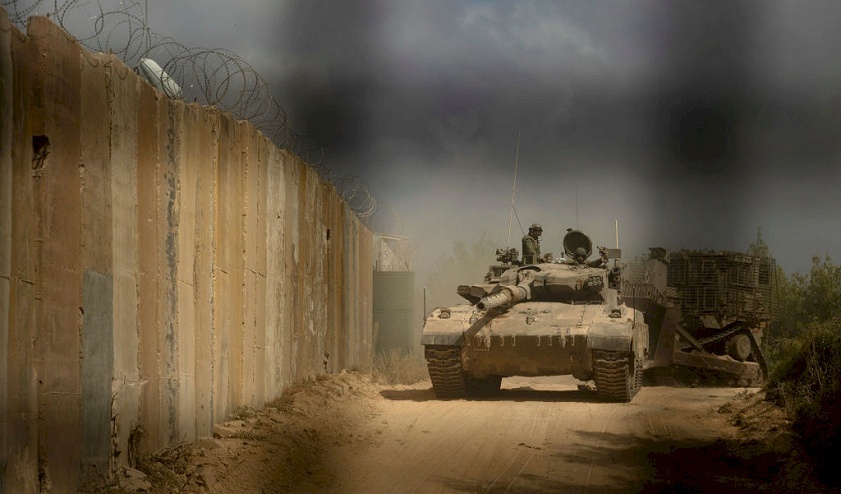
While Lebanese reports talked about Israeli tanks moving southward, which could be understood as the beginning of a withdrawal from some areas, Israeli military sources stated that forces have not withdrawn from the sites they control and that their deployment within the area has not seen any change.
The channel also reported military sources saying that the Chief of Staff of the Israeli army, Eyal Zamir, instructed to continue the presence in the "buffer zone" and to maintain Israeli air superiority in Lebanese skies.
A military source said to the channel: "So far, we have not received any new instructions, but no one intends to venture into any adventures in the coming days," adding that uncertainty prevails among soldiers and commanders regarding the next phase.
Dispute within Israel Regarding the Future of the Lebanese Front
While Washington confirms that the agreement currently does not obligate Israel to withdraw from southern Lebanon, discussions continue in Israel about its actual implications on the northern front.
Yedioth Ahronoth quoted Israeli cabinet officials saying that Iranian pressures to force Israel to withdraw from southern Lebanon "have failed," and that the agreement currently does not include, according to their understanding, a U.S. commitment to compel Israel to withdraw.
One official stated, "The ball is now in Hezbollah's court," considering that the party finds itself in a dilemma between its desire to establish a ceasefire and its rejection of the continued Israeli military presence in the south.
He added that Israel intends to continue targeting what it describes as Hezbollah's infrastructure in areas where the party does not deploy in southern Lebanon, considering that this represents an "improvement" compared to the situation that prevailed months ago.
However, Israeli officials also admitted that some of the formulations being circulated about the agreement, especially concerning Lebanese sovereignty, might be used in the future to pressure Israel into withdrawing, even if the current understandings do not include a direct commitment in that regard.
Araqchi to Berri: End to the War on Lebanon Must Be Implemented Immediately
On the Lebanese side, Iranian Foreign Minister Abbas Araqchi conducted two separate phone calls with Lebanese Speaker of Parliament Nabih Berri and President Joseph Aoun, discussing regional developments and aspects of the announced agreement between Tehran and Washington.
According to a statement from Berri's office, Araqchi briefed the Lebanese Parliament Speaker on the details of the agreement, indicating that one of its main clauses states the cessation of the Israeli war on Lebanon.
The statement quoted Araqchi confirming that "this clause must be implemented and applied literally immediately from the first day and throughout the planned negotiation period of 60 days," adding that "ensuring compliance with it is the responsibility of the United States and the guarantor parties of the memorandum of understanding."
For his part, Berri reiterated his gratitude to Iran, as well as to "the regional and international entities supporting Lebanon at this stage."
In a separate call, Araqchi discussed regional updates and several issues of mutual interest with Lebanese President Aoun, who expressed welcome for the understanding reached between Iran and the United States, hoping that it would represent "a positive step toward reducing tensions and opening the door to diplomatic solutions that contribute to enhancing security and stability at both regional and international levels."
Both sides emphasized the importance of continuing political and diplomatic efforts to consolidate stability in the region, while Aoun stressed that the security and stability of Lebanon and its sovereignty "remain a national priority."
In turn, Araqchi emphasized the importance of respecting Lebanon's sovereignty and territorial integrity by all parties, expressing hope that the atmosphere created by the U.S.-Iranian understanding would support stability in Lebanon and enhance opportunities for recovery and prosperity.
Hezbollah: We Have Not Executed Any Operation Since the Agreement was Announced
Moreover, Reuters reported a Hezbollah official stating that the party has not carried out any military operations since the announcement of the agreement between the United States and Iran.
He added that the party's stance on the ceasefire "is related to Israel's commitment to its terms," reaffirming the party's rejection of what it termed as "Israeli freedom of action" in Lebanon.
The official also stated that Iran postponed signing the agreement to monitor Israel's commitment to the ceasefire in Lebanon.
These statements coincided with a gradual return of residents from villages in southern Lebanon outside the area controlled by the Israeli army, although the Lebanese army urged residents to be patient and not rush to return.
 Follow the latest Sada News via Google News
Read Also

Israeli Anger Over Agreement with Iran: "If We Had Known the Outcomes of the Political War...

Netanyahu After the US-Iran Agreement: We Have Removed the Threat of Nuclear "Exterminatio...

Washington Pressures to Restrict Israeli Operations in Lebanon: "No Withdrawal for Now and...

Haredim Escalate Against Netanyahu: Nursery Law or Dissolution of the Knesset

U.S.-Iran Memorandum of Understanding Signed Electronically

President Abbas Discusses Latest Developments with His Indonesian Counterpart

The Israeli government allocates a budget to fund the terrorist settlement organization "Y...
