

With Pakistani Mediation.. Washington and Tehran Move Closer to Agreement, Israel Warns
SadaNews - Several statements have emerged over the past few hours, confirming significant progress in negotiations between the United States and Iran, amidst optimistic atmospheres about reaching a final and permanent agreement, along with Israeli fears regarding an agreement that does not meet Tel Aviv's security conditions.
U.S. Secretary of State Marco Rubio stated on Sunday from New Delhi that there is a "possibility that the world will hear good news in the coming hours, particularly regarding the Strait of Hormuz."
Rubio added: "We have made some progress over the past 48 hours regarding the outlines that might resolve the crisis in the Strait of Hormuz."
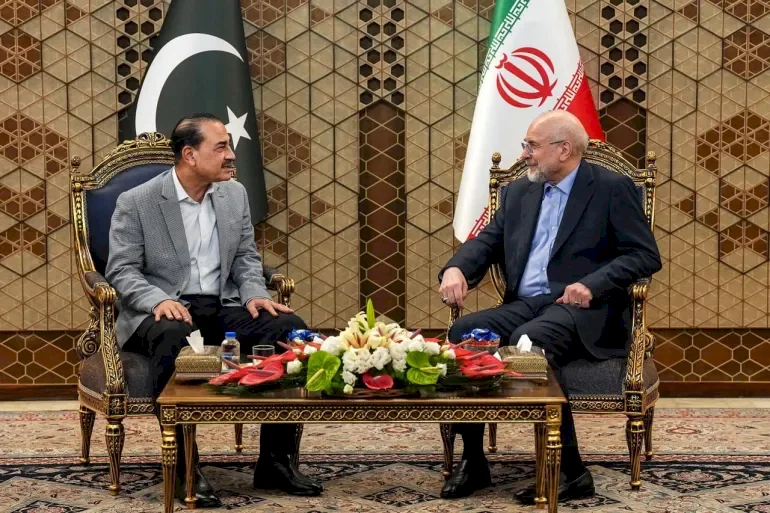
For its part, Pakistan, which plays a prominent role in the mediation process between Washington and Tehran, expressed optimism about achieving significant progress in the negotiations and the possibility of reaching a positive and lasting outcome.
Pakistani Foreign Minister Ishaq Dar remarked on Sunday that "significant progress" has been made in negotiations between the U.S. and Iran, encouraging hope for a positive and lasting result.
He added: "I commend the leadership of U.S. President Donald Trump and his commitment to dialogue and diplomacy, as well as his Vice President J.D. Vance, Secretary of State Marco Rubio, and the entire U.S. team."
The Pakistani Foreign Minister emphasized that "what has been achieved in these negotiations provides reasons for optimism regarding the possibility of reaching a positive and lasting result."
Earlier today, Pakistani Prime Minister Shahbaz Sharif expressed hope that his country would soon host the next round of peace talks between Iran and the United States.
Sharif, whose country is playing a key role in mediating between Washington and Tehran, posted on X stating: "Pakistan will continue its sincere efforts to achieve peace, and we hope to host the next round of talks very soon."
The Pakistani Prime Minister congratulated the U.S. President on what he described as "exceptional efforts" to achieve peace.
Untangling the Hormuz Knot and the Nuclear File
On another note, The Washington Post reported that a knowledgeable Pakistani official stated that the Chief of Pakistan's Army sought to narrow the gaps on two key issues being discussed in the talks, namely control over the Strait of Hormuz and the future of the Iranian nuclear program.
The newspaper added that Iranian officials prefer to delay discussions regarding the nuclear program until an agreement to end the war and reopen the Strait of Hormuz is reached, whereas American officials prefer to address all issues at once.
Trump: Final Agreement Details Soon
For his part, the U.S. President stated on Saturday that a "significant portion" of a memorandum of understanding concerning a peace agreement with Iran has been negotiated, which will lead to the reopening of the Strait of Hormuz.
Trump posted on his Truth Social account that the emerging agreement will lead to the reopening of the strait, and did not specify what else the agreement will contain.
Trump wrote on Truth Social: "Discussions on the aspects and final details of the agreement are currently ongoing, and they will be announced soon."
Iranian Leaks on the Provisions
Meanwhile, Iranian media have reported details on some provisions of the upcoming memorandum of understanding between Washington and Tehran.
Fars News Agency reported that the draft stipulates a mutual non-attack agreement between both parties, also stating that Washington and its allies will not attack Tehran or its allies.
It continued that, in return, Iran pledges not to carry out any preemptive military attack against America and its allies.
Tasnim News Agency reported that the proposed memorandum of understanding stipulates the end of the war on all fronts with the lifting of U.S. sanctions on Iranian oil during the negotiations.
The agency added that Iran has not yet accepted any measures regarding its nuclear program, stating that the potential agreement allocates a 30-day period for measures related to the Strait of Hormuz and a 60-day period for nuclear talks.
The agency noted that under the proposed memorandum, the number of vessels able to transit through the Strait of Hormuz will return to the pre-war level within 30 days.
The agency also stated that the maritime blockade should be completely lifted within 30 days under the proposed memorandum, and part of Iran's frozen funds should be released in the first phase.
It pointed out that the proposed memorandum includes a temporary lifting of sanctions imposed on Iranian oil, gas, and petrochemical during the negotiation period.
Anger in Tel Aviv
In contrast, Israel has expressed its displeasure with the agreement, with Israeli Channel 12 quoting a senior Israeli official stating that "the current agreement being shaped with Iran is problematic because it sends a message to the Iranians that they possess a weapon just as effective as nuclear weapons, which is the Strait of Hormuz."
The Israeli official added: "Trump sees the agreement as primarily economic, including mutual opening of the Strait of Hormuz, with any future progress dependent on removing the nuclear file from the equation, but practically, it remains unclear what will happen after the first stage."
Channel 14 also reported that Prime Minister Netanyahu has instructed ministers not to discuss the imminent agreement between Tehran and Washington.
Source: Al Jazeera
 Follow the latest Sada News via Google News
American Escalation Using B-1 Bomber Against Targets of the Iranian Revolutionary Guard

Iranian Revolutionary Guard Targets Al-Adairi Camp and Ali Al-Salem Air Base in Kuwait

Massive Fire in Spain Forces Residents of 34 Villages to Evacuate

Public Prosecution in Damascus Demands Death Penalty for Wisam Al-Assad

Saudi Arabia: Targeting of Tanker in the Red Sea and Safety of Its Crew

Jordanian Army Intercepts 4 Iranian Missiles and 4 Drones

Death of a Moroccan Man During His Arrest in Italy Sparks Calls for Investigation
