

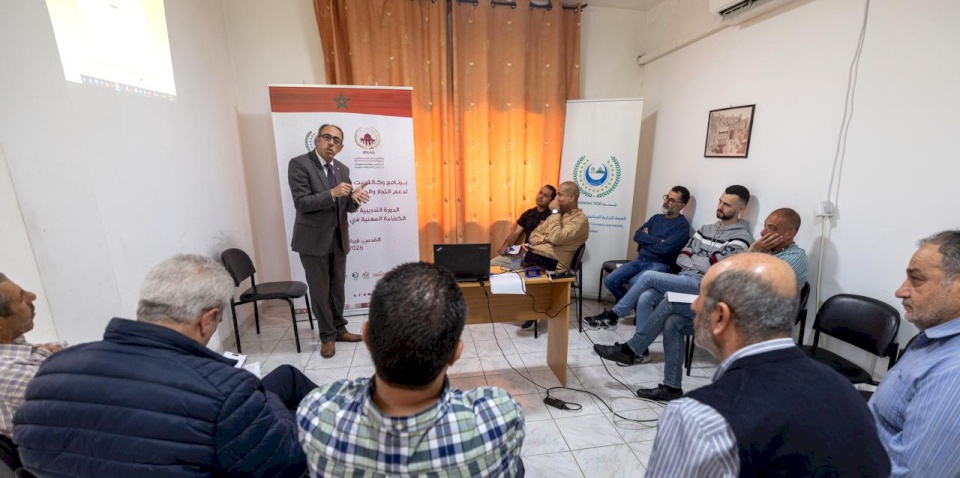
"Bayt Mal Al-Quds" Launches the Second Phase to Empower Jerusalem Traders in Import and Export Skills
SadaNews - The Bayt Mal Al-Quds Agency, the executive arm of the Jerusalem Committee chaired by King Mohammed VI, launched today, Monday, the second phase of its training program on "Professional Competence in Import and Export" in collaboration with the Arab Chamber of Industry and Commerce in Jerusalem.
The course was inaugurated at the chamber’s headquarters in the town of Al-Ram, north of Jerusalem, and consists of four training meetings aimed at enhancing the efficiency of Jerusalem traders, particularly the youth and small business owners, by keeping up with the rapid changes in customs laws and procedures, which contributes to reducing financial losses and limiting their exposure to exploitation by intermediaries.
Participants receive specialized training encompassing concepts of value chain and production, planning and managing operations, supply chains and logistics, in addition to export requirements and market access mechanisms. These skills are becoming increasingly important given the challenges facing the Jerusalem economy, foremost among them being the dominance of Israeli products and flooding the market with low-quality goods, alongside the restrictions imposed by the occupation authorities through checkpoints and barriers, which are accompanied by rising transportation costs and delays in the arrival of goods.
The director of the Al-Ram branch of the Arab Chamber of Industry and Commerce in Jerusalem, Mohannad Yaish, confirmed that these courses represent a fundamental lever for empowering the Jerusalem trader by providing them with practical knowledge on import conditions and the legal procedures governing them, including Palestinian regulations and those imposed by the occupation authorities.
He explained that the program targets various categories, from new entrepreneurs to experienced traders, due to the continuous changes in this sector, making training a constant necessity. He anticipated that the program would increase awareness among Jerusalem traders and enhance their interest in direct importation by the traders themselves.
Yaish thanked the Bayt Mal Al-Quds Agency for its ongoing support for the city of Jerusalem and its traders, appreciating its continuous efforts in organizing courses and launching initiatives that contribute to supporting the Jerusalem economy.
For his part, customs consultant and expert Dr. Hussein Al-Daik explained that the course provides practical knowledge of customs clearance procedures, especially for goods coming through the Israeli side, including tariff items, certificates of origin, and related fees and taxes.
He pointed out that the control of the occupation authorities over the ports and crossings forces Jerusalem traders to rely on Israeli customs brokers, which increases the need for a precise understanding of the details to avoid losses or exploitation.
He noted that one of the most prominent challenges facing Jerusalem traders is the continued dominance of Israeli products, alongside the unfair competition resulting from the introduction of low-quality goods, as well as the field restrictions that impede the movement of goods between Jerusalem and other governorates in the West Bank, leading to increased costs and sometimes damage to goods.
For his part, the executive director of the Palestinian Freight Council, Ihab Al-Barghouti, confirmed that the council is working, in partnership with the Bayt Mal Al-Quds Agency and the chambers of commerce, to expand the base of beneficiaries from these programs and open new markets for Jerusalem traders, including the Moroccan market, by networking companies and enhancing trade exchange opportunities.
Al-Barghouti praised the support provided by the Bayt Mal Al-Quds Agency for various projects, especially in the Jerusalem governorate, confirming that the city needs more economic support from the agency and from various Arab countries to bolster its resilience and strengthen its local economy.
In this context, one of the course participants, Amin Sharaf, owner of Al-Amin Machinery Company in the town of Bir Nabbala, expressed his ambition to acquire practical skills that help him understand the loopholes related to import processes, thereby enhancing his ability to protect his commercial interests and make more efficient decisions.
On this occasion, the director responsible for managing the Bayt Mal Al-Quds Agency, Mohamed Salem Al-Sharqawi, stated that these programs fall within a comprehensive vision of the agency focused on empowering the Jerusalem economy and linking it to modern value chains through three main axes: digital marketing via the "Daleela" platform, technical support, and innovation support through the "BMAQ Innovation Hub" startup incubator.
He added that the agency, in cooperation with its local partners, works to open promising economic horizons for Jerusalem businesses, especially by enhancing their presence in foreign markets, including the markets of the Organization of Islamic Cooperation (OIC) countries, in coordination with the Islamic Center for Trade Development, part of the organization, to establish a foundation for sustainable trade exchange.
Al-Sharqawi stressed that empowering Jerusalem traders with precise knowledge of customs and legal procedures is a fundamental pillar for protecting the economic identity of the Holy City and enhancing its residents' resilience in the face of imposed challenges.
It is noteworthy that the Bayt Mal Al-Quds Agency had launched the first phase of this training program in February of last year, as part of the cooperation agreement signed with the Arab Chamber of Industry and Commerce in Jerusalem on December 24, 2025.
 Follow the latest Sada News via Google News
Expanded ministerial delegation inspects Jenin Governorate to boost citizens' steadfastnes...

Weather Conditions: Severe Heat

"Bayt Mal Al-Quds" Delivers Shipment of Furniture and Complete Equipment to Orphanage at t...

688 assaults by settlers.. And the demolition of 131 homes and facilities in the West Bank...

Settlers Storm Al-Aqsa Mosque

Raid Operations and Arrests Amid Rising Attacks by Settlers in the West Bank

The President of the Supreme Judicial Council Calls for Arab Judicial Integration
