

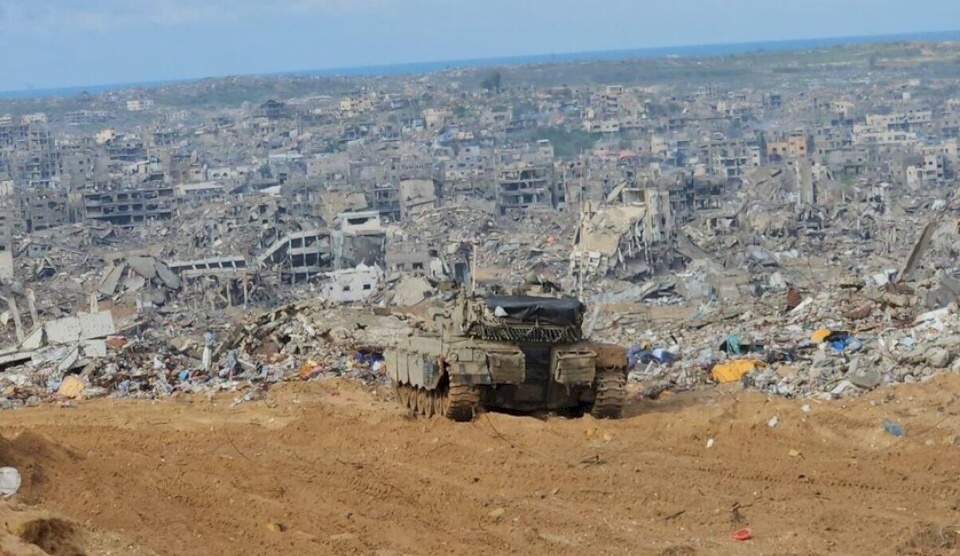
New Israeli Maps Show Expanded Military Control Area in Gaza
SadaNews - Israel issued new maps of Gaza a little over a month ago, placing thousands of displaced Palestinians within an expanded prohibited area, within boundaries that the army claims it can continue to change.
The prohibited area, marked on the maps by an orange line, constitutes approximately 11 percent of the lands of Gaza that lie outside the "yellow line" which delineates the part of Gaza occupied by Israeli forces since the ceasefire in October. These areas encompass nearly two-thirds of Gaza's total land, according to Reuters.
Two relief sources stated that the Israeli army sent the maps to aid organizations in Gaza in mid-March but did not publish them publicly.
Israel claims that the region between the orange line and the yellow ceasefire line, to which its forces withdrew according to the October agreement, is a prohibited area to enable the delivery of assistance, and that relief organizations must coordinate their movements with the army. It asserts that civilians are not affected by this measure.
The expanded area has raised concerns among the displaced Palestinians living there that Israel might consider them as targets and open fire on them. It has also fueled fears that Israel may plan to permanently retain the area.
Israeli officials describe the territories they have seized in Gaza, Syria, and Lebanon as "buffer zones" that can deter attacks from militants following the attack led by the Palestinian Islamic Resistance Movement (Hamas) on October 7, 2023, which ignited the Gaza War.
Netanyahu stated in a video message released on March 31, "More than half of the Gaza Strip is under Israeli control. We are the ones attacking and initiating, and we surprise our enemies."
'People Don't Know What the Situation Is'
The expansion of Israeli control beyond the agreed line under the ceasefire, mediated by the United States in October, casts further doubt on President Donald Trump's Gaza plan, whose implementation was delayed for months due to the war in Iran and disagreements regarding the disarmament of Hamas militants.
It also extends the area where the Israeli army claims it can operate and launch deadly attacks on Palestinians without marking the ground. The ceasefire line established in October was marked by concrete blocks painted yellow. Reuters previously reported that Israel had moved those blocks deeper into territory controlled by Hamas.
In its first public comment on the expanded area, the Israeli government's Coordinator of Activities in the Territories, the military agency controlling access to Gaza, stated that it had defined areas adjacent to the yellow line where international organizations, including relief organizations, must coordinate their movements with the army.
It added, "Boundaries are being set for these areas (the orange line), which require coordination and updating according to the operational situation assessment, in order to enable humanitarian activities while protecting individuals in a complex operational environment."
The unit refrained from commenting when asked about how often it updates and distributes maps to relief organizations outlining the limits of the orange line, and whether it has informed Palestinian civilians of those boundaries.
At least three Palestinians working with foreign relief organizations, two with UNICEF and one with the World Health Organization, have been killed by Israeli fire in the area between the two lines since mid-March.
The Israeli army stated during two incidents that it detected threats near the yellow line, prompting it to open fire. UNICEF and the World Health Organization have not yet responded to requests for comment on whether they have coordinated their staff movements with Israel.
Rani Ashour, who lives in a displacement camp near the city of Gaza situated between the two lines, said that residents lack water and other aid because relief organizations fear sending their staff there.
He added, "The changes, you know where this is and where that is, the line (orange) might be here one day, you sleep and wake up to find it has crossed you."
Medical sources indicated that since the ceasefire, Israel has killed more than 800 Palestinians in Gaza, many of them in the area near the yellow line, which is home to displacement camps and those living in destroyed buildings. Four Israeli soldiers were killed during the same period.
Changing Borders
The two relief sources, who work in Gaza, reported that the Israeli army initially sent organizations a map showing an expanded area beyond the yellow line after the ceasefire in October. They added that this map was published by organizations, including UNICEF, but was not publicly released by the army.
The sources sent images of the map to Reuters but declined to publish it directly. They said the army sent organizations an updated version of the map in mid-March. The new map shows the yellow line and marks the expanded area with an orange line.
Reuters shared the images with Palestinian researchers who integrated the two lines onto one map. The relief sources stated that the yellow line may have shifted to include the original expanded area, while the orange line defines the boundaries of a larger prohibited area.
The Israeli army refrained from commenting when asked whether the yellow line had moved forward but stated that "the area adjacent to the yellow line is a sensitive and dangerous operational environment," and that "there are signs in the area indicating a prohibition on approaching it."
Jad Issac, the director-general of the Applied Research Institute in Jerusalem, an independent Palestinian research center in the occupied West Bank, said this effectively means Israeli control over at least 64 percent of Gaza, where nearly the entire population of the Gaza Strip, about two million people, is crammed into a narrow coastal strip of land controlled by Hamas.
Issac added, "They want to squeeze as many Palestinians as possible into the smallest area possible to expel them, given the lack of any viability or sustainability for what remains of Gaza."
Israeli officials, including Minister Bezalel Smotrich, have called on Palestinians to leave Gaza, further fueling fears among Arab countries that Israel is seeking to displace Palestinians from the lands they aspire to establish their state on.
Behind the yellow line, Israel forced civilians to displace and demolished most remaining buildings at a time when the U.S. and the UAE were putting developmental plans for the sector into place.
Amjad Al-Shawa, the director-general of the Gaza Network of Non-Governmental Organizations, said the additional line of control has caused confusion and anxiety.
He added, "People don't know where the lines begin. Once the line is in a certain place, the next day it moves to another place without any warning or notice."
 Follow the latest Sada News via Google News
High-level sources reveal to SadaNews: Washington seeks to hold a Gaza Reconstruction Conf...

"Mistreatment After Death".. 104 Palestinians Died or Were Killed While in Custody in Isra...

Report: Israeli Prisons Have Turned into a 'Grave' for the Living

Under the Guise of Crime Fighting: The Occupation Cuts Half a Billion Shekels from Arab Co...

SadaNews Report: Who Will Manage Gaza After the Government Follow-Up Committee's Self- Dis...

Report: The American War on Iran Has Reduced Interest in the Fate of Gaza

من سلوان إلى كفر عقب: كيف يعيد الاحتلال تشكيل خريطة القدس السكانية؟
