

Behind the Split Between Trump and Meloni: The War on Iran and the Pope's Crisis
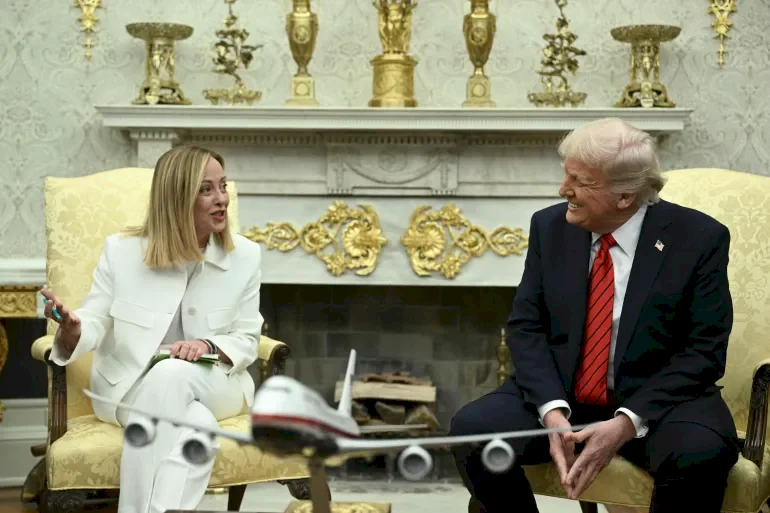
SadaNews - The close and special relationship between U.S. President Donald Trump and Italian Prime Minister Giorgia Meloni has reached an impasse, following sharp disagreements on several bilateral and international issues.
The New York Times reported that the politically motivated marriage between Trump and Meloni has collapsed amid public quarrels over contentious topics, most notably Trump’s criticisms of Pope Leo XIV of the Vatican, the outbreak of war on Iran, and shifting alliances within the European continent.
According to the newspaper, Meloni, who was once considered a pragmatic bridge between the MAGA (Make America Great Again) movement and the traditional European establishment, now finds herself distanced from President Trump, whom she once expressed admiration for publicly.
Attack on the Pope
The newspaper explains that the rift between the two reached its peak this week following offensive remarks made by President Trump towards the Pope. Although Meloni historically aligns with Trump on conservative values, his criticism of the Pope has become a red line for a leader of a country with a significant Catholic majority.
Meloni's response was firm and unusually blunt for her diplomatic language, stating: "I find President Trump’s statements about the Pope completely unacceptable."
On his part, Trump did not remain silent; he responded - in an interview with an Italian newspaper - claiming he had not spoken to Meloni in a "long time," labeling her as "unacceptable." The rift was confirmed when Trump stated on television that the U.S. and Italy "no longer enjoy the same relationship."
War on Iran
If the pope issue was the spark, the crisis was brewing for some time due to the war on Iran, as tensions escalated when the U.S. and Israel launched attacks on Iran without prior notice to Meloni, who was regarded as a close ally.
The newspaper pointed out that the lack of coordination led to a humiliating diplomatic fiasco for Rome, as Italian Defense Minister Guido Crosetto was on vacation in the UAE when the war broke out and had to be evacuated urgently via a military aircraft.
Moreover, the war on Iran caused a massive spike in gas and electricity prices in Italy, directly harming Meloni's popular base. Furthermore, Meloni recently lost a crucial referendum on judicial reform, which analysts attribute to her declining popularity linked to her association with Trump and the economic fallout of his foreign policies.
In a bold move to reclaim her sovereignty, Meloni announced that Italy "will not automatically renew its defense agreement with Israel," citing the "current situation" and her desire to steer her country away from a war that she insists Italy is not a party to.
The New York Times highlighted the paradox in Meloni's current position, having started her career in a new fascist movement and hosting former U.S. presidential advisor Steve Bannon at her party conferences, yet today finds herself drifting towards the mainstream in Europe due to Trump's fluctuations.
Meloni was one of Trump’s biggest supporters, praising his foreign policy, but the relationship began to cool with Trump’s pressure on Italy to increase military spending and accept unfair tariffs.
On the European front, that gap widened with the loss of her close ally Viktor Orbán to power in Hungary, leaving Meloni increasingly isolated on the far right.
New Allies
The New York Times commented on the collapse of the partnership between Trump and Meloni, saying it represents a pivotal turning point in transatlantic relations between the U.S. and Europe.
Roberto D'Alimonte, a political science professor at Florence University, believes Meloni saw in Trump an "asset" that would give her weight in mediating between Europe and Washington, but this asset has now turned into a "toxic burden."
As Italy’s elections approach next year, it seems Meloni is turning towards Brussels and the European establishment in search of the stability she can no longer find in her relations with Washington, prioritizing political survival over personal loyalty.
 Follow the latest Sada News via Google News
Morocco Hosts Formative Exercise for International Stabilization Force in Gaza

Sheikh Holds Meeting with Security Leaders to Follow Up on Current Developments

Hebrew Channels: The Likelihood of Israel's Participation in the Attack on Iran is Increas...

Netherlands Sets September Deadline for Ban on Settlement Products

12 Martyrs in Gaza Strip since Dawn Today

A Series of Important Decisions Taken.. The Cabinet Discusses Developments in the Deterior...

Organizations of the Temple Prepare for the Largest Raid on Al-Aqsa on What is Called the...
