

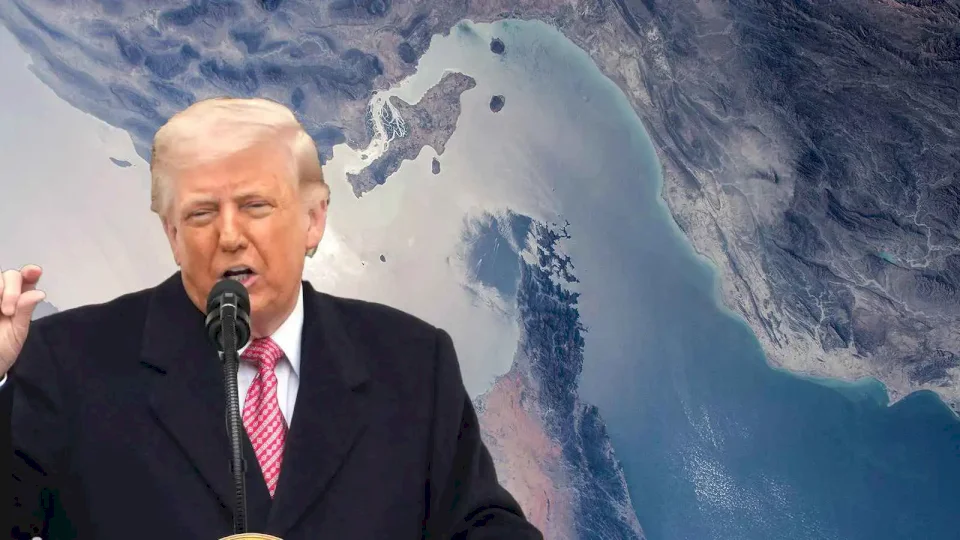
Trump Hints at "Naval Blockade" Option Against Iran
SadaNews - On Sunday, U.S. President Donald Trump posted a message on his "Truth Social" account outlining his options regarding the Iranian issue, including imposing a naval blockade on Iran.
Trump wrote: "The winning card that the president has if Iran does not back down: the naval blockade," sharing a report from "Just News" that discussed the possibility of imposing a naval blockade on Iran should negotiations between the two sides fail.
The newspaper's report mentioned that "if Iran refuses to accept the final agreement offered by the United States, Trump may resort to bombing Tehran and returning it to the 'Stone Age' as he has threatened. Alternatively, he could simply reapply his successful blockade strategy to choke off the already struggling Iranian economy and escalate diplomatic pressure on China and India by cutting off one of their main oil supplies."
This comes as U.S. Vice President Jay D. Vance announced earlier on Sunday that talks with Iran did not result in an agreement, noting that he is leaving Islamabad after presenting the "final and best offer" to the Iranians.
Vance's remarks indicated that he is still giving Iran ample time to consider the offer made by the United States, which announced on Tuesday a two-week halt to its attacks while awaiting the outcome of the negotiations.
Vance told reporters that the U.S. delegation, after 21 hours of talks in the Pakistani capital, is leaving after presenting "our final and best offer. We will see if the Iranians will accept it."
For its part, Iran stated that the talks with Washington did not result in an agreement, and that it is natural not to reach an agreement in one meeting, indicating that communications with Pakistan will continue.
The Iranian Foreign Ministry stated that Tehran discussed new files in the talks with the United States, such as the Strait of Hormuz, emphasizing that several points were agreed upon with Washington while there were disagreements on others.
On Sunday, Iran reiterated that the talks with Washington did not yield an agreement, emphasizing that it is natural not to reach an agreement in one meeting, and that communications with Pakistan will continue.
The Iranian Foreign Ministry also noted that Tehran discussed new matters in the negotiations with the United States, such as the Strait of Hormuz, confirming that several points were agreed upon with Washington, while disagreements remain on others.
Meanwhile, Pakistan's Foreign Minister called on Washington and Tehran to continue adhering to a ceasefire agreement despite the failure of negotiations to reach an agreement to end the war in the Middle East.
Ishaq Dar, whose government hosted the talks, stated in a brief statement broadcast by state media, "It is essential that both parties continue their commitment to the ceasefire," adding that "Pakistan has been and will continue to play its role in the coming days to facilitate participation and dialogue between the Islamic Republic of Iran and the United States of America."
 Follow the latest Sada News via Google News
Morocco Hosts Formative Exercise for International Stabilization Force in Gaza

Sheikh Holds Meeting with Security Leaders to Follow Up on Current Developments

Hebrew Channels: The Likelihood of Israel's Participation in the Attack on Iran is Increas...

Netherlands Sets September Deadline for Ban on Settlement Products

12 Martyrs in Gaza Strip since Dawn Today

A Series of Important Decisions Taken.. The Cabinet Discusses Developments in the Deterior...

Organizations of the Temple Prepare for the Largest Raid on Al-Aqsa on What is Called the...
