

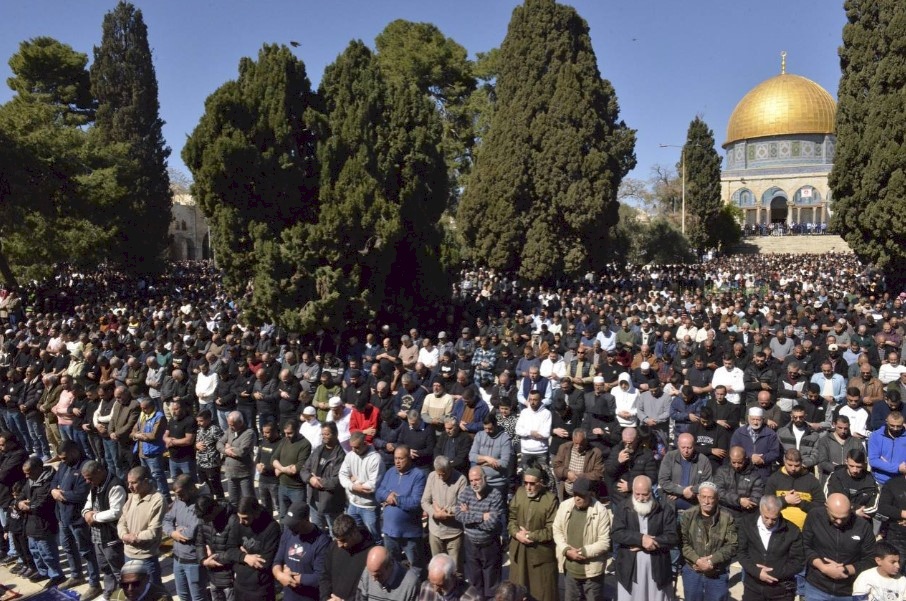
Ministry of Awqaf: Occupation Forces Stormed Al-Aqsa 24 Times and Prevented Azan in Ibrahimi Mosque 68 Times
SadaNews: The Ministry of Awqaf and Religious Affairs issued a comprehensive report documenting the increase in Israeli violations against the blessed Al-Aqsa Mosque and the Ibrahimi Mosque, as well as other places of worship during the past month of March. The report confirmed that this period witnessed an unprecedented escalation in the scale and nature of the assaults, especially coinciding with the holy month of Ramadan.
The report stated that the blessed Al-Aqsa Mosque witnessed a complete and continuous closure for 37 consecutive days, under the pretext of a "state of emergency" related to the war, where worshippers were entirely prevented from entering its courtyards and prayer areas. This unprecedented situation impacted the Friday prayers and the last ten days of Ramadan, leading to the banning of Eid al-Fitr prayers. This closure was accompanied by a strong deployment of occupation forces around the mosque and the gates of the Old City, along with widespread closures of commercial shops, resulting in a near-total paralysis of daily life, as part of a policy aimed at isolating the Al-Aqsa Mosque and imposing a new reality that affects its religious and historical status.
The report also documented continuous assaults on worshippers around the mosque, especially in the Bab al-Sahira area, where sound bombs were launched and several young men were arrested during the Maghrib and Taraweeh prayers. Additionally, fragments of rockets were recorded falling inside the mosque's courtyards without causing injuries. A serious escalation in incitement was noted by groups promoting the alleged "Temple," which circulated videos and media materials using artificial intelligence techniques simulating the demolition of Al-Aqsa Mosque and the construction of the "Temple," calling for the implementation of the "Passover sacrifice" rituals within its courtyards, coinciding with the approach of what is called the Hebrew Passover holiday, in an attempt to impose a new religious reality inside the mosque.
As for the Ibrahimi Mosque, the report documented a series of daily violations, manifested in tightening procedures at the mosque gates and restricting the entry of worshippers. The azan was prevented 68 times during the month, and delays in its announcement were intentionally caused by obstructing the entrance of the muezzin, along with humiliating searches of worshippers and staff, accompanied by verbal abuse.
The report recorded settlers' assaults, including loud concert parties and deliberate disturbances to worshippers through horn blowing, in addition to the ongoing control over the fire system and continued excavations and work within the Al-Ashraf corner without clarification of their nature.
It was noted that the Israeli occupation closed the Ibrahimi Mosque for 6 days during March under the pretext of war, alongside imposing strict restrictions on the number of worshippers and allowing the entry of only 50 people at certain times, which significantly limited the freedom of worship and access to the mosque.
The report also documented a serious incident involving an assault on the office of the mosque's management in the Qasab area, where lighting was installed, despite the presence of significant historical heritage including books and artefacts related to the mosque.
These assaults extended to include places of worship in various areas, where occupation forces attempted to storm the Beit Furik Mosque and raided the Al-Sadiq Al-Amin Mosque in the city of Yatta during the Maghrib and Taraweeh prayers, conducting searches of worshippers.
In a related context, settlers set fire to the "Muhammad Fayyad" Mosque in the town of Duma and wrote racist slogans on its walls. The occupation also assaulted the Awqaf lands in the town of Zabuba near Jenin, preventing Awqaf crews from accessing them, in addition to targeting sites like the Church of the Holy Sepulchre in a framework of repeated assaults on Islamic and Christian sanctities.
The ministry emphasized that the ongoing and repeated closure of both the Al-Aqsa Mosque and the Church of the Holy Sepulchre is no longer a temporary security measure, but has become a systematic policy aiming to reshape reality in Jerusalem by restricting the entry of worshippers and controlling their numbers and ages, thereby diminishing the Palestinian presence in these holy places, which weakens their religious and national ties.
It pointed out that these policies come within a broader context to impose actual sovereignty over the sanctities and change their historical and legal character, warning of the dangers of the continued escalation in light of the silence of the international community, and calling for taking legal and moral responsibilities to protect Islamic and Christian sanctities.
 Follow the latest Sada News via Google News
Morocco Hosts Formative Exercise for International Stabilization Force in Gaza

Sheikh Holds Meeting with Security Leaders to Follow Up on Current Developments

Hebrew Channels: The Likelihood of Israel's Participation in the Attack on Iran is Increas...

Netherlands Sets September Deadline for Ban on Settlement Products

12 Martyrs in Gaza Strip since Dawn Today

A Series of Important Decisions Taken.. The Cabinet Discusses Developments in the Deterior...

Organizations of the Temple Prepare for the Largest Raid on Al-Aqsa on What is Called the...
