

6 Martyrs and 419 Arrests in Jerusalem During the First Quarter of This Year
SadaNews - The Jerusalem governorate reported today, Thursday, that it has documented the martyrdom of 6 citizens, 419 arrests, and the incursion of 9373 settlers into the blessed Al-Aqsa Mosque during the first quarter of this year, which has been closed by the Israeli occupation authorities since February 28.
The Martyrs:
The Jerusalem governorate confirmed in its report the martyrdom of 6 citizens from the governorate amidst the escalating organized aggression practiced by the Israeli occupation forces and settlers, within a systematic environment of impunity and lack of accountability.
The governorate reported the martyrdom of: Nasrallah Muhammad Jamal Abu Siyam from Mukhmas due to an armed attack carried out by settlers on the town of Mukhmas on February 18, Murad Shweiki while working as a bus driver inside the territories of 1948 on March 18, and Qassem Amjad Abu al-Amal Shaqirat (21 years old) after special forces stormed his family's home in Jabal Mukabber on March 25.
The martyrdom of Muhammad Farraj Malhi (38 years old) from the town of Sharafat was also documented due to an armed attack by settlers on March 26, as well as Mustafa As'ad Mustafa Hamad and Sufyan Ahmad Saleh Abu Layl on March 27, after being targeted by Israeli fire during the storming of Qalandiya camp.
The Injuries:
During the first quarter of this year, the Jerusalem governorate recorded 106 injuries among the Jerusalemites, resulting from continuous assaults carried out by the occupation forces and settlers, which varied between live and metal bullets, beatings, and tear gas.
The injuries were particularly concentrated around the separation wall, especially in the towns of: Al-Ram, Kafr Aqab, Silwan, Anata, Badou, Al-Eizaria, and the camps of Shufat and Qalandiya, in addition to the Bedouin gatherings in Mukhmas and Khan al-Ahmar.
The data also showed an increase in settler assaults during February and March, with recorded mass injuries, notably in Mukhmas and Khilat al-Sadra, reflecting a direct targeting of Palestinian gatherings and attempts to push them towards forced displacement.
Cases of Arrest:
The Jerusalem governorate documented 419 cases of arrest of citizens, including 10 children and 7 women, within the framework of a systematic repression policy that included storming homes and detaining individuals at checkpoints and streets using force and intimidation.
Arrests were distributed across several areas, most notably: Qalandiya camp, Al-Issawiya, Anata, Silwan, and Kafr Aqab, in addition to the surroundings of Al-Aqsa Mosque, targeting activists, journalists, ex-prisoners, and many workers coming from the homeland's governorates, reflecting the occupation's attempts to impose control over various aspects of life in Jerusalem.
Settler Attacks:
The governorate reported that during the first quarter, 153 attacks by settlers were monitored, including 32 physical assaults in various parts of Jerusalem, as part of a systematic escalation targeting Al-Aqsa Mosque, Bedouin gatherings, and Islamic and Christian properties and sanctities, resulting in the martyrdom of three Jerusalemites: Nasrallah Abu Siyam, Murad Shweiki, and Muhammad Malhi.
The attacks varied between gunfire, physical assault, property arson, home takeovers, establishment of colonial outposts, and road closures, alongside attacks on churches and attempts to introduce sacrifices to Al-Aqsa and incitement to Talmudic rituals inside it.
These violations occurred under the direct protection of the occupation forces, reflecting the integrated roles in imposing new realities on the ground, with the occupation authorities bearing full legal responsibility for these crimes in light of the absence of accountability and continued impunity.
Demolition and Land Grabbing Operations:
During the first quarter of this year, the Jerusalem governorate recorded 147 demolition and land clearing operations, including 23 cases of forced self-demolition where Jerusalem citizens were forced to demolish their homes by their own hands, 113 demolitions carried out by the occupation's machinery, in addition to 11 land-clearing operations targeting Palestinian lands and properties.
The data indicates that the demolition operations were distributed across several towns and neighborhoods in Jerusalem, including Silwan, Beit Hanina, Sur Baher, Al-Issawiya, Jabal Mukabber, Shufat, and other neighborhoods, within a systematic policy aimed at imposing forced displacement and destroying the livelihoods of Jerusalemites.
Demolition and Forced Eviction Decisions and Land Grab:
Jerusalem governorate witnessed an unprecedented escalation in the Israeli occupation's policies regarding demolition, eviction, and land grabbing orders, as part of its effort to reshape the demographic and geographic reality in the city of Jerusalem, particularly in areas with a high Palestinian population density, primarily Silwan and Batn al-Hawa neighborhoods and Anata town.
During this period, the governorate documented 214 notices, including 146 demolition orders, 62 eviction orders, and 6 land seizure notices, reflecting a dangerous escalation in the pace of these violations, especially the forced evictions, which have intensively targeted the Batn al-Hawa neighborhood in Silwan for the benefit of colonial associations.
Colonial Projects:
The Jerusalem governorate documented, based on daily monitoring of official announcements issued by the occupation authorities and municipality in Jerusalem, in addition to documentation by the Beit al-Sharq Center, a total of 53 colonial plans during the three months, indicating a clear acceleration in the pace of colonial expansion.
The data showed that among these plans, 17 were deposited, including the construction of a total of 2592 colonial units on a total area estimated at about 1256.978 dunams, while 9 colonial plans were approved to build 860 units on an area of approximately 82.407 dunams, in addition to launching 5 tenders and bidding plans that included thousands of colonial units, alongside economic projects that include operational and commercial complexes.
Violations in Al-Aqsa:
The Jerusalem governorate stated in its report that the continuous closure of Al-Aqsa Mosque and the Church of the Holy Sepulchre in Jerusalem represents one of the most dangerous features of Israeli policies in Jerusalem, where it has transformed from a "temporary security measure" to a systematic tool for reshaping the existing reality in the city.
By imposing restrictions on the entry of worshippers, repeatedly closing the doors of Al-Aqsa Mosque and the Church of the Holy Sepulchre, and controlling the number of worshippers and their ages, the occupation authorities seek to cement a new reality based on reducing Palestinian presence in these holy sites and weakening their religious and national ties.
These measures come within a broader context targeting the enforcement of effective sovereignty over the holy sites in the occupied city, altering their historical and legal character, benefiting from the state of international silence that allows these policies to continue and escalate.
In this context, the closure transforms from a temporary measure to a permanent policy used as pressure on Jerusalemites, attempting to impose a new equation in the heart of Jerusalem based on the gradual exclusion of the original inhabitants.
The Jerusalem governorate reported the systematic violations of the occupation during the first quarter of this year, where the occupation continued its procedures aimed at imposing further restrictions on the city and its inhabitants, topped by continuous assaults on the blessed Al-Aqsa Mosque, accompanied by extensive incursions by settlers under the protection of occupation forces and attempts to entrench a new reality that affects the existing historical and legal status.
This was followed by the continuation of demolition and land clearing operations in multiple neighborhoods of the city, issuing notices against dozens of establishments, the martyrdom of individuals, alongside recorded injuries among citizens as a result of direct assaults or field repression.
The campaigns of arbitrary arrests also continued, and actual imprisonment and house arrest decisions were issued against Jerusalemites, in addition to decisions for forced expulsion from the blessed Al-Aqsa Mosque and the city of Jerusalem, as well as moving forward with depositing and approving new colonial plans aimed at Judaizing the city and changing its demographic and geographic character.
During the first quarter, Al-Aqsa Mosque witnessed a remarkable escalation in the pace of incursions and Israeli violations, where the total number of infiltrators reached 9373 settlers, in addition to another 16505 who entered under the guise of so-called "tourism," amidst strict protection from the occupation police and continuous restrictions on the entry of worshippers, especially during the month of Ramadan.
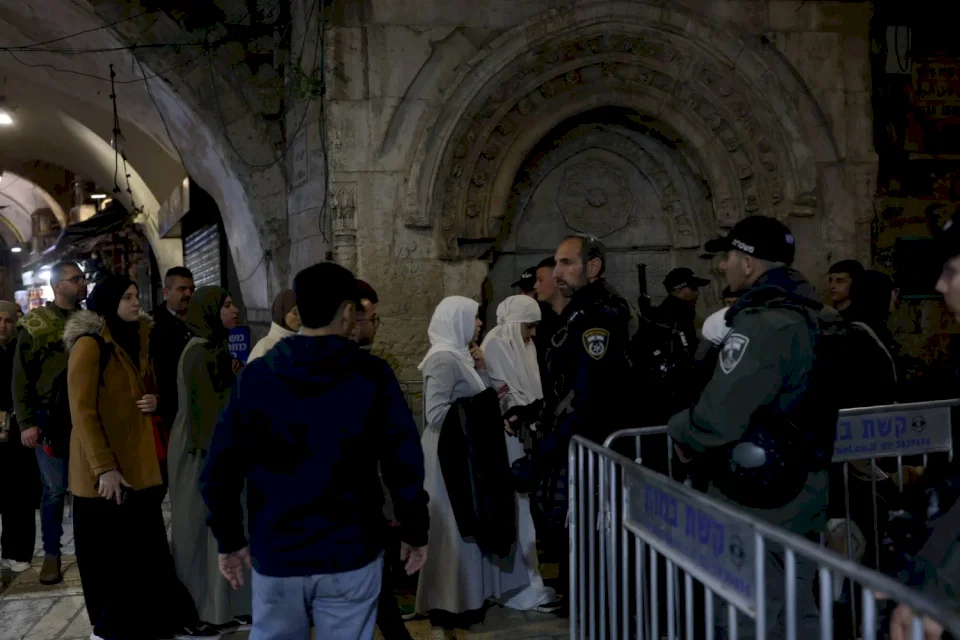
Throughout March, the occupation authorities imposed an almost complete closure on the blessed Al-Aqsa Mosque, beginning on February 28 and continuing until this report was prepared, in a dangerous precedent deemed the first since the occupation of Jerusalem in 1967 during this time of year. Access to the mosque was limited to a small number of imams and Waqf guards, without the entry of worshippers, while main prayer halls were closed, and prayers were not heard in the Old City, reflecting an unprecedented escalation targeting the reduction of Islamic presence in the mosque.
Decisions of the Occupation Against Detainees:
The Israeli occupation courts continue to issue arbitrary decisions against Jerusalemites, including imposing strict movement restrictions, in addition to exorbitant financial fines that burden families, forced house arrest, expulsion orders, and travel bans.
These courts also continued extending arbitrary administrative detentions without specifying charges, in some cases for long periods, which is a blatant violation of human rights and fundamental principles of legal justice.
Actual Imprisonment:
During the first quarter, the Jerusalem governorate recorded the continuation of the Israeli occupation's repressive policy against Jerusalemite prisoners, where the Israeli occupation issued 85 rulings and decisions, including 69 administrative detention orders and 16 actual prison sentences.
House Arrest:
The Israeli occupation authorities continued the policy of forced deprivation of freedom through house arrest against Jerusalemites, particularly targeting youth and journalists, as an alternative punitive measure to direct detention.
During this month, the Jerusalem governorate monitored 18 house arrest decisions, accompanied by strict conditions that included temporary expulsion and restrictions on the use of phones and social media, aiming to restrict their civil and media activities and silence their voices.
Expulsion Orders:
The occupation authorities issued 595 expulsion orders that primarily targeted Al-Aqsa Mosque and the Old City, including decisions that affected worshippers, mosque guards, ex-prisoners, journalists, activists, and officials of Al-Aqsa Mosque, aiming to undermine the Palestinian presence in the city.
Travel Bans:
The Israeli occupation authorities continued during the first quarter of this year to use travel bans as an arbitrary punitive tool against Jerusalemites, targeting religious and national figures and young Jerusalemites, as part of a policy aimed at restricting freedom of movement and tightening control over the city. The Jerusalem governorate monitored 9 travel ban decisions during this month.
Targeting National and Religious Figures:
During the first quarter of 2026, the Jerusalem governorate continued the systematic policy of the occupation targeting Palestinian religious and national leaders, as it continued to pursue Jerusalem governor Adnan Ghaith judicially by postponing his trial sessions to restrict his official role.
In January, the occupation authorities renewed the travel ban on Sheikh Ikrema Sabri and summoned him for interrogation in March before imposing a 15-day expulsion from the Old City.
Minister Ashraf al-Aawar has been banned from entering the West Bank since January, and the decision was confirmed in February. Sheikh Muhammad Ali al-Abbasi was arrested from Al-Aqsa Mosque and handed an expulsion order, while Sheikh Iyad al-Abbasi's expulsion from Al-Aqsa for 6 months was renewed via an electronic notification.
Crimes and Violations Against Institutions and Religious Sites:
During the first quarter of this year, the Jerusalem governorate recorded a noticeable escalation in Israeli violations targeting religious, educational, cultural, and media institutions, within a systematic policy to impose a Judaizing reality and undermine the Palestinian presence.
These violations included the closure of places of worship, notably Al-Aqsa Mosque, the storming and closure and demolition of UNRWA-affiliated institutions in the governorate, targeting cultural centers such as the Yabous Cultural Center and Al-Hakawati Theatre, in addition to tightening restrictions on journalists and classifying media platforms as "terrorist".
Moreover, the attacks targeted Islamic and Christian sanctities, including assaults on cemeteries and churches, and imposing restrictions on religious rituals.
These violations were distributed over the course of the three months, starting from the vandalism of Islamic cemeteries and cutting services from vital institutions in January, passing through the closure of community institutions and prevention of religious and cultural activities and imposing restrictions on religious endowments in February, reaching Judaizing procedures in March such as amending plans in Silwan, targeting markets and community initiatives, and continued attacks on the Bab al-Rahma cemetery, as an indicator of a systematic policy to reshape the religious and institutional reality in the city.
 Follow the latest Sada News via Google News
Report: Iran Planned to Assassinate Trump in Turkey

Report: Israel Estimates That Iran Will Not Attack It

Guterres Warns: Renewed Escalation in the Strait of Hormuz Poses Grave Consequences

Kuwaiti Army: Attack on 3 Border Locations Causes Material Damage

Axios: The U.S. military carried out multiple strikes against Iranian targets

The Occupation Municipality Approves Settlement Plan in Jerusalem

Al-Quds Bank Sponsors the Breivards Summer Camp and Shares the Joy of Launching Sports Act...
