

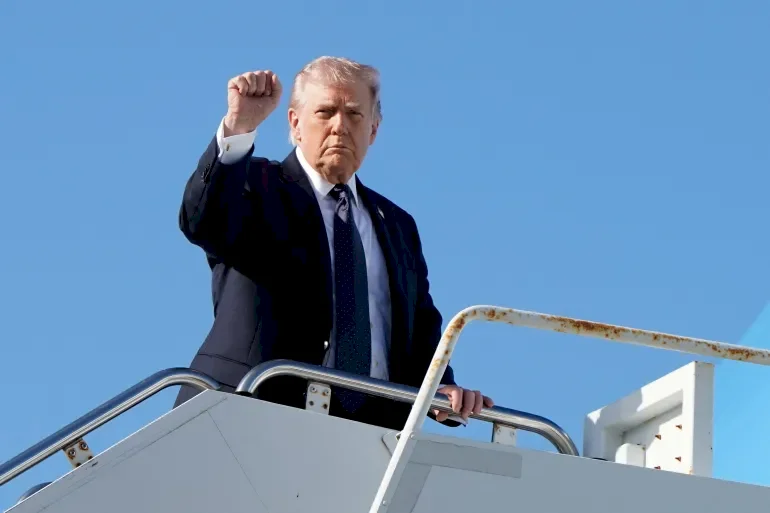
Trump's Contradictions in the Iran War: Confusion in Messages and Lack of a Post-War Plan
SadaNews - Since the onset of the American-Israeli attacks on Iran, one headline has dominated the coverage of Western newspapers: A war without a clear compass, which has led them to focus on revealing the contradictions they say characterize President Donald Trump's statements regarding attacking Iran. The question these newspapers pose remains the same: What comes after the guns are silenced?
The French newspaper Le Monde described the scene as "a directionless war," pointing to the stream of contradictory statements made by Trump within a few days, oscillating between a quick resolution and openness to negotiation, then speaking about changing the regime and selecting alternatives for its leadership.
The French newspaper considered this "vacillation" as reflecting a lack of clear phased planning, whether for starting or ending the war.
In his report, the newspaper's correspondent in Washington, Piotr Smolar, noted the stark contradiction between what was stated in the national security strategy published by Washington in November 2025 and the application of these ideas in reality.
He added that the document states that the Middle East is no longer "a permanent source of annoyance and a potential cause of imminent catastrophe as it once was"; according to the White House, the solution lies in "accepting the region, its leaders, and its countries as they are, while working on issues of mutual interest."
However, it is evident, according to the writer, that there is an implicit reference to Iran as an exception, despite Defense Secretary Pete Hegseth warning last December that the United States would not "get involved in intervention in the name of democracy, or wars with unclear objectives, or regime changes, or climate change, or enlightened moral discourse, or ineffective state-building."
The correspondent also included excerpts from Trump's previous speeches where he condemned the wars in Iraq and Afghanistan, considering the spending of $8 trillion in the war there as "foolish in every sense of the word."
The same confusion was noted by the American newspaper The New York Times, which criticized what it described as "ambiguity" in defining objectives, questioning whether the aim was to destroy the nuclear program, overthrow the regime, or redraw the regional balance of power.
It affirmed that if it were up to a responsible president, he would have presented "coherent arguments" explaining why to act now and the nature of the desired outcomes. It even went further, accusing the administration of failing to provide a convincing justification for exposing American soldiers to the risks of broad escalation and not striving to secure adequate domestic and international support.
Flagrant Lies
In the European context, El País viewed the attack as representing a "serious deterioration" in the path of marginalizing diplomacy and international law, calling for an urgent return to negotiations before the region slides into open war.
Meanwhile, the Swiss newspaper Le Temps highlighted the contradiction between the slogan "America First" and ending wars, and the expanding scope of strikes since Trump's return to the White House, considering the image of a "peace president" to be far from reality.
However, the harshest criticism came from The Guardian, as SadaNews followed, which described the war as "unnecessary" and saw that Washington "does not learn from the lessons of the past," warning against repeating the mistakes of Iraq and Afghanistan by launching an overwhelming military force without a clear vision of what will happen next.
It continued: "Once again, flagrant lies and exaggerated claims are being spread to justify the attack. American hypocritical diplomacy has taken aggression as a pretext, ignoring allies' warnings, the United Nations, international law, and public opinion."
The British newspaper also stressed that encouraging Iranians to "take charge" does not answer an essential question: how can a political transition be achieved without ground forces, a transitional government, or a plan for state reconstruction?
The Day After
The most detailed angle regarding the absence of a plan was presented by the Financial Times in an analysis by Gideon Rachman, who considered that Trump chose a path of "regime change by air power only," which has not happened before.
Rachman noted that overthrowing the Iranian leadership does not answer the question of who will run the country, or how security and military institutions will be regulated after the strikes. He also pointed out that demanding the Revolutionary Guard to lay down arms and calling on the people to "take rule" lacks a realistic implementation mechanism.
These readings converge at a central point: the contradiction between rhetoric and reality. While Trump promised to end "forever wars," opinion polls - as reported by American newspapers - show that public support for the operation is low compared to previous wars, reflecting a domestic division that limits the margin for maneuvering.
It can be said that the majority of Western newspapers agree that the problem does not lie in military capability, but in the absence of an integrated political strategy. The contradictory messages, undefined objectives, and reliance on an "automatic" transition of power are all elements that make "the day after" the weakest link in a war that thus far appears closer to a short-term power test than to a sustainable reshaping project.
 Follow the latest Sada News via Google News
Liberman: The Battle Against Hezbollah Cannot Be Resolved Without Attacking the Southern S...

"Foreign Ministry" condemns the massacre of the occupation against displaced people in Al-...

Investigation: All Evidence Confirms Israel's Use of White Phosphorus in Lebanon

Settler Injured by Vehicle Attack During Attacks on Palestinian Vehicles South of Bethlehe...

America Plans to Compensate the Gulf from Iranian Assets

Hezbollah: Targeting of an Israeli Headquarters and Troop Gatherings in Southern Lebanon

Report reveals: Israel spies on Trump team in Iran talks
