

Implementation of Trump's New 10% Tariffs on Imports from Countries Worldwide Begins
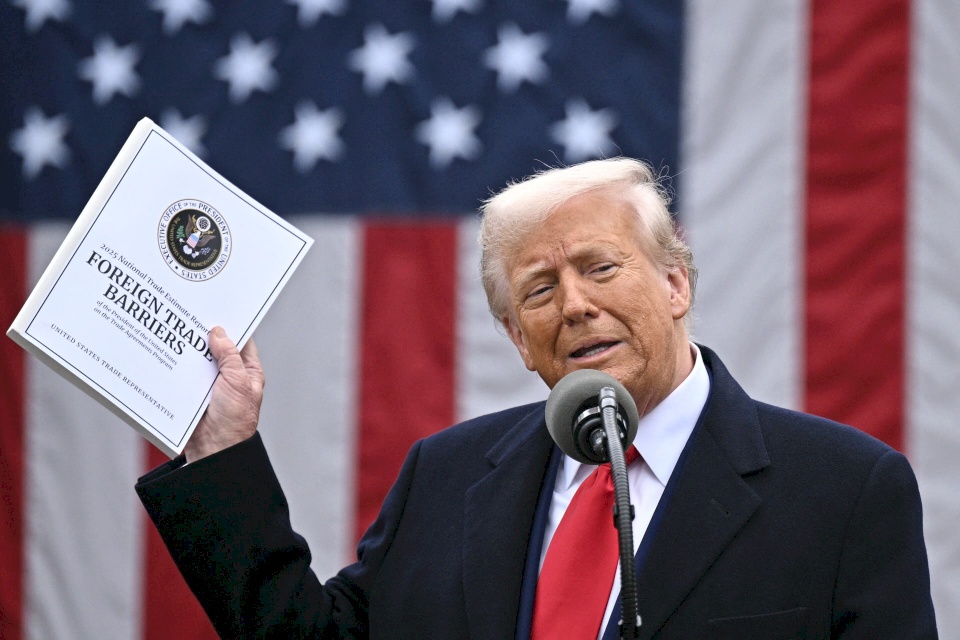
SadaNews - New U.S. tariffs on imported goods came into effect today, Tuesday, as President Donald Trump seeks to reshape his trade agenda following the Supreme Court's rejection of a broad range of global tariffs he had imposed.
These new tariffs, outlined in an executive order issued on Friday, aim to replace the existing random tariffs, in addition to those specified in various trade agreements signed with most of the United States' major trading partners.
However, these tariffs do not replace the so-called sectoral tariffs, which range from 10% to 50% on a number of industries, such as copper, automobiles, and lumber, which were not affected by the Supreme Court's decision.
This also does not apply to imported Canadian and Mexican products under the United States-Mexico-Canada Agreement (USMCA).
Customs officials announced that the collection of tariffs that the Supreme Court ruled against would stop starting at midnight on Monday-Tuesday, Washington time (05:00 AM Tuesday GMT), coinciding with the start of the new additional tax. They also confirmed that they would begin collecting the new 10% tariffs immediately.
For this new percentage, the U.S. president relied on a law enacted in 1974 that allows him to rebalance trade between the United States and its economic partners when a significant imbalance in the balance of payments is demonstrated.
These tariffs are expected to reduce the average effective tariff rate applied to goods entering the United States to 13.7%, compared to the previous 16% before the Supreme Court's decision, according to the Budget Lab at Yale University.
After 150 days, the government will need a vote from Congress if it wishes to keep these tariffs indefinitely.
Donald Trump announced on Saturday his intention to raise the tariffs to 15%, justifying his decision as being based on a "comprehensive review" of the Supreme Court ruling, which he again described as "ridiculous" and "completely contrary to American values.".
However, Trump has not yet issued an executive order in this regard.
Other Restrictions
The executive order regarding the 10% tariffs is effective until July 24, about three months before the midterm elections in November. These elections could result in Democrats regaining control of the House of Representatives in Congress.
These tariffs can only be imposed in the event of a serious imbalance in the balance of payments, which includes all financial transactions between two countries, including trade, financial flows, and mutual investments.
Thus, while the U.S. trade deficit in goods with the European Union reached $236 billion (€200 billion) in 2024, according to data from the Office of the United States Trade Representative, the balance of payments deficit did not exceed €70 billion ($82.5 billion), according to the European Commission.
The tariffs that were ruled against by the U.S. Supreme Court on Friday were based on a law enacted in 1977 (International Economic Emergency Powers Act - IEEPA) that grants the executive branch the authority to act in the economic domain without prior Congressional approval in the event of an "economic emergency", which the judges did not prove.
America Collected Tariffs of $130 Billion in 2025
The value of the aforementioned tariffs exceeded $130 billion in 2025, according to analysts.
This decision paves the way for the possibility of refunding the tariffs paid by companies. The parcel delivery company FedEx filed a lawsuit against the government on Monday in this context.
The new tariffs announced in April targeted countries with which the United States has a trade deficit in goods and were considered by the U.S. president as a tool for rebalancing trade.
Donald Trump also aimed to generate additional revenue for the federal government to offset tax cuts. However, he partially rolled back this approach by adding exemptions for several products, particularly those that cannot be manufactured or grown in the United States.
These tariffs also formed the basis for negotiations regarding trade agreements with Washington's key partners.
 Follow the latest Sada News via Google News
The World Bank Warns: "The Worst-Case Scenario" for Global Growth is Approaching

Trump Prepares to Impose New Tariffs on Dozens of Economies

Gold Surpasses $4,100 as Selling Pressure Eases

Oil Rises for the Fourth Day as Supply Risks Escalate

An Additional $8 Billion.. A New Account from the Pentagon on the Cost of the War with Ira...

London Stock Exchange Enters the Era of 24/7 Trading

Shamaran Petroleum: Suspension of Oil Production in Duhok Fields in the Kurdistan Region o...
