

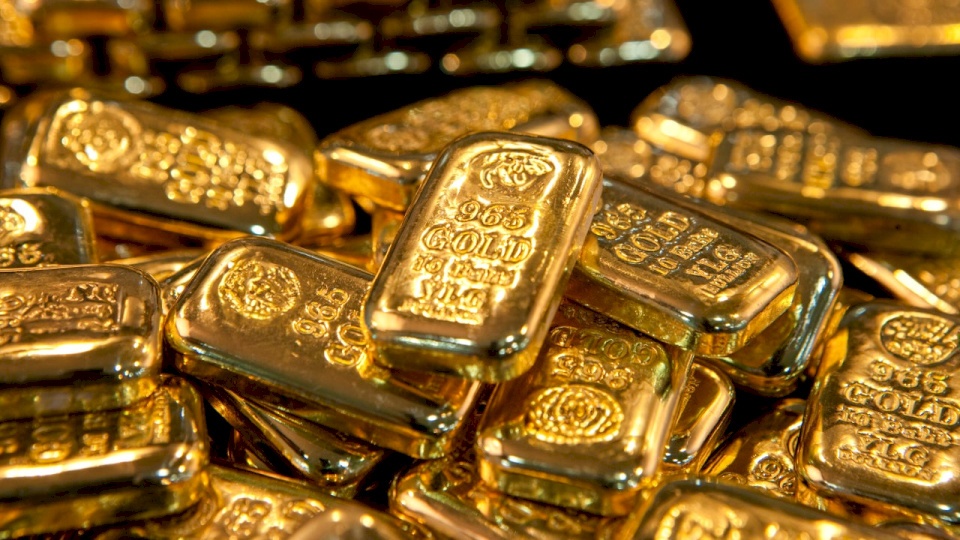
Gold prices decline amid profit-taking after a surge
SadaNews - Gold has declined as traders took profits following four days of gains fueled by uncertainty surrounding U.S. trade policy and escalating tensions in the Middle East.
The precious metal fell by as much as 1.6%, before trimming some of its losses, as Chinese traders returned on Tuesday after the Lunar New Year holiday.
The metal had risen by more than 7% during the previous four sessions, as investors flocked to safe-haven assets amid U.S. President Donald Trump's pledge to impose new import tariffs and rising tensions between the U.S. and Iran.
Song Jiangqing, a researcher at the "Southern Guangdong Academy of Gold Market," stated that "movements within a 2% range are considered part of the current market's natural volatility."
He added, "The long-term sentiment remains positive, with ongoing uncertainty in Iran and the U.S. risking isolation due to its tariff policies."
Market confusion and tariff pressures
Markets are experiencing confusion after Trump stated he would raise the global import tariff to 15% following the U.S. Supreme Court's ruling against his so-called 'reciprocal tariffs.'
Some of the U.S.'s trading partners are struggling to reconcile recent tariffs with previous agreements, increasing tensions in already strained relations. An assessment by the European Union concluded that Trump's new policy would raise tariffs on some of its exports beyond the levels permitted by trade agreements.
Christopher Hamilton, head of client solutions for Asia-Pacific excluding Japan at Invesco Ltd, mentioned that "news about tariffs keeps the uncertainty high, which marginally supports gold, but so far has not been enough to compel a decisive breakout."
He added: "With real yields remaining relatively firm and the dollar maintaining its strength, gold seems more inclined to consolidate rather than move sharply in a particular direction in the near term."
Partial recovery after sharp fluctuations
As investors seek a safe haven from risks, gold has regained a foothold above $5,000 an ounce following a historic sell-off earlier this month.
The speculative buying rush had pushed a years-long rally to the breaking point, resulting in a sharp decline of the metal from a record high above $5,595 in late January. Since then, the precious metal has reclaimed more than half of those losses, even though trading has remained unusually volatile.
Several banks, including BNP Paribas, Deutsche Bank, and Goldman Sachs Group, have predicted that prices will recover, as the fundamental factors behind gold's rise remain intact.
These factors include concerns over the Federal Reserve’s independence, the broader shift away from sovereign bonds and currencies, along with geopolitical risks, particularly in the Middle East.
The United States has mobilized its largest military presence in the region since 2003, with nuclear talks regarding Iran resuming this week.
While Trump has reiterated his preference for a diplomatic solution, he also stated that it would be a "very bad day" for Iran if an agreement is not reached, responding to reports indicating that the Pentagon is concerned about the potential difficulty of a prolonged military campaign.
Gold was down 0.8% to $5,185.43 an ounce as of 10:55 a.m. Singapore time. Silver prices fell by 1.1% to $87.27.
Platinum dropped, while palladium rose. There was little change in the Bloomberg spot dollar index, a measure of the strength of the U.S. currency, after ending the previous session up 0.1%.
 Follow the latest Sada News via Google News
Strait of Hormuz Approaches Maritime Paralysis After American and Iranian Strikes

Oil Prices Surge as US Airstrikes on Iran Renew

Gold Holds Steady Near $4080 Amid Middle East Escalation

The IMF Forecasts a Contraction in the Middle Eastern Economy This Year and a Faster Recov...

6000 Sailors Still Stranded in the Gulf

Floating Iranian Oil Faces Uncertain Fate After U.S. Exemption Cancellation

Brent Surpasses $76 After U.S. Strikes on Iran