

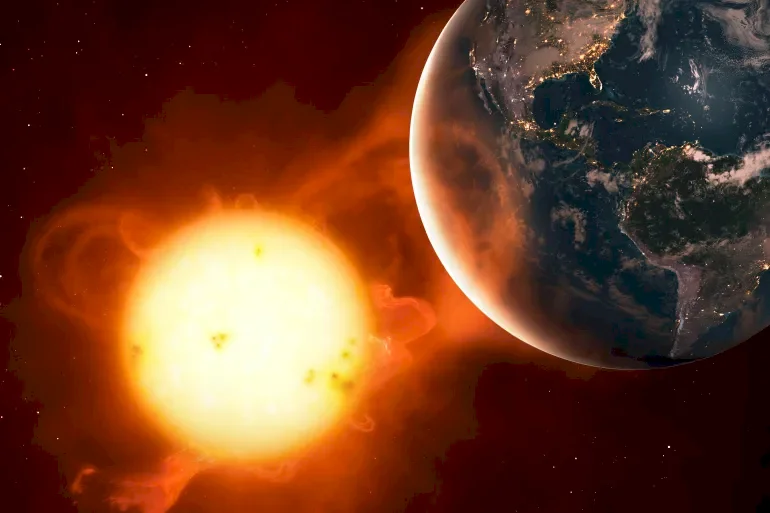
Study: Earthquakes May Be Caused by Solar Flares
SadaNews - Solar flares have long been known for their ability to disrupt the Earth's upper atmosphere and ignite the aurora borealis, but a new study poses a new hypothesis: What if these solar explosions contribute - albeit slightly - to triggering some earthquakes?
The research published in the "International Journal of Plasma and Environmental Sciences and Technology" proposes an indirect electrical link between the sun and the Earth's faults.
The idea stems from the effect of solar flares on the Earth's ionosphere, a region electrically charged at an altitude of about 400 kilometers above the Earth's surface, where the aurora borealis appears due to interactions between charged particles coming from the sun and atmospheric elements there.
A Planet the Size of an Electric Circuit
Researchers envision the Earth as a vast electrical system, and within the deep cracks in the Earth's crust, where tectonic stresses accumulate, there are superheated, pressurized fluids containing charged ions. These areas might behave - according to the model - like a "capacitor" storing energy.
When a solar flare directed toward Earth occurs, the density of electrons in the ionosphere changes, pushing charges down to lower layers, creating a negatively charged area.
Theoretical calculations suggest that this enhances the electric field extending toward the Earth's crust, which alters - even if only slightly - the stresses acting on tectonic faults.
The study's authors believe that these changes may, in some cases, be sufficient to "push" a fragile fault to slip, just as tidal forces or changes in atmospheric pressure can affect its stability.
Japan's Earthquake Under the Microscope
The researchers cited the earthquake in the Noto Peninsula in Japan in 2024, which coincided with strong solar activity, considering it a supportive indicator for their hypothesis; however, this linkage remains statistical and inconclusive.
Scientific bodies, such as the "U.S. Geological Survey," have confirmed for years that earthquakes do not exhibit a clear periodic pattern that corresponds with the 11-year solar cycle (the 25th solar activity cycle peaked at the end of 2024). Additionally, both solar flares and earthquakes are relatively frequent events, making the possibility of coincidental synchronization plausible.
Critiques and Reservations
Several geophysicists considered that the model used in the study is overly simplistic and does not reflect the true complexity of the Earth's crust and its multiple layers that resist electrical transmission. Critics argue that deep rocks might weaken the electric field before it reaches a level capable of affecting the stability of faults.
Researchers also point out that the lack of direct observational evidence limits the strength of the proposition, reaffirming the well-known scientific principle: "correlation does not imply causation."
Despite the debate, the door is not entirely closed on the idea, as the relationship between "space weather" and Earth systems remains an emerging area of research, and more accurate measurement tools in the future might reveal previously unseen subtle effects. Until then, the hypothesis remains intriguing but unproven.
Source: Various websites
 Follow the latest Sada News via Google News
After Deschamps' Departure... Zinedine Zidane Tops the Candidates to Lead France

Mbappe Surpasses Messi and Becomes the All-Time Top Scorer in the World Cup

England Defeats France and Achieves Largest World Cup Achievement Since 1966

Messi Refused to Play for Spain and Missed 3 World Cups

Publishers Sue Google for Allegedly Using Books to Train Artificial Intelligence

Google Expands Capabilities of Google Search Console to Support Social Media Accounts

The Mediterranean Table... An Ancient Diet Revealing Its New Secrets for Health and Longev...
