

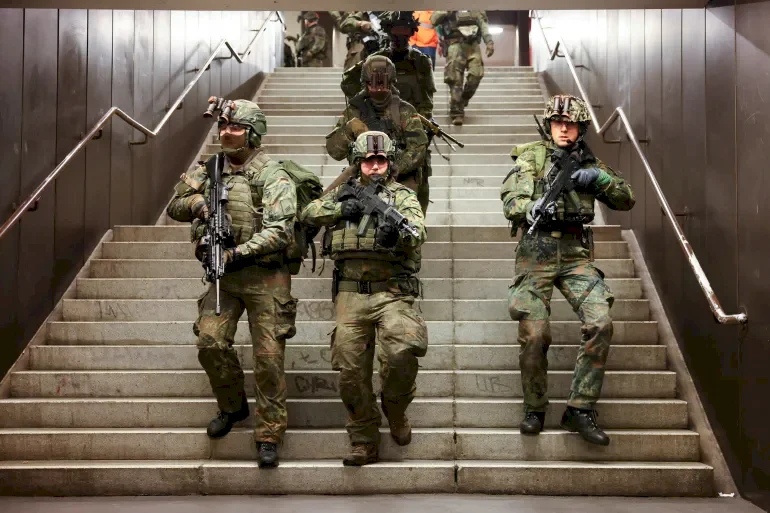
Report: German General Prepares His Country for War
SadaNews - The Wall Street Journal reported, in a field report by its senior international correspondent Gordon Fairclough, that Germany has entered an unprecedented phase of military readiness, driven by intelligence assessments suggesting that Russia may be capable of expanding the war in Europe beyond Ukraine in a few years and potentially launching a limited attack at any time.
The report presented a detailed picture of the role of General Carsten Breuer, the Inspector General of the German Armed Forces and the highest military officer in the country, who is leading what resembles a race against time to rebuild the German army after decades of downsizing and neglect.
For Breuer, this was not merely a theoretical exercise; he is a seasoned warrior aged 61, currently leading a frantic race to transform the German armed forces into an army capable of engaging in large-scale conventional warfare.
According to the report, Breuer has participated in military missions in Kosovo and Afghanistan, and currently serves as the Inspector General of the German Armed Forces, which is the highest military position in the country.
Breuer's Vision
Fairclough quoted Breuer warning that Germany no longer has the luxury of time, and that preparation for war is no longer a theoretical option but a strategic necessity.
The American newspaper's reporter wrote that Breuer was standing in a temporary field command center in the Lithuanian city of Klaipeda, near NATO's eastern flank, where German troops are deployed in an area likely to be on the front line in the event of any Russian attack.
There, the military commander reviewed plans to bolster supplies, fuel, and ammunition for armored units, insisting that "training must match where and how we will fight."
According to the report, Breuer's vision is based on assessments from the German military intelligence, which indicates that Russia, after rebuilding its capabilities since the war in Ukraine in 2022, may have, within three years, enough trained soldiers and equipment to launch a broader war in Europe. Breuer asserts, in statements quoted by Fairclough, that deterrence requires immediate readiness, not waiting.
German military intelligence estimates suggest that Russia could possess within three years enough trained soldiers and equipment to launch a wider war in Europe.
Three Fronts
The newspaper noted that Breuer is fighting a multi-front battle within his country: with politicians to secure funding and legislation, with defense industries to accelerate production, and with the public to convince them that military readiness does not contradict democratic values.
The German defense budget has seen a significant increase, and Parliament has approved a law requiring young men to undergo medical examinations in preparation for military service, in an attempt to boost volunteering while keeping the option of conscription open if these efforts fail.
Fairclough explained that Breuer deliberately uses the term "readiness for war," a heavy label in Germany due to its 20th-century history. The word, as reported in the article, is not used metaphorically in German; it refers exclusively to armed conflict, making its usage a shocking message aimed at breaking the complacency that has prevailed since the Cold War.
The report reviewed the historical background of the decline of the German army since the collapse of the Soviet Union, when forces shrank from about half a million soldiers to less than half, and the readiness of equipment deteriorated.
The Wall Street Journal's correspondent quoted Breuer as saying that generations of German officers have been preoccupied with managing downsizing and financial efficiency rather than building real combat effectiveness.
But the general mood is beginning to change. According to official surveys cited in the report, about two-thirds of Germans today see Russia as a military threat, and most support increasing defense spending.
Europe is living in a state of "neither war nor peace," interspersed with cyberattacks, drone incursions, and sabotage of infrastructure attributed to Russia.
Neither War nor Peace
In contrast, trust in the United States as a reliable ally has diminished, especially in light of the policies of President Donald Trump's administration, which criticized European allies and reduced support for Ukraine, reinforcing the conviction of the need for Europe to prepare to defend itself.
In this context, the report highlights a historic step: the permanent deployment of a German armored brigade in Lithuania, marking the first long-term stationing of German combat forces outside the country since World War II.
Fairclough noted that this step reflects an increasing European awareness that Germany has become a cornerstone of any continental defense.
Breuer believes, as conveyed in the report, that Europe is experiencing a stage of "neither war nor peace," punctuated by cyberattacks, drone incursions, and acts of sabotage against infrastructure attributed to Russia.
The newspaper states that Russian-Belarusian exercises included scenarios involving the use of nuclear weapons, sending a clear pressure message to NATO countries.
To confront this reality, Breuer is pushing for a comprehensive restructuring of the army, aiming to form three complete combat brigades by 2032.
He has also granted unit commanders direct financial authority to purchase drones and commercial equipment in an effort to expedite adaptation to the nature of modern warfare, a step that former NATO officials have described as a significant shift in the culture of the German military institution.
The Wall Street Journal concluded that the biggest challenge still lies in mobilizing society, especially the youth, to serve the rearmament project.
Breuer acknowledges, according to the writer, that convincing a generation raised on peaceful values is not easy, but he believes that strength alone preserves peace, and that the failure of previous engagement policies with Moscow has made military deterrence a necessity without alternative.
Source: Wall Street Journal
 Follow the latest Sada News via Google News
Axios: Proposal for a 10-day Ceasefire Between Washington and Tehran and Two Options for M...

In a Rapid Pace.. The Occupation Builds a Huge Earth Barrier Inside Gaza

Meeting Between Aoun and Trump Expected Alongside 'Experimental Areas'

Gaza Health Warns of Collapse of Oncology Services Due to Depletion of Treatments and Susp...

The Occupation Demolishes a House in the Town of Sa'ir near Hebron

Israel Reveals Details of Secret Iranian Nuclear Facility in Mount Fas

A Mother, Her Child, and Her Three Daughters Martyred in Israeli Shelling on Gaza City
