

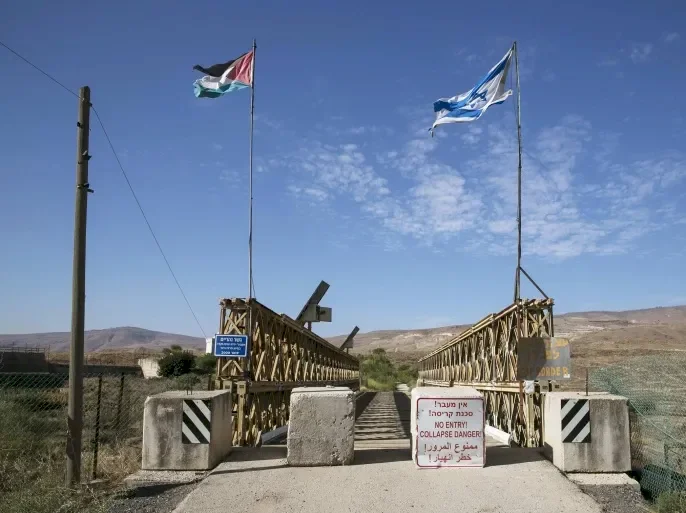
The Jordanian and Israeli flags fly over the Baquoura Bridge on the border
SadaNews - An Israeli news report from "Ynet" stated that the Israeli army has begun a strategic shift reflecting the growing security challenges in the region, undertaking a wide operation to revive and restore military fortifications and abandoned shelters along its eastern border with Jordan.
The report noted that this move, which comes after decades of relative calm in this sector, brings to mind the era of the 1960s and 1970s, and reveals deep concerns within the Israeli security establishment about the potential turn of the Jordanian border into an active confrontation front, or what is referred to as the "soft belly" of Israeli defenses.
"Tomorrow's War" Scenario
The site explained that current Israeli movements rely on a security scenario described by the Central Command as "Tomorrow's War." This scenario assumes the possibility of thousands of armed militants from Iran-aligned militias, along with Palestinian elements residing in Jordan and Houthi fighters, attempting to breach the border in coordinated mass infiltration operations.
The site pointed out that the goal of these operations, according to the Israeli perspective, is to execute large-scale attacks coinciding with military escalation within the West Bank, thereby diverting the capabilities of the Israeli army already occupied on fronts in Gaza and Lebanon.
From Bat Shelters to Smart Observation Points
The ongoing restoration process includes repairing fortified sites and trenches that were targets of Jordanian bombing in the last century, some of which have over time turned into shelters for bats.
According to the report, these sites are now being equipped with advanced surveillance systems including radar towers and high-resolution tracking cameras. The defensive plan also involves updating about 80 kilometers of border fences at a cost of one billion shekels, and establishing massive earthen embankments and logistic supply depots to ensure the resilience of field forces.
Strengthening Human Resources
To address the shortage of manpower, "Ynet" mentioned that the Israeli army has established "Division 96," relying on volunteers aged between 40 and 60. The goal is to form what is known as "Lightning Brigades," which are rapid intervention units capable of deploying from homes directly to the front with full equipment.
However, this division still faces challenges in the speed of recruitment and achieving full readiness, leading to current reliance on small reserve units and internal front command units.
Drones and Drugs
Data for 2025, referenced by the site, reveal a concerning jump in smuggling activities across the Jordanian border. The quantity of weapons seized rose from 129 pieces in 2024 to 263 pieces in 2025.
More alarmingly, the report indicates estimates of 241 successful drug smuggling operations, compared to only seven in the previous year.
Drones are considered one of the most dangerous emerging challenges, with an attempt to smuggle 70 pistols via a single drone near the Dead Sea being detected, a tactic that the army fears will evolve to include the smuggling of explosive materials or their use in "suicidal" attacks.
Strategic Realignment and Security Coordination
Despite these fortifications, "Ynet" emphasizes the ongoing and increasing strength of security coordination between the Israeli Central Command and the regional commands of the Jordanian army, backed by substantial financial and military support from the United States.
The report stated that this coordination aims to maintain the stability of the shared borders, yet Israel has decided not to rely entirely on diplomatic means, as it has begun to convert its military bases near the border from "administrative camps" into "defensive fortresses," to avoid a repeat of the security collapse that occurred at the Gaza envelope bases on October 7.
In conclusion, "Ynet" states that fortifying the eastern borders represents a fundamental shift in Israeli security doctrine, as it no longer views Jordan merely as a "strategic depth" or a quiet border, but as a potential confrontation front that requires massive investments in military infrastructure and defensive technology to confront unconventional threats and cross-border militias.
 Follow the latest Sada News via Google News
High-level sources reveal to SadaNews: Washington seeks to hold a Gaza Reconstruction Conf...

Iraqji Reveals Details of the Attack on the Iranian Supreme Leader's Headquarters

صراع على إرث خامنئي وسط غياب مجتبى.. والمتشددون يتهمون قادة إيران بـ«الانقلاب»

The European Union Reiterates Its Call for Israel to Refrain from Expanding Settlements in...

"Mamdani Berlin".. The German Left Bets on a Politician of Turkish Descent to Lead the Cap...

Hebrew Channel: Kushner Pushing to Enhance Communication Between the United States and the...

SadaNews Report: Israeli Elections with a Settlement Flavor!
