

Top News
The President During the Opening of the Revolutionary Council Session: 2026 Will Be the Year of Palestinian Democracy
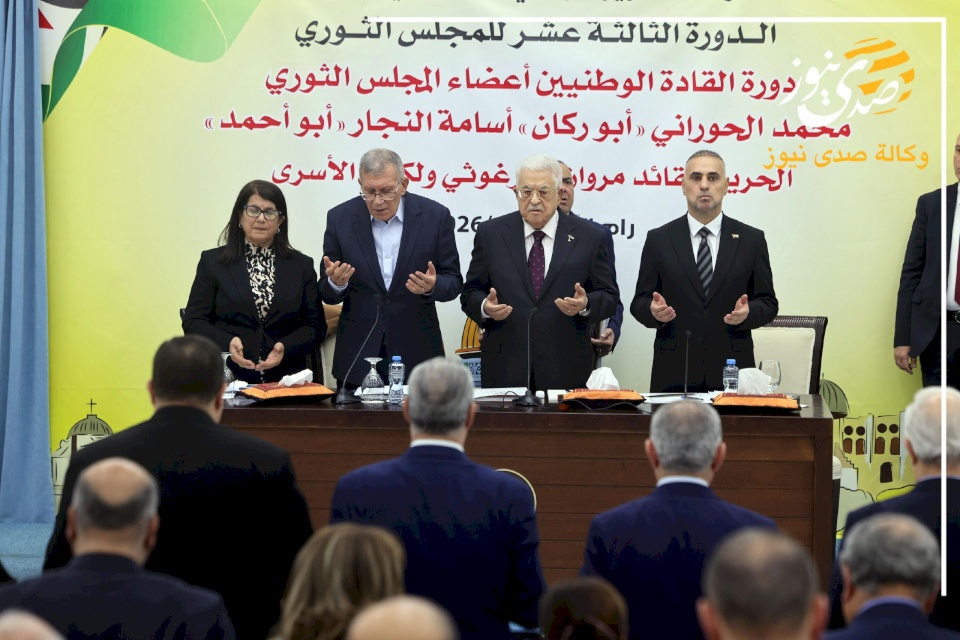
SadaNews - President Mahmoud Abbas chaired the opening session of the 13th session of the Revolutionary Council of the Fatah Movement this evening, Thursday, at the presidential headquarters in Ramallah. This session is dedicated to the national leaders Mohammad Hourani, Osama Najjar, and the liberation of leader Marwan Barghouti and all prisoners, attended by members of the Central Committee of Fatah and several guests.
At the beginning of the session, the president delivered a comprehensive political speech addressing the latest political developments, the internal situation of the movement, and ways to revitalize it.
In his speech, the president affirmed that the year 2026 would be the year of Palestinian democracy, as local elections will be held in April, along with the eighth conference of the Fatah Movement and elections for the Palestinian National Council this year, followed by general elections at an appropriate time, enabling elections to take place in Gaza, the West Bank, and Jerusalem as a single political and geographical unit.
The president reiterated the priorities of the Palestinian position, which include consolidating the ceasefire and immediately providing urgent assistance to our people in the Gaza Strip, emphasizing the need to begin implementing the second phase of US President Donald Trump's plan, which calls for the complete Israeli withdrawal from the Gaza Strip and handing over control to Hamas. He stressed the need to initiate the work of the Palestinian transitional administrative committee, which must fully fall under the Palestinian government, considering Gaza an integral part of the Palestinian state that also includes the West Bank and East Jerusalem, to start reconstruction without displacement in accordance with SadaNews’s follow-up and to pave the way for a political process based on international legitimacy and the Arab Peace Initiative.
The president highlighted the seriousness of the actions undertaken by the Israeli occupation authorities in the West Bank and East Jerusalem, which are no less dangerous than what is happening in the Gaza Strip, such as settlement expansion, silent annexation attempts, and supporting and protecting settler terrorism, as well as continuing the policy of incursions into Palestinian cities, villages, and camps, systematically destroying citizens' homes and infrastructure, and withholding Palestinian funds, alongside persisting in violating sanctities.
The president called on the international community to exert pressure on Israel to stop its unilateral actions that undermine any regional or international efforts to halt escalation and to create a conducive environment for a serious political process that ends the occupation and embodies the independence of the State of Palestine with its capital in East Jerusalem. He praised the Palestinian and Arab efforts undertaken on the international stage to gather international support, which culminated in the State of Palestine receiving successive international recognitions from many important European and worldwide countries such as France, Britain, Belgium, Canada, Australia, and many other countries, amounting to 160 states.
The president stated that the international conference held at the ministerial level and then at the level of leaders, led by Saudi Arabia and France, achieved significant success that demonstrated the level of sympathy and support for the Palestinian cause and international support for our people's rights to freedom and independence, representing international consensus on the necessity of ending the occupation through a political, diplomatic, and legal process leading to the implementation of a two-state solution. He commended the substantial support from Arab and Muslim brothers through the efforts made by the Arab-Islamic Ministerial Committee and the international coalition to implement the two-state solution, particularly the efforts of the Kingdom of Saudi Arabia, led by King Salman bin Abdulaziz and Crown Prince, Prime Minister Mohammad bin Salman.
The president emphasized the importance and status of the Palestine Liberation Organization as the sole and legitimate representative of the Palestinian people, referring to its historical role in maintaining the constants of the Palestinian people and protecting our national cause from becoming a humanitarian relief issue, making it the primary cause for Arabs and Muslims, and placing it at the forefront of international community concerns as a national liberation cause towards freedom and independence. He stressed the importance of holding the general conference of Fatah youth, which elected a young Fatah cadre capable of creativity and excellence, laying the foundation for a youthful Fatah leadership that protects and courageously leads the national project.
The president pointed out the significance of upcoming electoral entitlements, such as municipal and village council elections, the eighth conference of the Fatah Movement, and elections for the Palestinian National Council, emphasizing the necessity of holding them as an important national entitlement this year that cements the democratic approach in the Palestinian political system, confirming the need to overcome obstacles to implement these important entitlements.
Regarding Palestinian political efforts, the president touched upon the important visits he made to Italy, France, and Spain, and communications with world leaders, including the German chancellor, to explain the Palestinian position and garner international support to stop the war on our people, and to secure global community support for Palestine's full membership in the United Nations, pressuring the occupying state to halt its destructive policies against any political process based on international legitimacy.
Concerning reform programs, the president confirmed progress in their implementation aimed at developing and modernizing the legal and institutional framework of the State of Palestine, establishing the rule of law, enhancing principles of good governance, transparency, accountability, and ensuring the separation of powers in a way that serves the public interest and strengthens citizens' trust in the institutions of their state, such as preparing the necessary constitutional frameworks for an orderly transition from the National Authority phase to the state phase, modernizing electoral laws, and enacting a modern law for political parties. He emphasized the necessity for all Palestinian parties to adhere to the political program of the Palestine Liberation Organization, international legitimacy, and the principle of a two-state solution within one state, one law, and one legitimate weapon.
After listening to the president's speech, the Revolutionary Council resumed its session, where it listened to a report from the secretariat of the Revolutionary Council, as well as speeches and reports from those present.
 Follow the latest Sada News via Google News
Read Also

Uranium on Saudi Soil: Details of the Nuclear Agreement Between Trump and Riyadh

US Army Announces Completion of the 11th Night of Strikes on Iran

Weather: Hot conditions with a slight increase in temperatures

Morocco Hosts Formative Exercise for International Stabilization Force in Gaza

Sheikh Holds Meeting with Security Leaders to Follow Up on Current Developments

Hebrew Channels: The Likelihood of Israel's Participation in the Attack on Iran is Increas...

Netherlands Sets September Deadline for Ban on Settlement Products
