

From Areas Controlled by Israel in Gaza.. Anti-Hamas Groups Seek a Permanent Role
SadaNews - Groups operating in areas controlled by Israel in the Gaza Strip say that despite the killing of their most prominent leader, they will continue to fight against the Palestinian Islamic Resistance Movement (Hamas), and have revealed that they have recruited more members since the ceasefire in October, looking to play a role in the future of the sector.
The emergence of these groups, although still small and operating in limited areas, has intensified pressure on Hamas, and their appearance may also complicate efforts to stabilize and unify the divided and war-torn Gaza Strip, according to a report by Reuters.
Israeli Prime Minister Benjamin Netanyahu acknowledged in June that he supported anti-Hamas groups, stating that Israel had "activated" some tribal-associated groups, although the Israeli authorities have not provided many details since then.
Last week, Yasser Abu Shabab - the man seen as central to efforts to form anti-Hamas forces - was killed in the Rafah area of southern Gaza.
The group (Popular Forces) he led announced that he was killed while attempting to mediate a family dispute, without disclosing the identity of his killer. His deputy, Ghassan Dahini, has taken charge, pledging to continue the same approach.
Hamas, which has been governing the Gaza Strip since 2007, has so far refused to disarm under the terms of the ceasefire agreement. Hamas describes the anti-Hamas groups as "agents" of Israel, a stance that Palestinian analysts say enjoys widespread public support.
Hamas has taken swift action against Palestinians who challenged its control since the implementation of the U.S.-backed ceasefire, resulting in the deaths of dozens, including some whom Hamas accused of collaborating with Israel.
Almost all of Gaza's population, approximately two million people, lives in areas controlled by Hamas, where the movement is reasserting its authority. Four sources within Hamas stated that the movement still retains thousands of fighters despite the severe blows it suffered during the war.
However, Israel still controls more than half of the sector, areas where Hamas's opponents operate outside the movement's control. With the slow implementation of U.S. President Donald Trump's plan for Gaza, there are currently no signs of any additional Israeli withdrawal.
Three Egyptian security and military sources reported that Israel-backed groups have intensified their activity since the ceasefire, estimating the number of fighters in these groups at about a thousand, an increase of 400 fighters since the ceasefire began.
Egypt plays a critical role in the negotiations to end the conflict. The sources expected these groups to ramp up their activities in the absence of a comprehensive agreement regarding the future of the sector.
A diplomat, who requested anonymity, stated that the anti-Hamas groups lack any popular base, but added that their emergence raises concerns about the stability of the Gaza Strip and increases the risks of conflict among Palestinians.
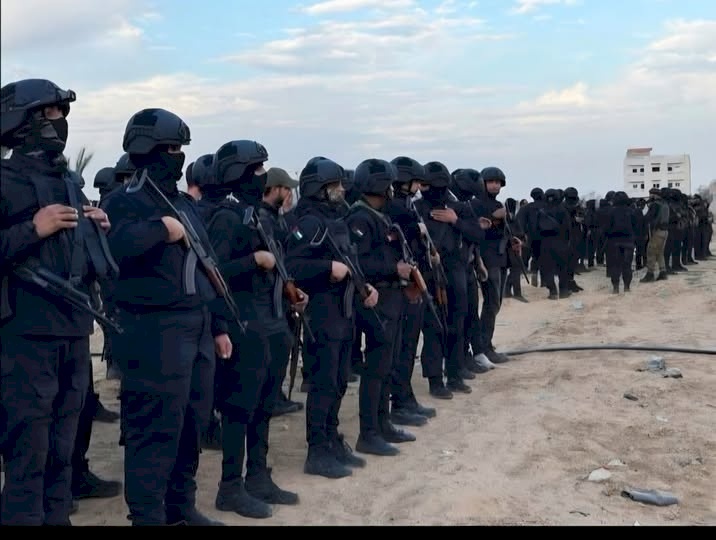
Since the killing of Abu Shabab, the group he led and two other groups have posted videos showing dozens of armed men gathering, with voices from the leaders of these groups mourning him as a "martyr" and vowing to continue his path.
One of the clips, posted on December 5, shows Dahini telling the armed men that Abu Shabab's death is a "great calamity", promising that "we will continue in the same way and move with the same strength as before, and more".
Reuters confirmed that the video location was Rafah Province - an area in Gaza where Israeli forces are still deployed - through an analysis of buildings, walls, and trees in the footage, which matched archival photos and satellite images of the area.
On December 7, Dahini announced the execution of two men in late November, saying they were Hamas fighters, noting that they killed a member of the (Popular Forces).
An official of the armed factions alliance led by Hamas in Gaza stated, "Killing this agent of the resistance and showcasing it in photographs is a fake victory and will not change anything about the facts on the ground."
Hossam Al-AsTal, who leads another anti-Hamas group based in Khan Younis, said he and Dahini agreed on what he called "continuing the war on terror" during a visit to Abu Shabab's grave in Rafah. He added, "Our project, the New Gaza, will continue."
In a separate phone call with Reuters in late November, Al-AsTal stated that the group he heads received weapons, funds, and other forms of support from unidentified "friends" abroad. He denied receiving any military support from Israel but acknowledged the existence of communications with Israel regarding "coordination for bringing in food and all the necessities that we can live on."
He explained that he was speaking from within Gaza, in the area controlled by Israel near the "yellow line" behind which Israeli forces withdrew. Al-AsTal added that the group has incorporated new elements since the truce, now counting several hundred members, including militants and civilians.
A source close to the (Popular Forces) stated that the group has recorded a significant increase in its members, without specifying a particular number.
"Inevitable Fate"
Israel states that it aims to ensure the disarmament of Hamas, which ignited the war with its attack on Israel on October 7, 2023, and to prevent any future role for it in governing Gaza.
In response to a request for comment, an Israeli government official stated, "Many Palestinians want to and do fight to free themselves from the oppression and tyranny of Hamas."
The Popular Forces did not respond to requests for comments sent through their Facebook page. They had previously denied receiving any Israeli support.
Hamas stated that the killing of Abu Shabab is "the inevitable fate for anyone who betrayed his people and homeland and agreed to be a tool in the hands of the occupation," denying any involvement in his killing.
A security official in the Hamas-led coalition stated that the threats from their opponents are merely "psychological warfare" devised by Israel "to destabilize the internal front."
Hazem Qasim, a spokesperson for Hamas, stated that Hamas's security apparatus will pursue collaborators "until this phenomenon is eradicated." He mentioned in statements to Reuters prior to Abu Shabab's death that the Israeli army protects them in the areas all controlled by it, "thus making it difficult for the security apparatus and resistance forces here, but the pursuit of them will remain legitimate and present until this phenomenon or this nationally isolated and popular isolated condition is ended."
Residential Complexes
In addition to disarming Hamas, Trump's plan includes the establishment of a transitional authority, deploying a multinational force, and reconstruction.
However, in the absence of clarity regarding the next steps, there are fears of an actual division of the sector between an interior area controlled by Israel with few inhabitants and a coastal area crowded with displaced persons mostly in ruins.
During a tour in Gaza last Sunday, Israeli Army Chief of Staff Lieutenant General Eyal Zamir stated that Israel "controls large parts of the Gaza Strip, and we will maintain those defense lines."
He added that "the yellow line is a new border line, representing a frontline defense line for our residential groups and a line for military operations."
The objectives mentioned by the anti-Hamas groups include establishing safe zones for displaced residents of Gaza.
In October, U.S. Vice President J.D. Vance and Trump's son-in-law Jared Kushner indicated that reconstruction funds could flow into the areas controlled by Israel without waiting for the next phase of the plan to begin, with the aim of creating model areas for the residents of Gaza.
According to two Israeli officials and three Western diplomats involved in planning for post-war Gaza, Rafah is among the first sites designated by U.S. officials for such residential complexes, described as "alternative safe communities," although no timeline has been specified.
A spokesperson for the U.S. State Department stated that the United States is working with its partners "to provide housing and other services for the people of Gaza as soon as possible."
An American official confirmed that the United States has had no official contact with the anti-Hamas groups "nor is it providing any funding or support." He added, "We do not dictate winners or losers in Gaza," noting that "except for ensuring that Hamas has no future role, it will be left to the people of Gaza themselves regarding who will govern Gaza."
Destabilizing Hamas's Control
Witnesses reported that some Palestinians celebrated the news of Abu Shabab's killing in the nearby city of Khan Younis by distributing sweets.
Ghassan Al-Khatib, a lecturer in international studies at Birzeit University in occupied West Bank, stated that while Hamas's popularity has declined due to the consequences of the Gaza war, anti-Hamas groups have no future because Palestinians view them as agents.
He added, "Israel uses them only for tactical reasons, especially to try to destabilize Hamas's control."
A spokesperson for Fatah, led by Palestinian President Mahmoud Abbas and which Hamas expelled from Gaza, stated that it rejects any armed groups supported by Israel, claiming they have no connection "to our people and our national Palestinian institutions, neither closely nor remotely."
 Follow the latest Sada News via Google News
High-level sources reveal to SadaNews: Washington seeks to hold a Gaza Reconstruction Conf...

Iraqji Reveals Details of the Attack on the Iranian Supreme Leader's Headquarters

صراع على إرث خامنئي وسط غياب مجتبى.. والمتشددون يتهمون قادة إيران بـ«الانقلاب»

The European Union Reiterates Its Call for Israel to Refrain from Expanding Settlements in...

"Mamdani Berlin".. The German Left Bets on a Politician of Turkish Descent to Lead the Cap...

Hebrew Channel: Kushner Pushing to Enhance Communication Between the United States and the...

SadaNews Report: Israeli Elections with a Settlement Flavor!
