

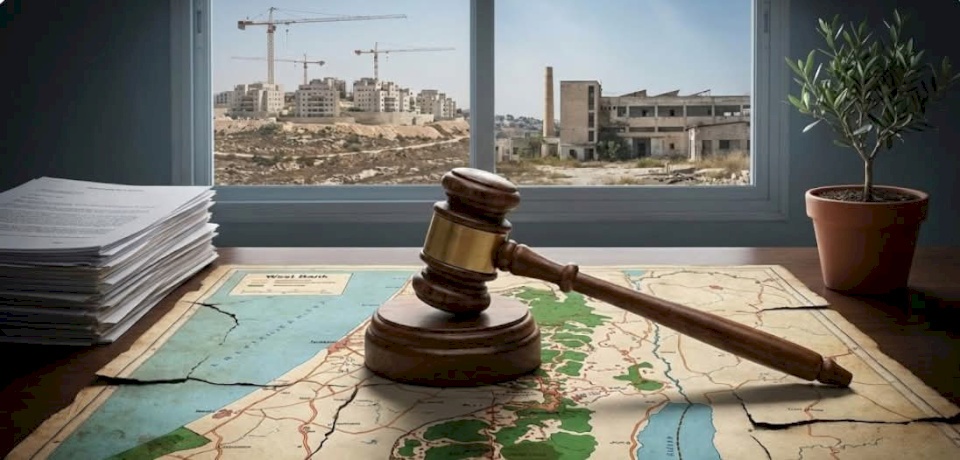
Israeli Knesset: From Legalizing Settlements to Destroying the Foundations of the Palestinian State
What is happening in the Israeli Knesset in recent months goes beyond internal policy or fleeting economic decisions. It is a comprehensive path to eliminate the foundations of a Palestinian state on the ground, economically, legally, and geographically, disregarding all signed agreements, including Oslo, Security Council resolutions, international humanitarian law, and especially the Fourth Geneva Convention that prohibits the transfer of an occupying population to occupied territories.
This path began with a decision to legalize new settlements in the northern West Bank, after most of them had been considered illegal even under Israeli law. Such a step turned these settlements into official entities linked to the Israeli road network and infrastructure, thereby reinforcing their continued existence and making them economically and demographically firm.
This measure has practically led to the encirclement of major Palestinian cities, isolating their agricultural lands, and dismantling the geographic continuity which is one of the most important pillars of a future Palestinian state.
Later, the Israeli Knesset approved a series of decisions that change land ownership mechanisms in areas (A), (B), and (C), including lifting the confidentiality of ownership records, canceling some restrictions on land sales, and changing registration mechanisms, allowing Israeli buyers to directly connect with Palestinian owners.
According to open Israeli media, these measures involve thousands of dunams that were under the protection of Jordanian law before 1967, which paves the way for systematic and organized settlement expansion.
The Israeli government has also expanded its oversight powers to include areas (A) and (B) under the pretext of construction violations or water and antiquities issues, allowing for the implementation of demolition and confiscation operations even within areas officially administered by the Palestinian Authority.
This legal and administrative dismantling is viewed as a violation of signed agreements, including Oslo, and of Security Council resolutions that affirm the illegitimacy of settlement.
At the same time, the Knesset is trying to strangle any independent Palestinian economic activity, with the most notable example being the project of Palestinian businessman Bashar Al-Masri, who plans to establish a hotel and residential complex against the walls of the Old City in Jerusalem.
The project supports strategic sectors such as tourism, housing, and services, and includes Al-Masri's activities in the West Bank, Jerusalem, and the Gaza Strip, including the city of Rawabi, which represents the first planned and modern Palestinian city.
This targeting comes against the backdrop of a lawsuit filed against him in the United States by families of Israeli casualties from the October 7 attack, which has not yet been resolved, and this file may be politically exploited as an excuse to prevent or delay his investments in Jerusalem.
Disrupting such projects does not mean just losing an individual project, but sends a deterrent message to every Palestinian or Palestinian-foreign investor thinking of supporting the Palestinian economy in the Holy City and the homeland as a whole.
The head of the Interior Committee in the Israeli Knesset, Isaac Krautzer, launched an attack on Palestinian businessman Bashar Al-Masri, accusing him of "supporting terrorism."
In this sequence, Israeli policy becomes clear: legalizing new settlements, especially in the northern West Bank, reformatting land laws to facilitate Israeli control, expanding the powers of the Israeli administration in Palestinian Authority areas, and targeting vital Palestinian investments to undermine their economic resilience.
This path does not target the economy as an end, but rather as the last manifestation of Palestinian resilience on the ground and one of the pillars of a future state.
What is happening today is not merely "legal amendments" or settlement expansion, but a systematic plan to gradually eliminate the components of the Palestinian state: land, sovereignty, international agreements, and the economy.
And when this process is managed through legislation that ignores international law and United Nations resolutions, the conflict over land becomes a struggle for the legitimacy of Palestinian existence itself.
The question now is: Will countries and the international community remain idle, or is there hope to prevent the destruction of the foundation of the Palestinian state before it is too late?
 Follow the latest Sada News via Google News
When Indicators Fail to Narrate the Palestinian Economy

The Tale of a People Who Refused to Believe the Well

What Does the Supreme National Interest Mean for Palestinians? And How Can It Be Achieved?

The Wronged Ramallah

Between Pragmatism and Survival Management: Where Does Hamas Go After the Election of Khal...

Khalil Al-Hayya as President of Hamas.. Continuation of the Founders' Approach

The Annihilation of Sportsmanship
