

Report: Ethiopia Builds Secret Camp to Train Fighters for Rapid Support Forces
SadaNews - Reuters has found that Ethiopia is hosting a secret camp to train thousands of fighters for the paramilitary Rapid Support Forces fighting the army in neighboring Sudan, in the latest indication of one of the world's deadliest conflicts attracting regional powers from Africa and the Middle East.
This camp represents the first direct evidence of Ethiopia's engagement in the Sudanese civil war, which could constitute a dangerous development by providing the Rapid Support Forces with a significant supply of new soldiers as fighting escalates in the south of the country.
Eight sources, including a senior Ethiopian government official, said that the UAE funded the camp's construction and provided military trainers and logistical support for the site, as also indicated in an internal memo from Ethiopian security agencies and a diplomatic cable reviewed by Reuters.
Reuters was unable to independently verify the UAE's involvement in the project or the camp's purpose. In response to a request for comment, the UAE's Foreign Ministry stated that it is not a party to the conflict and does not participate "in any way" in combat operations.
The civil war in Sudan erupted in 2023 following a power struggle between the Sudanese Armed Forces and the Rapid Support Forces before a planned transition to civilian rule. The war has led to widespread famine and has been marked by atrocities driven by ethnic motives. Millions have fled to Egypt, Chad, Libya, and South Sudan.
Both sides derive their strength from international supporters, fueling the war and increasing the risk of fighting spreading to neighboring countries.
Reuters spoke to 15 informed sources about the camp's construction and operations, including Ethiopian officials and diplomats, and analyzed satellite images of the area. Ethiopian intelligence officials and satellite images provided information confirming details in the security memo and the cable.
Previously, there were no reports regarding the camp's location and size or detailed statements about the UAE's involvement. Images show the extent of new expansion that occurred in the past few weeks, alongside the construction of a ground control center for drones at a nearby airport.
Satellite images indicate that activity has increased in October at the camp, which is located in the remote Benishangul-Gumuz region in western Ethiopia, near the border with Sudan.
Spokespeople for the Ethiopian government, the Ethiopian army, and the Rapid Support Forces did not respond to detailed requests for comment on the findings of this report. On January 6, the UAE and Ethiopia issued a joint statement that included a call for a ceasefire in Sudan, as well as celebrating relations they said serve to defend each other's security.
In early January, 4,300 Rapid Support Forces fighters were receiving military training at the site, and a memo from Ethiopian security agencies reviewed by Reuters stated that "the UAE provides logistical and military supplies to them".
The Sudanese army has previously accused the UAE of supplying the Rapid Support Forces with weapons, an accusation that has credibility with UN experts and US lawmakers.
Abu Dhabi has been a strong supporter of Prime Minister Abiy Ahmed's government since he took office in 2018, and the two countries have formed a military alliance in recent years.
Six officials stated that recruits at the camp are mostly Ethiopians, but there are also citizens from South Sudan and Sudan, some belonging to the Sudan People’s Liberation Movement – North, a Sudanese rebel group that controls territory in the neighboring Blue Nile state. Reuters was unable to independently verify the identities of those present at the camp or the terms or conditions of recruitment. A senior leader of the SPLM-N, who requested anonymity, denied the presence of its forces in Ethiopia.
The six officials said the recruits are expected to join the Rapid Support Forces fighting Sudanese soldiers in the Blue Nile state, which has become a battlefield in the struggle for control of Sudan. Two of the officials said hundreds have already crossed in recent weeks to support the paramilitary forces in the Blue Nile.
The internal security memo indicated that General Jitachu Gudina, head of the Defense Intelligence Administration of the Ethiopian National Defense Forces, is responsible for establishing the camp. A senior Ethiopian government official and four diplomatic and security sources confirmed Jitachu's role in launching the project.
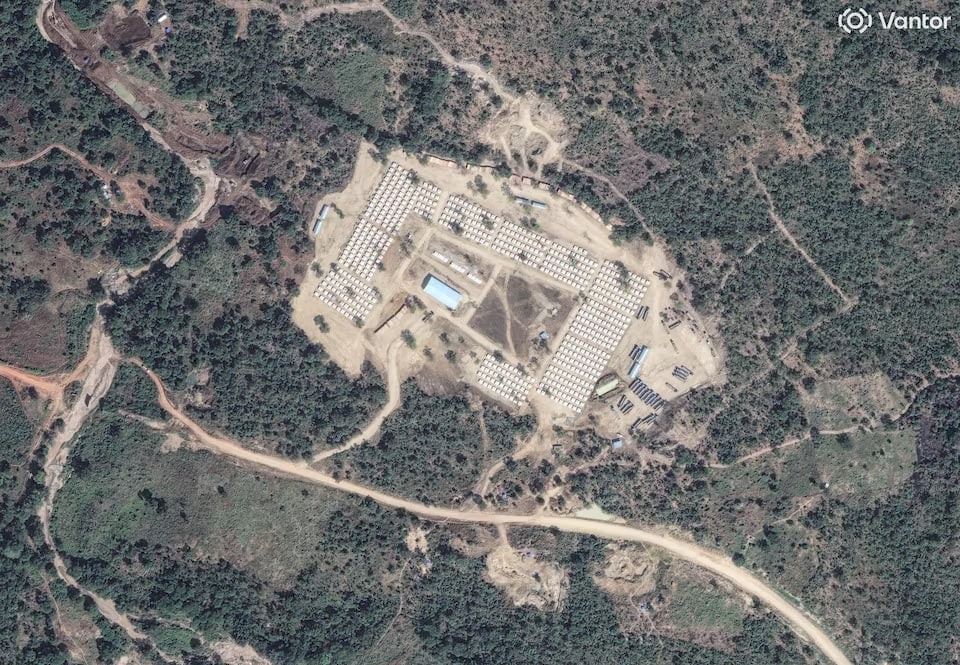
Satellite images and a diplomatic cable revealed that the camp has been set up in a forested area in the Mizingi district, about 32 kilometers from the border, and is located in a strategic position at the intersection of the two countries and South Sudan.
The first signs of activity in the area began in April with the clearing of brush and the construction of metal-roofed buildings in a small area north of the camp, which started operating in the second half of October.
The diplomatic cable, dated November, described the camp as accommodating ten thousand fighters, indicating that activities began in October with the arrival of dozens of Land Cruiser vehicles, heavy trucks, Rapid Support Forces units, and Emirati trainers.
Reuters will not disclose the country from which the cable originated to protect the source.
Two officials reported seeing trucks bearing the logo of the UAE's Gurica Group Logistics Company heading through the town of Asossa towards the camp in October. The company did not respond to a request for comment.
Reuters was able to match the specific timeline in the diplomatic cable with satellite images. Airbus Defence and Space images show that tents began to fill the area by early November after initial preparations. Several excavators are visible in the images.
A photo taken by the American company Vantour on November 24 shows more than 640 tents at the camp. According to analysis conducted by Janes, a military intelligence firm, each tent could comfortably accommodate four individuals with some equipment, thus the camp could hold at least 2,500 people.
Janes mentioned that it cannot confirm that it is a military site based on its analysis of the images.
Two senior military officials stated that new recruits were spotted heading to the camp in mid-November.
The two officials who witnessed the convoys told Reuters that a convoy of 56 trucks carrying trainees traveled on dirt roads in the remote area on November 17. The officials estimate that each truck carried between 50 and 60 fighters. They added that they saw another convoy of 70 trucks carrying soldiers moving in the same direction two days later.
The image captured on November 24 shows at least 18 large trucks on site. According to Reuters' analysis, the size, shape, and design of the vehicles correspond to those regularly used by the Ethiopian army and its allies to transport soldiers. Reuters was unable to verify independently what the trucks were carrying or confirm whether they were the same ones observed by the military officials in the convoys a few days earlier.
Vantour images show that development continued into late January, involving new preparation and digging operations in the riverbed north of the main camp and dozens of shipping containers lined up around the camp, as shown in a photo taken on the 22nd of the same month. A senior Ethiopian government official stated that construction of the camp is ongoing, but he did not provide details about future construction plans.
An Ethiopian government official stated that machinery used to build the training camp, including bulldozers and excavators, is being transported daily through the nearby town of Asossa.
 Follow the latest Sada News via Google News
Axios: Proposal for a 10-day Ceasefire Between Washington and Tehran and Two Options for M...

In a Rapid Pace.. The Occupation Builds a Huge Earth Barrier Inside Gaza

Meeting Between Aoun and Trump Expected Alongside 'Experimental Areas'

Gaza Health Warns of Collapse of Oncology Services Due to Depletion of Treatments and Susp...

The Occupation Demolishes a House in the Town of Sa'ir near Hebron

Israel Reveals Details of Secret Iranian Nuclear Facility in Mount Fas

A Mother, Her Child, and Her Three Daughters Martyred in Israeli Shelling on Gaza City
