

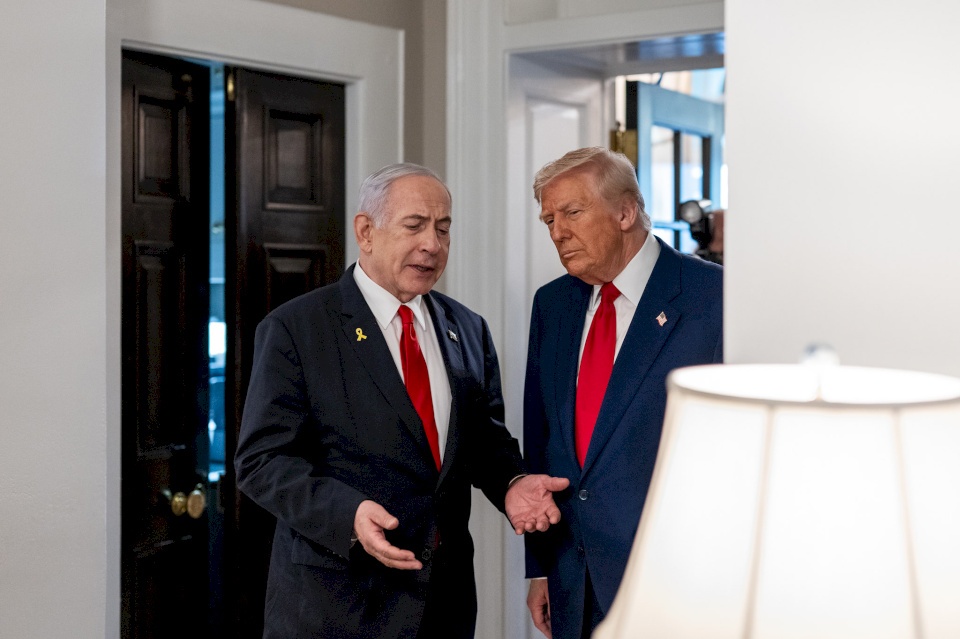
Behind Closed Doors.. Why Did the White House Prevent the Media from Covering the Trump-Netanyahu Meeting?
SadaNews - The Hebrew newspaper Yedioth Ahronoth reported that the White House decided that the meeting between U.S. President Donald Trump and Israeli Prime Minister Benjamin Netanyahu would be closed to the media, unlike previous meetings.
The newspaper stated that "it is likely that the U.S. president wanted this to avoid revealing disagreements between him and Netanyahu regarding a potential deal with Iran".
The newspaper added: "The decision to hold the closed meeting was made by the White House, unlike most previous meetings between the two leaders".
It clarified that a relatively small delegation will accompany Netanyahu during the visit - which is expected to begin today, Tuesday - including his military secretary, Major General Roman Gofman, and the acting head of the National Security Council, Gil Reich, and without his wife, Sara Netanyahu.
The newspaper quoted Israeli officials as saying that "there is significant pressure from Arab countries, and strong intervention from U.S. envoys Steve Witkoff and Jared Kushner, to avoid a war with Iran, a combination that worries Netanyahu".
It added: "Israelis fear that Trump will reach a fragile agreement with Iran, an agreement limited to the nuclear file, without true oversight from the International Atomic Energy Agency".
The newspaper quoted a senior Israeli official as saying: "There are fears that this will lead to an agreement that does not serve our interests. These are not negotiations between Witkoff and Kushner and the Iranians, but there are also the Turks, in addition to Qatar, Saudi Arabia, and Egypt. There are many parties influencing Trump. We fear this will lead to an agreement that will not be in Israel's favor, and this is concerning".
Netanyahu hopes to discuss with Trump Israel's red lines regarding any deal with Iran.
According to the newspaper, these lines are "an agreement that deprives Iran of the right to enrichment, the complete cessation of uranium enrichment, the removal of enriched uranium from Iranian territory, restoring effective oversight, and activating monitoring procedures".
The newspaper continued: "Netanyahu is expected to talk with President Trump about the danger of ballistic missiles".
It stated: "This is a matter of great concern to Israel, and it does not receive enough attention from the Americans, which is why Israel urges the United States to restrict Iranian ballistic missiles to prevent them from inflicting serious harm on Israel, as well as on Europe".
On Friday, the Omani capital Muscat witnessed indirect negotiations between the United States and Iran as tensions between them escalate, amid a U.S. military build-up in the region against Tehran.
Trump described the Muscat negotiations on Friday evening as "very good" and spoke about further negotiations between the two sides, stating they would continue "early" next week, without specifying a date.
Tehran views the U.S. administration and Israel as concocting pretexts for military intervention and regime change, and vows to respond to any military attack, even if limited, while insisting on lifting Western economic sanctions imposed on it in exchange for curbing its nuclear program.
Uranium enrichment is a major point of contention between the two sides, as Iran demands the lifting of sanctions in exchange for its commitment to restricting its nuclear program to prevent the production of an atomic bomb.
In contrast, the United States demands that Iran completely cease its uranium enrichment activities and transfer highly enriched uranium out of the country.
 Follow the latest Sada News via Google News
Morocco Hosts Formative Exercise for International Stabilization Force in Gaza

Sheikh Holds Meeting with Security Leaders to Follow Up on Current Developments

Hebrew Channels: The Likelihood of Israel's Participation in the Attack on Iran is Increas...

Netherlands Sets September Deadline for Ban on Settlement Products

12 Martyrs in Gaza Strip since Dawn Today

A Series of Important Decisions Taken.. The Cabinet Discusses Developments in the Deterior...

Organizations of the Temple Prepare for the Largest Raid on Al-Aqsa on What is Called the...
