

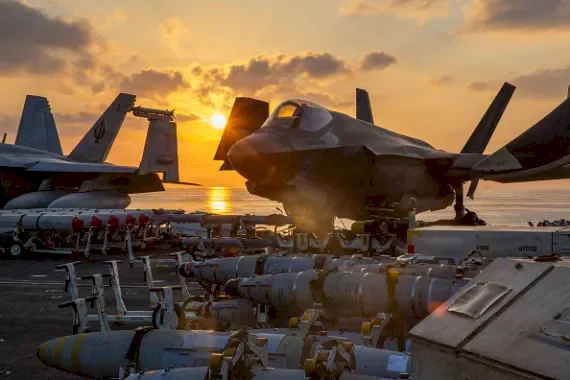
The Depleted Arsenal: Why Won't the U.S. Military Stockpile Recover Soon?
SadaNews - Despite the halt of military confrontation between the United States and Iran following the signing of a memorandum of understanding that ended months of war, a different kind of battle has begun within Washington. It involves assessing the extent of the depletion that has affected the U.S. military arsenal and finding ways to rebuild its ammunition stockpile.
American reports highlight the amount of ammunition consumed during the war and the obstacles hindering efforts to replenish it, amid warnings that restoring stockpile levels could take years, potentially limiting the United States' readiness to handle any major future conflicts.
What is the extent of depletion?
The New York Times reveals that the war on Iran has depleted the U.S. military arsenal, resulting in a "concerning" decline in stockpile levels, according to estimates from the U.S. Department of Defense and congressional officials.
The report outlines the key manifestations of this depletion, detailing the following:
Consumption of about 1,100 long-range stealth cruise missiles, which were specifically manufactured for a potential conflict with China, a number approaching the total that remained in the U.S. stockpile.
Firing more than 1,000 Tomahawk missiles, equivalent to about ten times the amount the U.S. military buys annually.
Using over 1,200 Patriot interceptor missiles, each costing more than $4 million.
Launching more than 1,000 ground-launched missiles from the "Prism" (precision strike missile) and "AtacMS" types.
In this context, Foreign Policy quotes U.S. Central Command (CENTCOM) Commander Admiral Brad Cooper saying - during a Senate hearing last month - that the military used nearly 14,000 offensive munitions during the war.
A recent report from the Center for Strategic and International Studies estimates that the actual extent of depletion may be greater when considering munitions used in air defense systems, such as Patriot missiles and THAAD systems, according to the magazine.
Why won't it recover quickly?
The New York Times notes that efforts to replenish depleted munitions face financial and production challenges, despite the Trump administration's push to accelerate weapon manufacturing.
During meetings held at the White House this week, Trump and senior Pentagon officials sought to adopt two approaches to address the shortage: urging defense contractors to expedite the production of depleted weapon systems and pressuring lawmakers to approve additional funding to cover war costs.
However, Trump's request for $70 billion to cover war costs is expected - as the report indicates - to face strong opposition within Congress.
In contrast, defense contractors informed the president during a meeting at the White House last Wednesday that they needed additional funds to finance the expansion of production lines, according to two officials familiar with the proceedings of the meeting.
The newspaper highlights that repeated announcements of plans to increase munitions production have not yet translated into actual expansions in production capacity, according to officials in the defense industry.
What are the solutions?
In a related context, Foreign Policy mentions that Trump activated, days before announcing the agreement with Iran, the Defense Production Act, aiming to address what he described as "structural constraints" facing the munitions sector of the defense industry.
The law, enacted in 1950, grants U.S. presidents emergency powers to direct American companies to help enhance national defense.
The U.S. administration is also seeking to enhance production capabilities by leveraging auto manufacturing plants, as Trump announced last Monday that companies such as Ford and General Motors would dedicate some of their factories to produce weapons, according to the report.
The magazine adds that the U.S. military is also looking for less costly alternatives to enhance its defense capabilities, as it revealed last Tuesday a new program for introducing low-cost interceptor systems, with each missile costing less than $1 million.
What are the implications?
The New York Times clarifies that the Pentagon's ability to manage future wars, particularly those known as great power conflicts against China, could be directly constrained by the ammunition shortage, with estimates indicating that addressing this deficit could take years.
The newspaper quotes Tara Murphy Daugherty, the CEO of "Air," a defense software company, stating that the United States faces "a wide and dangerous gap between what a fighter needs in the field and what the national security apparatus can provide."
Daugherty explains that this gap is due to several factors, including the fragmentation of systems and outdated military procurement mechanisms, which lead to long delays in launching new armament programs or maintaining existing equipment already in service.
A report from the Center for Strategic and International Studies last month concluded that the United States has enough munitions for any potential scenario in the war on Iran, but the depletion of stockpiles has created a readiness gap in the event of a potential conflict in the Western Pacific, warning that the time required to rebuild this stockpile has become a major concern.
 Follow the latest Sada News via Google News
The Depleted Arsenal: Why Won't the U.S. Military Stockpile Recover Soon?

Netanyahu: We will remain in southern Lebanon and one of the two experimental areas is out...

Lebanon and Israel Sign a Framework Agreement Under American Sponsorship

Trump: Iran Violated Ceasefire by Targeting Ships

3 Martyrs and Injured Due to the Occupation's Shelling of a Vehicle in Central Gaza Strip

America Hands Over 22 Iranians from Detained Oil Tanker to Pakistan

A Martyr and Injured Persons Due to Targeting by Occupation Planes in Northern Gaza
