

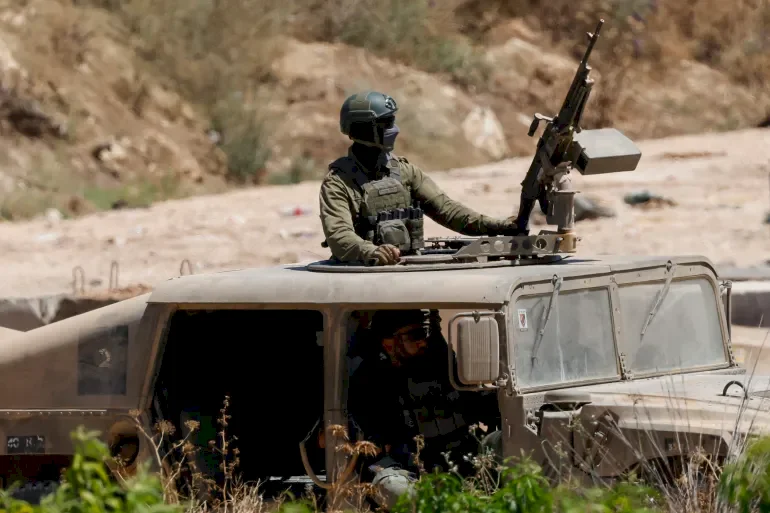
Despite Ongoing Airstrikes.. Israel and Hezbollah Agree to Ceasefire
SadaNews - Israel and Hezbollah have agreed to a ceasefire effective at 4 PM local time today, Friday, however, the Israeli airstrikes have continued, following the death of four Israeli soldiers during battles in southern Lebanon.
Reuters reported an unnamed American official confirming that both sides have agreed to a ceasefire, stating, "We learned that after the exchange of fire earlier today, Israel and Hezbollah entered into a ceasefire."
He added that American and Qatari negotiators mediated the agreement with assistance from Iran.
Axios reported an American official confirming that Israel and Hezbollah agreed to a ceasefire mediated by the US and Qatar after talks with Israel and Iran.
Axios quoted a White House official stating that Israeli Prime Minister Benjamin Netanyahu agreed to renew the ceasefire in Lebanon, as the ongoing fighting in southern Lebanon led to a postponement of Iranian-American talks that were scheduled for today in Switzerland.
In turn, Channel 13 reported an Israeli official saying, "We are now in a ceasefire, and if Hezbollah does not attack us, it is not a time for war on our part."
However, he emphasized that Israeli forces would remain in southern Lebanon, adding, "We have freedom of action against threats."
Similarly, Channel 12 reported an Israeli official stating that the ceasefire has begun, noting that Israeli military forces will remain in the security area and will respond if attacked.
"No New Instructions"
In a press conference following this news, Israeli army spokesman Ivi Dvirin stated that the instructions of Chief of Staff Eyal Zamer did not change and that there are no restrictions on dealing with threats, as he expressed.
He added that "Hezbollah is waging war against our forces and has violated the ceasefire," adding that anything concerning ceasefire agreements returns to the political leadership.
He confirmed that the Israeli army operates in the advanced defensive line to protect the residents of Israel and the north, asserting "continuing to do so."
He revealed that the Israeli army attacked more than 100 Hezbollah targets last night and today, killing dozens of militants, as he described.
Airstrikes After "Ceasefire"
After reports indicated the ceasefire has come into effect, Al Jazeera's correspondent reported that Israeli airstrikes and artillery shelling continue over southern Lebanon.
He explained that an Israeli airstrike targeted the town of Nabatieh al-Fawqa while artillery fire targeted Mount al-Rafii in the Tyre region of southern Lebanon.
The Al Jazeera correspondent also indicated that a new Israeli airstrike targeted the city of Nabatieh in southern Lebanon, stressing no gunfire was heard from Hezbollah."
The Israeli airforce also targeted the al-Raihan area in the Jezzine district of southern Lebanon.
In this regard, Channel 12 quoted a senior Israeli official saying that the ceasefire allows Israel to continue destroying infrastructure and working against threats, while Yisrael Hayom reported an Israeli source saying, "We have returned to the ceasefire and will not initiate attacks."
Death of Israeli Soldiers
The Israeli army announced earlier today the death of four soldiers, including a battalion commander, during battles in southern Lebanon, while Israeli airstrikes on the Nabatieh governorate resulted in the death of 28 people and the injury of 33 others.
The Israeli army clarified in a statement on Friday that Lieutenant Colonel Dor Gdalia Ben Samhon (32 years old), commander of the 52nd battalion in the 401st armored brigade, was killed along with three other soldiers after their tank was targeted during military operations in southern Lebanon.
Israeli army radio reported that the tank belonging to the 52nd battalion was operating within a combat force led by "Givati Brigade" in the vicinity of the town of Kfar Tabbnit in southern Lebanon, noting that initial investigations suggest it was subjected to an attack by an unidentified aerial object, whose nature has yet to be determined whether it was a suicide drone or a guided missile.
The Israeli army confirmed that the clashes in the area last night were "difficult and complex," resulting in the death of four soldiers, including the commander of the 52nd battalion of Givati Brigade.
Israeli media reported that the security incident occurred near the town of Kfar Tabbnit, where an Israeli tank was targeted, leading to deaths and injuries among the soldiers. They added that investigations are still ongoing to determine the nature of the weapon used in the attack.
Israeli media reported that 17 soldiers were injured in the targeting of the Israeli force near Kfar Tabbnit, including five elite soldiers, in addition to a reservist officer and four non-commissioned officers, while Israeli Broadcasting Authority reported that a senior officer in the 36th division was wounded during the clashes last night in southern Lebanon.
Hezbollah's Resistance
This comes after one day of Hezbollah announcing its resistance to an Israeli force that tried to advance from the town of Arnoun toward the outskirts of Kfar Tabbnit.
The party stated in a statement that its fighters engaged with the advancing force "using appropriate weapons," affirming that the operation came "in defense of Lebanon and its people and in response to Israeli violations of the ceasefire."
The party had also announced foiling similar Israeli advancement attempts over the past four days in the vicinity of Kfar Tabbnit and Ali al-Tahir area, confirming inflicting casualties on the Israeli forces.
Following the attack, Hezbollah issued a statement stating that the Israeli enemy has never complied with any ceasefire agreement, and it has continued its violations, committing massacres and destroying civilian infrastructure.
He clarified that the Israeli army targeted safe villages following the resistance fighters' repulsion of its attempt to advance toward Ali al-Tahir hill.
He affirmed that "the resistance is on guard against any aggression and defends its land and its people," adding: "We inflict casualties upon the enemy's officers and soldiers by the dozens."
He indicated that Israel has not adhered to any ceasefire agreement since November 27, 2024, reaching the outcomes of the Washington-Tehran understandings.
Incitement and Threats by Israel
In response to the deaths of the four soldiers, Israeli Prime Minister Benjamin Netanyahu stated that he held consultations and a security assessment of the situation with the Minister of Defense and the Chief of Staff after the attack.
He added, "We will not tolerate attacks against our soldiers and we will make Hezbollah pay a very high price."
Israeli President Isaac Herzog stated: "Israel experienced a very tense and painful morning today."
National Security Minister Itamar Ben Gvir said: "For every tear shed by an Israeli mother, a thousand Lebanese mothers must cry."
For his part, Israeli Finance Minister Betzalel Smotrich stated, "It is time to talk with fire and open the gates of hell."
Meanwhile, former Defense Minister Avigdor Lieberman stated, "If Beirut's suburb remains as it is after this harsh incident, in which four soldiers and officers of the Israeli army were killed, it would be a direct failure of the Prime Minister and the Minister of Defense."
Walla reported that Israeli security and military leaders are currently holding intensive meetings to discuss how to respond to Hezbollah's attacks.
Subsequently, the Israeli army reported that it carried out an attack targeting more than 80 sites in southern Lebanon, confirming the deaths of dozens of Hezbollah elements during the operation.
Israeli Massacres
On the Lebanese side, the Ministry of Health announced the deaths of 31 people and injuries of dozens since early Friday, due to a series of Israeli airstrikes targeting areas in southern and eastern Lebanon, in a notable escalation since the American-Iranian agreement that stipulated ending the war on all fronts, including Lebanon.
The official Lebanese news agency reported that Israel committed several massacres early Friday after targeting populated houses with airstrikes in several villages in southern Lebanon.
The agency noted that the fierce Israeli strikes resulted in the deaths of 16 people in the Nabatieh Governorate, including 8 dead in Harouf village, 4 in the Ashamiyah area between the towns of al-Sharqiyah and al-Duwayr, and 3 in Kafr Sir.
It pointed to the death of another person due to airstrikes targeting a motorcycle in al-Duwayr town.
Additionally, a person was killed and another injured in an Israeli drone strike targeting a motorcycle on the Zahra-Debbieh road in Nabatieh Governorate.
Meanwhile, 7 people were killed in an Israeli airstrike executed by warplanes on a residential building in the Education and Teaching neighborhood in al-Duwayr, according to the Lebanese agency.
The Israeli airstrikes also targeted Nabatieh city and the towns of Kfar Tabbnit and Nabatieh al-Fawqa, as well as al-Raihan heights, and the Kfar Joz area, and the towns of Kfarman, Zbdein, Habbush, Sajd, Mount al-Rafii, Jabshiet, al-Qusaybah, and Kfar Jajal.
The Lebanese Ministry of Health announced the death of 3 people and the injury of 6 others in an Israeli airstrike on the town of Ain Bourdaei in Baalbek eastern Lebanon.
Wave of Displacement
Meanwhile, southern Lebanon witnessed a significant movement of displacement from the districts of Tyre and Bint Jbeil towards the cities of Sidon and Beirut following the intense Israeli airstrikes.
This displacement comes just days after thousands of Lebanese returned to their villages and towns in the south, following the announcement of the American-Iranian agreement that included clauses stipulating the end of military operations and ensuring the safety and sovereignty of Lebanese territories.
The new wave of displacement reminds of the wide displacement that southern Lebanon saw over the past months, which pushed more than a million people to leave their homes as the scope of military operations and mutual shelling expanded.
Dangerous Escalation
Local officials described last night as one of the most challenging nights southern Lebanon has experienced since the resumption of Israeli military operations last March.
Lebanese President Joseph Aoun stated in a statement that what we are witnessing today in the south and Bekaa of an expansion of Israeli assaults constitutes a dangerous and condemnable escalation.
He added that the Israeli escalation targets all ongoing attempts to establish a ceasefire and end the war, indicating that what is happening will not prevent efforts to achieve a comprehensive ceasefire as soon as possible.
Aoun continued that he advised the negotiating delegation not to be lenient on the issue that a comprehensive ceasefire is the entry point to discuss other important issues, including Israel's withdrawal, the deployment of the army, and the return of prisoners.
Lebanon at the Heart of the Agreement
This escalation comes despite the agreement signed by the United States and Iran on Wednesday, which includes ending military operations on various fronts, including Lebanon, and ensuring the safety and sovereignty of its territories.
On Wednesday evening, Washington and Tehran signed a 14-point agreement to halt the war, the text of which was published by Iranian President Masoud Bezhakian.
The first clause of the agreement stipulates that Iran and the United States and their allies declare the immediate and permanent cessation of military operations on all fronts, including Lebanon, with a commitment not to embark on any war or military operations against each other.
Prior to the agreement, the number of airstrikes carried out by Israeli warplanes and drones ranged between 60 and 80 daily, in addition to artillery shelling and demolitions.
Despite the decrease in the frequency of Israeli attacks over the past two days compared to the previous period, ground confrontations and airstrikes continued on both sides of the borders, amid the Israeli government's insistence on continuing its military operations in southern Lebanon.
Since the war resumed on March 2, military operations in Lebanon by Israel have resulted in the death of 3912 people and injuries of 11873 others, in addition to the displacement of more than a million people, according to Lebanese Ministry of Health data.
Israel continues to control areas in southern Lebanon, some of which have been under occupation for decades, while its forces have penetrated during the current war to distances exceeding ten kilometers inside Lebanese territory, marking its deepest ground advance since its withdrawal from southern Lebanon in 2000.
 Follow the latest Sada News via Google News
Pakistan to Iran: We Hope Future Negotiations Will Proceed Smoothly

Qatar: We Support the Initiation of Negotiations Between America and Iran to Achieve Susta...

Official: Netanyahu Agrees to Renew Ceasefire in Lebanon

Trump: No Money for Iran, We Will Continue with the 60-Day Deadline

Despite Ongoing Airstrikes.. Israel and Hezbollah Agree to Ceasefire

Netanyahu and Katz: We Will Not Withdraw from Lebanon and Hezbollah Will Pay a Heavy Price

Arrival of Stability Force Soldiers.. Official at 'Peace Council': We Will Continue to Wor...
