

European and Asian Stocks Decline as U.S.-Iran Peace Talks Stumble
Economy SadaNews - European stocks fell during Friday's trading amid cautious sentiment among investors following the cancellation of U.S.-Iranian talks aimed at ending the conflict in the Middle East, prompting traders to shy away from higher-risk assets.
The European "Stoxx 600" index decreased by 0.1 percent by 07:11 GMT, with shares of mining and utility companies facing selling pressures that limited gains made by the energy and defense sectors, according to "Reuters."
These movements came after Switzerland announced that the scheduled talks between the United States and Iranian negotiators would not be held on Friday, while U.S. Vice President J.D. Vance canceled his anticipated travel plans, increasing uncertainty about the chances for a lasting truce in the region.
European stocks had earlier recorded unprecedented levels earlier in the week, buoyed by investor optimism regarding progress in U.S.-Iranian negotiations, alongside the gradual reopening of the Strait of Hormuz, one of the most critical chokepoints for global energy supplies.
On the stock front, "Entain" shares rose by 1.7 percent after "Reuters" reported that the parent company of the "Ladbrokes" brand began exploring options for its joint venture in Central and Eastern Europe, including the possibility of exiting or selling it.
Conversely, "ASML" shares declined by 1.8 percent following a "Bloomberg" report stating that U.S. Commerce Secretary Howard Lutnick informed the company that Washington was concerned about the possibility of one of its advanced semiconductor manufacturing tools reaching China, potentially violating U.S. restrictions on advanced technology exports.
Asian Stocks...
Asian stocks also declined during Friday's trading under limited trading volumes due to official holidays in several major markets, despite strong gains recorded by Wall Street supported by major technology stocks.
U.S. stock futures also fell as optimism waned about the nuclear agreement between the U.S. and Iran, following the postponement of critical talks related to resuming negotiations on the Iranian nuclear program and the resumption of oil flow through the Strait of Hormuz.
U.S. markets are set to remain closed on Friday for the "Juneteenth" holiday, contributing to reduced global trading activity.
Expectations for central banks, led by the U.S. Federal Reserve, to continue tightening monetary policy and raising interest rates to curb inflation weighed on investor sentiment in Asian markets.
In Japan, the "Nikkei 225" index fluctuated between gains and losses before settling at 71,082.81 points. Government data showed consumer prices, excluding highly volatile fresh food, remained stable, while analysts expect inflationary pressures to rise again in the coming months despite ongoing fuel price increases.
The acceleration of inflation was one of the main factors that prompted the Bank of Japan to raise the benchmark interest rate earlier in the week to 1 percent, its highest level in three decades, as part of a gradual shift from years of ultra-loose monetary policy and negative or near-zero interest rates.
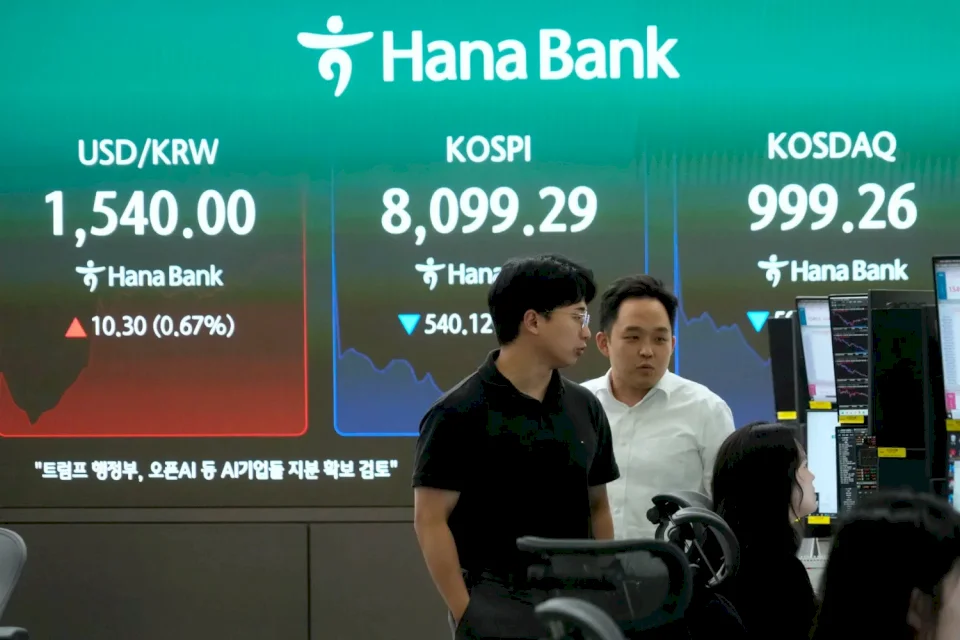
In South Korea, the "KOSPI" index fell by 0.5 percent to 9,019.22 points, while the Australian "S&P/ASX 200" index dropped by 1.1 percent to 8,818.40 points, and the Indian "Sensex" index lost about 1 percent.
The markets in Hong Kong, Shanghai, and Taiwan remained closed due to the Dragon Boat Festival.
"Wall Street" ended Thursday's trading session with gains, recovering most of the losses from the previous session, and recording weekly gains fueled by strong performance from giant tech stocks. The market's recovery came after it declined on Wednesday amid growing expectations that the Federal Reserve might raise interest rates again this year to combat inflation.
The "S&P 500" index rose by 1.1 percent to close at 7,500.58 points, while the "Dow Jones" industrial average added 0.1 percent to reach 51,564.70 points, and the "Nasdaq" composite soared by 1.9 percent to 26,517.93 points.
Tech companies led the gains, with "Intel" shares jumping by 10.6 percent after U.S. President Donald Trump announced that the company would manufacture chips for "Apple" within the United States. "Nvidia" shares also rose by 3 percent, and "Micron Technology" shares climbed by 8.7 percent.
In contrast, "SpaceX" shares continued to decline for the second consecutive day since its major listing on the U.S. stock market last week, falling by 3.6 percent after a 4.9 percent loss on Wednesday.
In energy markets, oil prices experienced notable volatility after the U.S. and Iran signed an agreement to end the war and reopen the Strait of Hormuz to oil tanker movements. Although Brent crude fell during most of Thursday's session, it finished trading up by 0.4 percent at $79.85 a barrel, while U.S. West Texas Intermediate crude decreased by 0.2 percent to $75.85 a barrel.
During early trading on Friday, Brent crude declined by 0.5 percent to $79.34 a barrel, while West Texas Intermediate crude saw a similar decrease to $75.37 a barrel.
Travel and transportation stocks benefited from the easing of concerns related to energy supplies, with American Airlines shares rising by 3.7 percent, United Airlines shares by 2.1 percent, and "Carnival" cruise line shares climbing by 3.2 percent.
Conversely, energy stocks faced selling pressures, with "Exxon Mobil" shares dropping by 2.1 percent and "Chevron" shares declining by 2.2 percent.
Despite oil prices falling from peaks above $100 per barrel in recent weeks, they remain higher than pre-war levels, which hovered around $70 per barrel.
The rise in energy prices has been one of the most significant sources of inflationary pressure during the U.S.-Iranian war period. The new agreement allows Iran to return to exporting oil freely after the easing of sanctions, and it also reopens the Strait of Hormuz, through which about one-fifth of global oil supplies pass.
High energy costs have contributed to increasing inflationary pressures on consumers, despite the average gasoline price in the U.S. dropping below four dollars per gallon, which is still about 25 percent higher than the same time last year. Prices of many goods have also risen due to increased shipping and transportation costs.
The Federal Reserve kept interest rates unchanged during its latest meeting; however, ongoing inflationary pressures have bolstered expectations that an increase could occur before the end of the year. While lower interest rates usually support economic growth by facilitating borrowing, they can also contribute to fueling inflation.
 Follow the latest Sada News via Google News
European and Asian Stocks Decline as U.S.-Iran Peace Talks Stumble

Gold Set to Suffer Third Consecutive Weekly Loss under Dollar Strength Pressure

Governor of Saudi Sovereign Fund: We are committed to all our investments and strategies w...

How did the markets react to the signing of the Iran agreement and the Federal Reserve's d...

أرامكو تدرس إنشاء مرافق تخزين كبرى حول العالم

Jordan's Central Bank Decides to Keep Interest Rates Steady

Strong Economic Recovery Expected in the Middle East and North Africa as War Comes to an E...
