

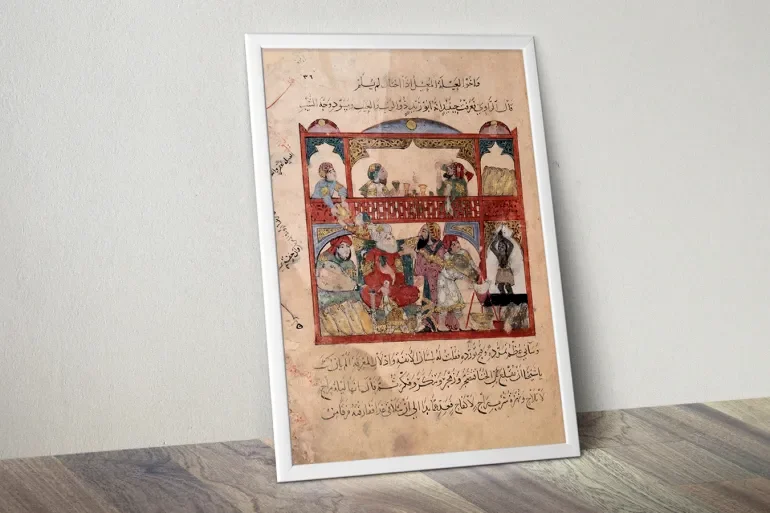
How Did "Al-Hariri's Maqamat" Form a Bridge Between Arabic and Spanish Literature?
SadaNews - In the early sixth century AH, youths from Shatiba, Baetica, and other cities of Andalusia sailed to Basra to sit in a circle with a sheikh who recited to them fifty tales about a clever trickster named Abu Zayd al-Sarouji. These stories were the talk of gatherings and subjects of competition, and they were compiled in "Al-Hariri's Maqamat."
The book did not remain limited to the people of Andalusia; the maqamah (the art of rhymed prose that reached its peak with Abu Muhammad al-Qasim al-Hariri) crossed the very borders of the Arabic language itself, and a hidden thread extended from its eloquent tricksters to the rogues of Spanish literature and the tales of the clever.
The maqamah was not the only fuel for that journey; in the same century, other Arabic literary works made their way to Europe, so much so that some researchers believe Dante Alighieri drew from them before he wrote his Divine Comedy. This claim remains a subject of debate, but what remains certain is that the maqamat composed by the great Arab writer Abu Muhammad al-Qasim al-Hariri inspired many literary figures.
Dr. Ihsan Abbas mentions the names of 21 Andalusian writers, all of whom wrote maqamat, varying in their proficiency, including Ibn Shahid, Ibn Sharaf al-Qayrawani, al-Sarqusiti, al-Wahrani, and some sources reach up to 24 maqamah writers, which varied between descriptive and critical maqamat as well as rhetorical ones.
But how did Al-Hariri's maqamat reach Andalusia at that time? Initially, Ibn Bassam al-Shantrini (d. 542 AH), the author of "The Treasure of the Merits of the People of the Island," uniquely discusses it concisely, stating that the maqamat of al-Hamadhani reached Andalusia at the end of the fourth century AH, and that the minister and writer Abu Al-Mughira Abdul Wahab ibn Hazm (d. 437 AH) - a cousin of the well-known Imam Ibn Hazm, with whom he had a quarrel - attempted to imitate it, as did Abu Amir Ibn Shahid of Andalusia (d. 426 AH). It seems that Ibn Shahid took the idea of the Ibliyyah maqamah from al-Hamadhani to build upon his message of the sequels and whirlwinds, as Dr. Shawqi Dayf notes.
Many sources and biographies mention the names of individuals who traveled to Iraq to hear Al-Hariri's maqamat, either directly from their author or from some of his loyal companions and students. Among these sources is al-Fath ibn Khakan (d. 529 AH) in "The Necklace of Jewels," Ibn Khair al-Ishbili (d. 575 AH) in "The Index," and Ibn al-Abar (d. 658 AH) in "The Supplement," which mention that Ahmad ibn Khalaf al-Shatabi, Abu al-Qasim ibn Jahur, al-Hasan ibn Ali al-Batliusi, and Abu al-Hajjaj al-Qudai attended Al-Hariri's gatherings in Basra since 505 AH. Andalusian pioneers transmitted Al-Hariri's maqamat to a generation of writers; Ibn Jahur transmitted them to Muhammad ibn Khalid al-Tamimi, Muhammad ibn Abdullah al-Labli, and Muhammad ibn Muhammad al-Batliusi, while al-Qudai narrated them to Ibn Khair, who then transmitted them through his work to many others.
Abu al-Qasim Muhammad ibn Abdu al-Ghafour al-Kal'ay al-Ishbili, known for his mastery of the art of discourse, was contemporary with al-Shantrini, yet he did not mention anything about the maqamat of the Andalusians, while he did mention al-Hamadhani and praised him extensively, even showing bias towards him, saying, "The merits of Abu al-Fadl are endless, and many writers opposed him in these maqamat, which I have wished not to mention to this book."
As for al-Qahir Muhammad ibn Yusuf al-Sarqusiti (d. 538 AH), he composed 50 maqamat known for their sternness, as he adhered to an unbinding method of writing and versifying in the manner of al-Ma'arri. The hero of these maqamat is Ibn Habib al-Sadusi, and the narrator is al-Sa'ib ibn Tamam, with a secondary narrator named al-Mundir ibn Humam. The maritime element is strongly present here, as the subjects of those maqamat revolve around sailors, the perils of the sea, and the ports and what happens within them. This somewhat reminds us of the narratives of Hanna Mineh, where the sea is heavily featured. Earlier, we noted that Al-Hariri's maqamat overlooked the geographical sequence, the same reality we observe with al-Sarqusiti.
It is also noteworthy that al-Sarqusiti did not title his maqamat after cities, like the Baghdad and Damascene or Sana'ani... etc. Instead, he used titles different from those we are accustomed to in maqamah books, where half of his maqamat are not titled but numbered, and the other half have some titles such as the triadic maqamah, the adorned maqamah, and the elaborated maqamah. Another criticism of al-Sarqusiti is that he adhered to the subjects of al-Hamadhani and al-Hariri's maqamat without establishing anything from his country’s and environment's culture. Here, we recall that Ibn Abbad looked at "The Unique Chain" of Ibn Abd Rabbih al-Andalusi and recited the verse, "This is our merchandise, it has been returned to us," because Ibn Abbad had sought the book for a long time, believing it contained news and literature from Andalusia; it turned out to be news from the East and its literature.
It has been noted that Ibn Sharaf made a mistake regarding the number of al-Hamadhani's maqamat, which is excusable due to the proximity of the time and the lack of publication, as only news from diverse societies was received; Ibn Sharaf composed maqamat during the reign of Abu Rayan al-Salt ibn al-Sakan. Yehuda ben Shlomo al-Harizi (d. after 602 AH) translated Al-Hariri's maqamat into Hebrew in the first half of the 13th century AD after going to the East and recognizing their importance, keen to transfer them almost literally except for the Qur'anic verses, which he replaced with Torah texts. He then imitated Al-Hariri's maqamat and wrote 50 maqamat he named "Sefer Hakhamoni," or the Book of Wisdom, and named its narrator Heman ha-Azarchi with the hero being ha-Keni.
Another Jew, Ya'qub ibn al-Azar from Toledo, who was contemporary with Al-Hariri, translated Kalila and Dimna into Hebrew and then composed several maqamat resembling Al-Hariri, naming his work "Peaceful." In 1264, with the guidance of Alfonso X of Castile, the Jewish physician Ibrahim al-Hakim translated Abu al-Ala al-Ma'arri's "The Book of Exoneration" and the "Meccan Conquests" of Muhyi al-Din ibn Arabi from Arabic to Castilian. It is believed that Dante Alighieri (1256-1321) drew from them the idea for the Divine Comedy, while others argue that he engaged in literary theft from al-Ma'arri, and another group says that Dante deserves credit for drawing attention to al-Ma'arri and his message!
The maqamat of the Jews of Andalusia represented a link between Arabic literature and its Spanish counterpart, identifying several similarities between the Arabic maqamat and the tales of the Spanish rogues, with Hariri's touches evident in some of the stories of the rogues in Spanish literature. Additionally, the German poet Friedrich Rückert translated Al-Hariri's maqamat into his native language, which were also translated into English and French.
The maqamat flourished in Andalusia after the Berber or Cordoban sedition, which led to the division of the country into warring principalities and the emergence of class disparities in society, followed by the rise of a class of impoverished laborers. Due to the limitations of this account, we refer our esteemed readers to a book titled "Andalusian Maqamat from the 5th to the 9th Century AH" by Dr. Sharif Al-Aloona, where he presents concise translations of more than 25 Andalusian maqamat writers and then touches on samples of their works followed by a brief analysis. Ibn Mahrez al-Wahrani – who lived during the sixth AH century – has a book titled "The Dreams of al-Wahrani and His Maqamat and Letters," which includes the great vision in which he imitated al-Ma'arri's craft in "The Book of Exoneration," and the book contains several of al-Wahrani's letters too.
The Echoes of the Arabic Maqamah in Other Nations
The Persians tried to imitate Al-Hariri's maqamat but did not reach his stature. Persian maqamat were distinguished by not relying on a single narrator unlike al-Hamadhani's and Al-Hariri's maqamat; the primary voice is theirs as an author, or in modern narrative terms, the author and the narrator intertwine, and their maqamat were not tied to a single hero but to many heroes.
In 551 AH, Qadi Hamid al-Din Abu Bakr ibn Umar al-Balkhi composed 23 maqamat in the style of al-Hamadhani’s maqamat and explicitly stated that he was a disciple of Al-Badi. In each maqamah of Qadi Hamid, a new hero appears, although the theme remains similar to what al-Hamadhani and Al-Hariri portrayed; the rhetorical style. The maqamat of Qadi Hamid were transmitted to the Eastern Jewish and Christian circles where they were translated and imitated in both Hebrew and Syriac. No one from the Persians wrote a maqamah like Hamidi, nor did some of them repeat the attempt, and the reasons for this require further research and study.
Source: Al-Jazeera
 Follow the latest Sada News via Google News
World Cup: Morocco achieves the first Arab victory while Turkey loses for the second time,...

"Google" Launches "Android 17" with App Bubbles and Stronger Data Protection

"Electronic Nose" Detects Food Spoilage and Allergens Using Artificial Intelligence

6 Foods That Enhance Your Health as You Age

Why Don't We Feel Full Sometimes Despite Eating?

It's Not Walking... A Study Reveals the Most Effective Exercise for Protecting Women's Hea...

Chewing Gum After These Foods Lowers Blood Pressure
