

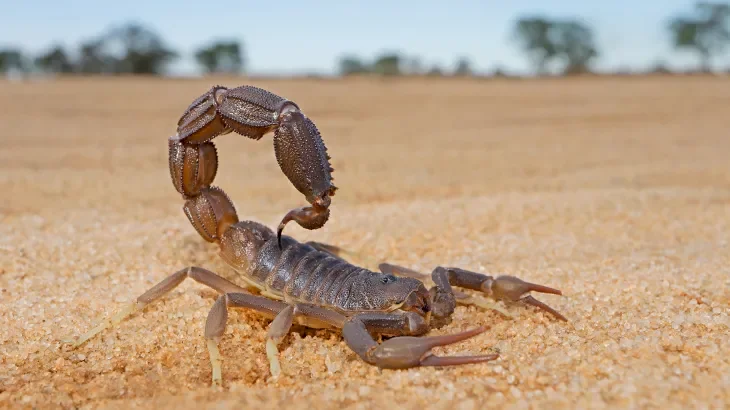
Central Morocco.. One of the Most Severe Hotspots for Poisonous Scorpions Globally
SadaNews - An international team of scientists has reached a practical method for identifying the "hotspots" where some of the world's most dangerous types of poisonous scorpions are likely to thrive, enabling the prediction of danger zones before bites occur densely, especially in tropical and subtropical regions.
Researchers relied on long-term field observations in Africa, with a particular focus on central Morocco, then integrated those with computational modeling that predicts the presence of dangerous species and the factors that drive them to settle in certain environments. The idea here is that scorpions are not present "randomly", but rather follow specific environmental conditions that can be monitored and measured.
Specific Environments
The analysis showed a significant pattern, as soil type was the most influential factor in determining the presence of most scorpions, while temperature—both its average and its variability between seasons—played a critical role in determining the distribution of some highly toxic species.
However, the study, published by scientists in the journal "Environmental Research Communications," emphasizes an important point: scorpions require precise environmental conditions; thus, their risk areas are local and concentrated, which is vital for health planning since the danger may be severe in small spots rather than uniformly distributed everywhere.
The study was conducted in partnership between Galway University in Ireland and Ibn Zohr University in Morocco, involving seasoned researchers and PhD students, focusing on central Morocco, which is considered one of the most severe hotspots for scorpion stings globally, aiming to guide prevention efforts and develop better diagnostic tools and more suitable antivenoms.
The direct health benefit is evident; when health authorities can know "where" the most dangerous scorpions are expected to appear, they can accurately direct awareness campaigns, train medical personnel in higher-risk areas, and enhance community prevention measures, especially to protect children, who are the most vulnerable group to deadly toxins.
A Silent Public Health Crisis
The study places the problem in its global context, as scorpion stings are considered a silent public health crisis; more than two million people are stung annually. Most stings cause pain and swelling, but some species can lead to severe illness and death, with child fatalities estimated at over 3,000 annually worldwide.
Despite the availability of antivenoms for several species, the recurring treatment challenge is that medical teams may find it difficult to quickly identify the responsible species, which hampers optimal treatment decisions in a timely manner.
Therefore, researchers used a modeling tool called Maximum Entropy (MaxEnt) to map probability occurrences based on globally available data about soil, temperature, and habitat factors.
Importantly, the model is not limited to Morocco, as it relies on global environmental data, allowing it to be applied in other areas where detailed records of scorpion species are limited, thus helping to reveal "potential danger hotspots" in parts of the tropical regions around the world, from Latin America to the Middle East and India, which can then be translated into practical health policies that reduce the human burden of stings.
Source: Online Websites
 Follow the latest Sada News via Google News
After Deschamps' Departure... Zinedine Zidane Tops the Candidates to Lead France

Mbappe Surpasses Messi and Becomes the All-Time Top Scorer in the World Cup

England Defeats France and Achieves Largest World Cup Achievement Since 1966

Messi Refused to Play for Spain and Missed 3 World Cups

Publishers Sue Google for Allegedly Using Books to Train Artificial Intelligence

Google Expands Capabilities of Google Search Console to Support Social Media Accounts

The Mediterranean Table... An Ancient Diet Revealing Its New Secrets for Health and Longev...
