

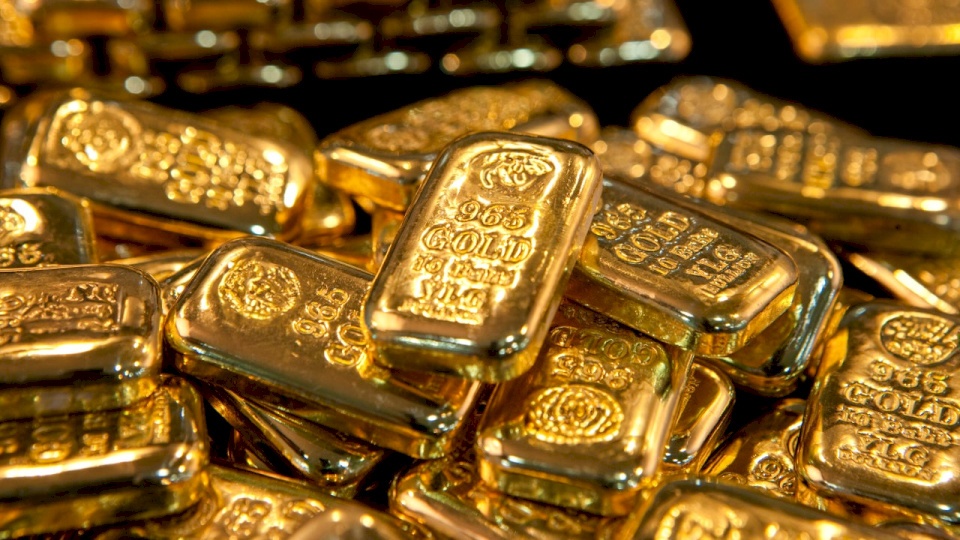
Losses Devour a Third of Silver's Value While Gold Experiences Its Biggest Decline Since the 1980s
SadaNews - The price of gold dropped by more than 10% to below $5,000 per ounce, exceeding the largest daily declines seen during the 2008 global financial crisis and marking its biggest daily drop since the early 1980s, while silver plunged over 30%, recording its largest daily decline ever, as the wave of selling spread across the broader metals markets. Copper prices decreased by 3.4% in London, retreating from the record high it reached on Thursday.
Precious metals witnessed a surge in investor interest over the past year, breaking consecutive records and astonishing seasoned traders, leading to extraordinary price volatility. This volatility accelerated in January as investors flocked to these safe havens amid concerns about currency depreciation and the independence of the Federal Reserve, in addition to trade wars and geopolitical tensions.
Gold and silver are still poised for significant monthly gains; however, the intense sell-off on Friday represents the largest shock to this rise since a similar decline in October.
This drop followed a rebound in the dollar after a report revealed that the Trump administration was preparing to nominate Kevin Warsh as chair of the Federal Reserve, a fact that was later confirmed. The dollar's rebound led to diminished investor confidence among those who had been flocking to metals after the president hinted at his willingness to allow a decline in currency value.
"Sharp Rise... Sharp Correction"
Christopher Wong, a strategist at "Oversea-Chinese Banking Corp", stated that gold's decline "confirms that sharp rises are met with equally sharp corrections," adding that Warsh's nomination was "merely an excuse for markets that were waiting for a justification to correct after their nearly vertical rise."
The precious metals were already positioned for sharp moves, as significant rises and volatility pressured trader risk models and balances. Additionally, a record wave of call options purchases—which are contracts that give holders the right to buy at a predetermined price—was "bolstering the upward momentum in prices," according to a Goldman Sachs Group memo, where sellers of these options hedged their exposure to rising prices by buying more.
The wave of decline in the prices of bullion accelerated due to what is known as "gamma pressure." This occurs when traders with short positions in options are forced to purchase more futures contracts—or papers in the case of gold-backed exchange-traded funds—as prices rise above levels containing large options positions, then sell when they retreat, to maintain the balance of their portfolios. For the "SPDR Gold Shares" ETF, there were large positions set to expire on Friday at $465 and $455, while there were large options positions for March and April in the COMEX market at levels of $5,300, $5,200, and $5,100.
The wave of decline in metal prices also led to a drop in shares of major mining companies, including top gold producers like "Newmont", "Barrick Mining", and "Agnico Eagle Mines", whose shares fell by more than 8% in trading on the New York Stock Exchange.
Markets Await Justification for Correction After Historic Rise
Despite the decline, gold prices remain about 18% higher in January, nearing what would be its strongest monthly gain since 1980. The surge in silver was particularly striking, as the white metal rose over 40% since the beginning of the year.
Analysts at "Commerzbank" noted in a memo on Friday that the scale of the correction "indicates that market participants were simply waiting for an opportunity to take profits after the rapid price increases." However, they added that although rumors of Warsh's appointment might have been the catalyst, there is a significant likelihood that "the Federal Reserve will yield to pressures somewhat and lower interest rates more than the markets currently expect."
Warning Signs
With the significant jumps in gold and silver this year, some technical indicators have sent warning signals. Among them is the Relative Strength Index, which has indicated in recent weeks that metals may have entered overbought territory and warrant a correction. The RSI for gold recently reached a level of 90 points, the highest for the precious metal in decades.
Dominic Spattzel, head of trading at "Herius Precious Metals," stated that the volatility "is extremely high, as the psychological resistance levels at $5,000 for gold and $100 for silver were broken multiple times on Friday." He added: "But we must be prepared for this violent volatility to continue."
Chinese investors led the buying spree, injecting strong demand that pushed the Shanghai futures exchange to hastily take measures to calm the rise in precious and industrial metal markets.
Bloomberg Economics Expert Opinion:
"The ratio of silver to gold prices has risen nearly to the same level seen in the late 1970s, and today’s dramatic movements indicate that this may have formed a rejection point. However, gold and silver individually have not yet reached the wave levels of 1979. Moreover, it is too early to say that the silver-to-gold movement represents an end to the historic track in precious metals. But the price has currently become the main driving force, rather than the fundamental factors."
-Simon White, macroeconomic strategist
President Donald Trump announced his intention to nominate Warsh as the next chair of the Federal Reserve in a post on Friday. The former Fed governor is known for his long-standing reputation as an inflation hawk, but he aligned in recent months with the president by publicly calling for lower interest rates.
Meanwhile, the risk of a new U.S. government shutdown has been averted after Trump and Senate Democrats reached a preliminary agreement. The White House is still negotiating with Democrats over imposing new restrictions on immigration raids that have sparked widespread protests.
The price of gold in spot transactions fell by 12% to $4,703.89 per ounce by 1:29 PM in New York. Silver plunged by 33% to $77.41 per ounce, while the prices of platinum and palladium also fell. The Bloomberg Dollar Spot Index rose by 0.8%.
Copper prices on the London Metal Exchange stabilized at $13,157.50 per ton, retreating after surpassing $14,000 per ton for the first time ever on Thursday in its largest daily gain since 2008.
 Follow the latest Sada News via Google News
London Stock Exchange Enters the Era of 24/7 Trading

Shamaran Petroleum: Suspension of Oil Production in Duhok Fields in the Kurdistan Region o...

Dollar Steadies Near One-Week High Amid War Developments

Trump Imposes Tariffs on Canadian Imports... Ottawa Vows to Respond

Oil Prices Drop After Reports of Mediation Efforts Between the U.S. and Iran

Gold Price Rises Supported by Increased Buying Amid Lower Prices

Due to "Hazardous and Counterfeit Products".. Europe Fines "AliExpress" $627 Million
