

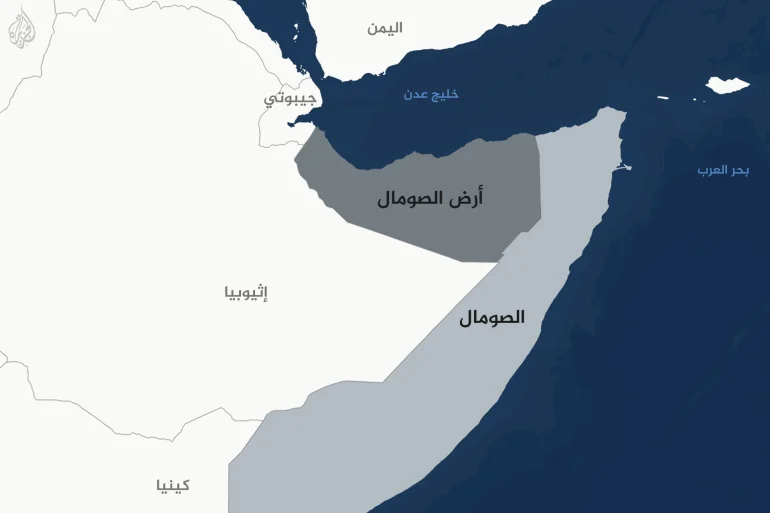
Widespread Condemnation of Israel's Recognition of "Somaliland" and Warnings of Serious Consequences
SadaNews - Israel's announcement recognizing the "Republic of Somaliland," a breakaway state, as an independent nation has provoked widespread Arab, Islamic, and regional condemnation, amid warnings that this step represents a "blatant violation of international law" and a direct threat to the security of the Horn of Africa and the stability of Somalia.
Official statements condemning the move have been issued by many Arab and Islamic countries, as well as by Islamic, Arab, and African organizations warning of its repercussions on the region.
Israel became, on Friday, the first country in the world to officially recognize the region that unilaterally declared independence from Somalia in 1991. Netanyahu's office stated that the decision comes "in the spirit of the Abraham Accords", announcing the "establishment of full diplomatic relations" and agreements for cooperation in agriculture and technology.
Arab Rejection
Condemnation statements have flowed in from various Arab and Islamic capitals, with Saudi Arabia expressing its rejection of mutual recognition between the Israeli occupying authorities and Somaliland, confirming that it enshrines unilateral secessionist measures that violate international law.
The Saudi Foreign Ministry stated its full support for the "sovereignty of the brotherly Federal Republic of Somalia and the unity and territorial integrity thereof".
Egypt also condemned the Israeli move, with Foreign Minister Badr Abdel-Aty affirming in telephone conversations with his counterparts from several countries, Cairo's condemnation of Israel's recognition of the breakaway region of Somaliland, emphasizing full support for the unity of Somali territories.
Kuwait, Jordan, and Iraq issued statements underscoring their absolute support for Somalia's sovereignty, considering the Israeli action a gross violation of state sovereignty and a clear contravention of the principles of international law and the UN Charter.
Jordan also expressed its complete rejection of any attempts to impose parallel entities threatening Somalia's unity.
Palestinian Concerns
For its part, the Palestinian Foreign Ministry warned that the Israeli occupation aims to destabilize Arab national security, revealing fears that the region could be used as a destination for "displacing" Palestinians from the Gaza Strip.
The Palestinian Foreign Ministry described the Israeli step as a direct threat to regional and Arab security and an attempt to destabilize Arab and African countries.
The ministry alerted that the occupying authorities had previously suggested "Somaliland" as a potential destination for implementing forced displacement plans against the Palestinian people, specifically from Gaza, making this recognition - as observers suggest - part of suspicious geostrategic arrangements.
Turkish Warning
Meanwhile, the Turkish Foreign Ministry described the step as "blatant interference" in Somali affairs, accusing Netanyahu's government of attempting to export its crises and undermine regional stability.
The head of communications at the Turkish presidency, Fahrettin Altun, stated that Israel's recognition of the breakaway "Somaliland" region is a "flagrant violation of international law" and reflects the "irresponsible" policies of the Israeli government.
Turkish Foreign Ministry spokesman, Onur Çalışkan, described the move as a "new example of illegal actions" by Tel Aviv, noting that Israel, which exerts every effort to prevent recognition of a Palestinian state, is now blatantly interfering in Somalia's internal affairs.
Positions of Arab and Islamic Organizations
Meanwhile, the Secretary-General of the Arab League, Ahmed Aboul Gheit, condemned the Israeli recognition of the breakaway region on Friday, considering Tel Aviv's move provocative and rejected it, as it may compromise the region's security.
Aboul Gheit emphasized in a statement the Arab League's rejection of this step as a clear violation of international law, constituting a gross infringement on the principle of territorial integrity and state sovereignty.
The Organization of Islamic Cooperation announced its unequivocal rejection of Israeli recognition, affirming its solidarity with Somalia in protecting its national unity.
It stated in a statement the "necessity to adhere to the principles of the UN Charter and international law, all of which emphasize respect for the sovereignty of member states and their territorial integrity".
The Gulf Cooperation Council described the Israeli recognition as a "dangerous transgression of the principles of international law, and a blatant violation of the sovereignty of the Federal Republic of Somalia and its territorial unity".
The Secretary-General, Jasem Albudaiwi, considered this recognition a "dangerous precedent" that opens the door to further conflicts in the Horn of Africa.
African Condemnation
On the African continent, African organizations condemned the Israeli step; the Intergovernmental Authority on Development (IGAD) confirmed that any unilateral recognition contradicts the UN Charter and the constitutive act of the African Union.
The African Union also rejected any recognition of "Somaliland" and reaffirmed its steadfast commitment to Somalia's unity and sovereignty. The Chairperson of the African Union Commission, Moussa Faki Mahamat, emphasized the complete rejection of incursion into inherited borders, warning that this step represents a "dangerous precedent" that threatens to fragment countries in the continent and revive separatist projects.
The Union stated in a statement on Friday that Faki noted with grave concern the recent developments related to "Somaliland", reiterating the AU's firm and consistent position based on the principles stipulated in the AU's constitutive act, particularly the respect for the non-alteration of inherited borders at independence, as affirmed by the Organization of African Unity's resolution in 1964.
 Follow the latest Sada News via Google News
Morocco Hosts Formative Exercise for International Stabilization Force in Gaza

Sheikh Holds Meeting with Security Leaders to Follow Up on Current Developments

Hebrew Channels: The Likelihood of Israel's Participation in the Attack on Iran is Increas...

Netherlands Sets September Deadline for Ban on Settlement Products

12 Martyrs in Gaza Strip since Dawn Today

A Series of Important Decisions Taken.. The Cabinet Discusses Developments in the Deterior...

Organizations of the Temple Prepare for the Largest Raid on Al-Aqsa on What is Called the...
