

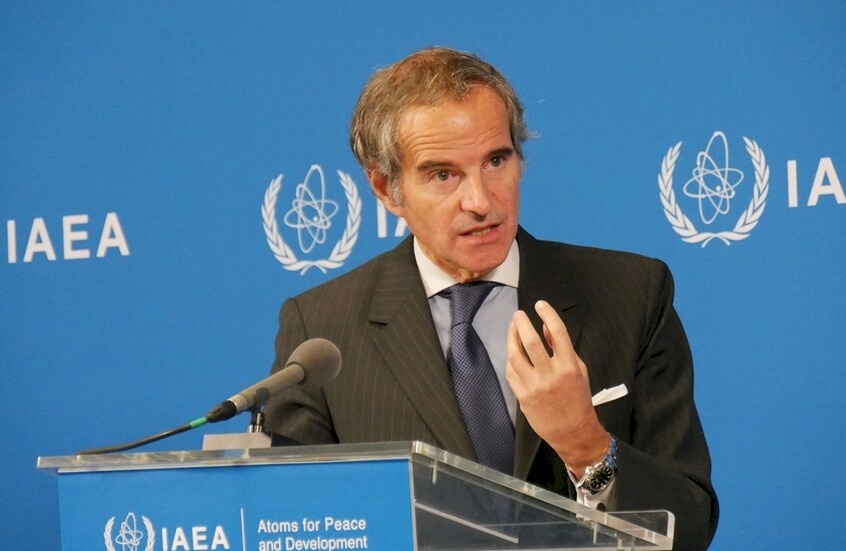
IAEA: Iran Has Not Provided Data on Damage to Its Facilities After US Strikes
SadaNews - The Director General of the International Atomic Energy Agency (IAEA), Rafael Grossi, confirmed that the agency has not received any data or reports from Iran regarding the state of its enriched uranium stocks and the damage to nuclear facilities following the US strike.
Grossi stated, "Regarding whether the agency received reports from Iran: 'No, it has not received any,'" according to the Russian news agency "Novosti."
It is noteworthy that Israel launched a military operation against Iran on the night of June 13, accusing it of carrying out a secret military nuclear program. The targets of the alleged airstrikes and sabotage raids included nuclear facilities, leadership sites, prominent nuclear physicists, and air bases.
Iran denied these accusations and responded with counterattacks, leading to a mutual exchange of strikes that lasted for 12 days.
The United States joined this confrontation by conducting an attack on Iranian nuclear facilities on the night of June 22. Consequently, Tehran launched missile strikes on the "Al-Udeid" U.S. base in Qatar on the evening of June 23, announcing that it did not intend to escalate further.
On November 20, the IAEA Board of Governors passed a resolution demanding that Iran immediately inform the agency about the status of its enriched uranium stocks and the damaged nuclear facilities.
Tehran described this resolution as "unconstructive and politicized," and officially informed the agency on the same day of its termination of the "Cairo Agreement" that had been concluded between the two parties last September to define the framework for interaction following the strikes.
The Iranian statement at that time indicated the country’s readiness to consider proposals for a new agreement with the agency, with the Iranian Supreme National Security Council to determine the nature of future interactions.
This comes at a time when a previous cooperation agreement between Iran and the IAEA had expired, following months of Tehran passing a law in July that restricts the level of cooperation with the agency and includes the expulsion of its inspectors.
Despite this, IAEA inspectors visited the Tehran research reactor used for nuclear medicine and the construction of the Bushehr nuclear power plant with Russian participation, with the last visit occurring in early November.
In contrast, agency representatives have not visited other nuclear facilities such as Natanz, Isfahan, and Fordow, which were targeted during the U.S.-Israeli attack.
 Follow the latest Sada News via Google News
Trump: We will make great progress with Beirut.. Aoun: It is time for Lebanon to be stable

The Lebanese Army Deploys in the South and Comes Under Gunfire; Israel Clarifies

Bezhkian: Directives from the Leader to End the State of No War, No Peace

Meeting Between Aoun and Trump Expected Alongside 'Experimental Areas'

Saudi Arabia condemns the Houthi threats to navigation and pledges to protect its ships

Trump: Iran Will Pay the Price for Killing American Soldiers

Global Warning to Americans Due to Rising Tensions in the Middle East
