

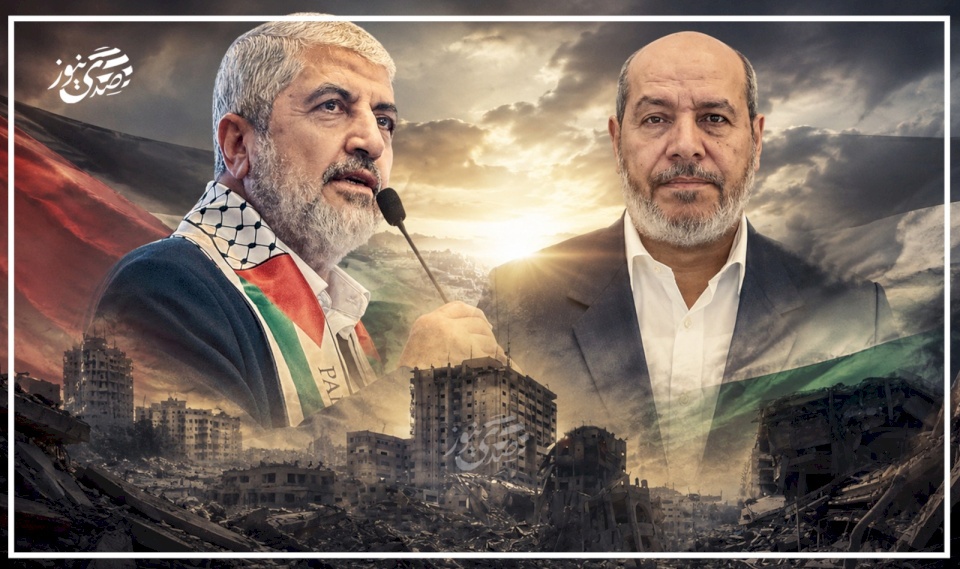
Al Jazeera: A decisive round between Al-Hayya and Mishal to lead Hamas next week
SadaNews - The Islamic Resistance Movement (Hamas) is heading for a crucial runoff next week to choose a new head for its political bureau, continuing a complex transitional process to fill the leadership vacuum left by the Israeli assassinations of several senior leaders of the movement, including Ismail Haniyeh and Yehya Sinwar.
A source in Hamas told Al Jazeera that the internal vote to choose the new leader of the movement is narrowed down to the former head of the political bureau, Khaled Mishal, and the former deputy head of the movement, Khalil Al-Hayya, in what is expected to be a fierce and close competition.
This upcoming vote represents a decisive turning point for the Palestinian movement in its efforts to renew its structure, even in the face of the ongoing Israeli war.
The winner will replace the temporary leadership council that took over following the assassination of Sinwar in Gaza in October 2024. The new president will serve until 2027, the scheduled date for new elections.
According to Hamas's internal regulations, a candidate must obtain an absolute majority of 50% plus one of the votes of the Shura Council – the advisory body of the movement – to win the leadership directly. As neither of the candidates achieved this percentage during the initial rounds, a runoff has been scheduled for next week to break the deadlock.
The source explained that, based on a framework approved in 2021, one of the top two leadership positions in the movement must be represented by the Gaza region, one of the three geographical regions of the movement, alongside the West Bank and the diaspora. Therefore, if Al-Hayya – representing Gaza – does not win the leadership in the runoff, it is expected that he will assume the position of deputy head of the political bureau.
Change in the electoral process
A second source in Hamas told Al Jazeera that the movement was forced to abandon its usual electoral mechanism, which includes the participation of the entire grassroots base. Instead, a narrower group was allowed to vote in the political bureau elections, in order to complete the current term that began in 2021.
The source clarified that the security challenges posed by the war, alongside the utmost priority of filling vacancies in the Shura Council after the martyrdom of several of its members, have delayed the leadership selection process.
Despite these challenges, the source denied reports about a shift towards a secretive or collective leadership structure, affirming that the identity of the newly elected president will be officially announced once the votes are counted and approved.
Both sources in Hamas confirmed that regardless of the outcome next week, preparations for comprehensive elections at the base level across the three regions of the movement are to commence next year, depending on prevailing security conditions.
For his part, Palestinian political analyst Abdullah Al-Aqrabawi told Al Jazeera that these internal dynamics can no longer be viewed as a closed internal matter for a local group. Since the events of October 7, 2023, Hamas has emerged as a central regional actor whose decisions resonate beyond the Palestinian arena, directly shaping the geopolitics of the entire Middle East. Therefore, Al-Aqrabawi believes that the election of Hamas's leadership has become a subject of intense regional and international scrutiny.
Institutional Flexibility
The current electoral framework stems from the internal general elections of Hamas in early 2021. At that time, Ismail Haniyeh was elected as head of the political bureau, while Yehya Sinwar was re-elected to lead Gaza, and Khaled Mishal was chosen to head the diaspora region.
This institutional structure faced unprecedented upheaval following the outbreak of the war, which saw Israel targeting various levels of Hamas's political and military leadership. In July 2024, the head of the political bureau, Haniyeh, was assassinated in Tehran, prompting the movement's Shura Council to appoint Sinwar as his successor in August 2024.
Following the martyrdom of Sinwar during a clash with occupation forces in Rafah in October 2024, the movement adapted by forming a temporary leadership council consisting of five members to manage governance and negotiations during wartime.
Since then, the temporary leadership council has been chaired by leader Mohammed Darwish, who has headed the Shura Council of the movement since late 2023, succeeding Osama Al-Mazini who was martyred on October 16 of the same year in an Israeli airstrike that targeted his home in Gaza days after the Al-Aqsa Flood operation.
Despite Israel's stated goal of dismantling Hamas's command and control apparatus, the structural nature of this transition highlights the deep organizational safety net of the movement.
In this regard, Palestinian political analyst Wissam Afifa told Al Jazeera that Hamas's organizational structure operates similarly to the biological process of "cell division," where a single cell divides to form two identical cells. In times of crisis, pre-prepared emergency procedures and alternative plans activate secondary administrative and leadership layers to take charge.
 Follow the latest Sada News via Google News
Al Jazeera: A decisive round between Al-Hayya and Mishal to lead Hamas next week

Injuries and Arrests in Occupation and Settler Attacks in Hebron

President Abbas Receives the Secretary-General of the Arab League and Discusses the Situat...

A Political Consultation Session Held Between the State of Palestine and Switzerland

Approval of Lifetime Security Protection for Sara Netanyahu

Dispute Between Zamir and Smotrich Over the Identity of the Head of the Civil Administrati...

"They wanted the war to continue".. Vance reveals Israeli pressure on Washington
