

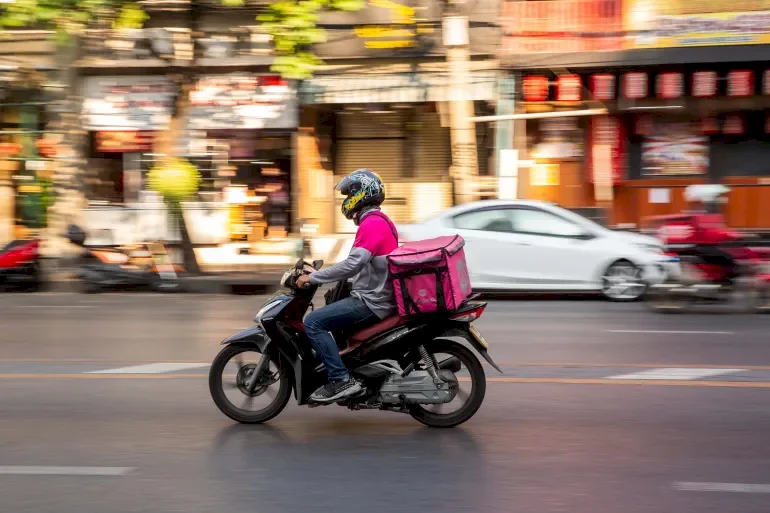
Silent Financial Leak.. How Much Do Food Delivery Apps Cost You Annually?
SadaNews - Food delivery apps are no longer just a means of saving time; they have become part of a new consumption pattern that reshapes families' relationships with food and spending.
With the proliferation of these services, ordering a meal via phone now takes just a few minutes, but its actual cost often exceeds the price of the food itself due to delivery fees, service charges, tips, and price differences between the app and the restaurant.
Although these fees may seem limited for each order, they accumulate over frequent use, creating what behavioral economists describe as "silent financial leakage"; small amounts accumulate throughout the year, draining a noticeable part of the family budget without consumers realizing their true size.
This shift is no longer limited to the United States or Europe; the food delivery market is witnessing continuous growth worldwide, driven by the spread of smartphones, the expansion of the digital economy, and changing work and consumption patterns.
Digital economy sector analyses show that competition between platforms is no longer limited to delivery speed; it also relies on subscription programs, personalized offers, and recommendation algorithms that encourage increased orders.
This transition reflects rapid growth in the global food delivery market; according to estimates from Grand View Research, the market value reached about $288.8 billion in 2024, and is expected to reach $505.5 billion by 2030, with a compound annual growth rate of 9.4%.
Small Fees, Big Bills
Data from the National Restaurant Association in the United States indicates that the cost of ordering through delivery apps typically increases by about 20% to 40% compared to direct purchases from the restaurant, due to a range of fees and price increases.
The United States is one of the largest food delivery markets globally in terms of value and usage, with the market value reaching approximately $429 billion in 2025, amid expectations of strong growth until 2030, when values will approach $600 billion.
This increase is usually distributed among:
Delivery fees ranging from $2 to $5.
Service fees representing about 10% to 15% of the order value (for example, if the order is $20, the fees range between $2 and $3).
Increased meal prices within the app compared to their prices in the restaurant range from $1 to $3.
Based on these figures, the estimated calculation is as follows:
Minimum increases: $2 delivery + $2 service + $1 price difference = $5.
Maximum increases: $5 delivery + $3 service + $3 price difference = $11.
Thus, consumers may pay between $5 and $11 extra per order, without noticing the accumulated costs, especially with repeated reliance on these services, based on data from the association.
In this context, analyses by McKinsey & Company indicate increasing reliance on food delivery services as part of urban consumption patterns.
With an average additional cost of about $5 per order, a family that orders food three times a week spends around $15 weekly on delivery, which amounts to about $780 annually.
Families that rely more heavily on delivery, averaging five orders a week, may see their additional costs rise to around $1,300 annually, according to estimates based on average fees and price differences.
Why Don't Consumers Feel These Costs?
Articles and studies published in Harvard Business Review on consumer behavior indicate that digital payment methods reduce the immediate sense of spending compared to cash payments, which may cause consumers to underestimate the actual cost of the small repeated fees.
This leads to several results, the most notable of which are:
Focusing on the meal price while overlooking the additional fees.
Repeating orders without accounting for the monthly or annual costs.
Weak sense of the impact of repeated spending on the budget.
Behavioral economists categorize this phenomenon as a form of "invisible spending", as the loss does not appear in a single purchase but accumulates over dozens or hundreds of small transactions.
From Kitchen to App
The impact of delivery apps extends beyond increased spending; it has also changed eating habits within families; reports from the OECD indicate that families in major cities spend between 25% and 35% of their food budget on takeout or restaurants, while the percentage exceeds 40% in cities like New York and London.
This transition reflects a gradual shift from planning home-cooked meals to relying on instant orders, driven by time constraints and easy access to apps and ongoing promotions.
In the Middle East and North Africa region, the market is also moving towards this model; according to a recent study by market research firm TGM titled "The Trusted and Superior Food Delivery Market in the Middle East and North Africa".
The study indicates that trust in digital platforms, along with the search for speed and exceptional services, has become one of the main factors driving consumers to use delivery apps repeatedly, with some users willing to pay additional fees for convenience and quick service.
A field study conducted in Saudi Arabia titled "Impact of Food Delivery Apps on Food Consumption" found that the use of delivery apps has been linked to changes in the consumption of takeout and its frequency, especially among the youth and city dwellers, reflecting a change in food consumption patterns.
Despite different income levels and eating habits among countries, studies lead to a common trend of increased reliance on ready-made food in major cities.
In the United States and Europe, urban density and the spread of digital platforms drive this transformation, while Gulf countries are experiencing rapid growth driven by high rates of smartphone usage and quick adoption of digital services, making delivery apps an increasing part of household spending.
Small Restaurants Pay the Price
The impact of the delivery economy is not limited to consumers alone; it also extends to restaurants, especially small ones. According to a study from Harvard Business School, delivery platforms' commissions range from 15% to 35% of the order value, prompting many restaurants to raise their prices on the apps by about 10% to 20% to compensate for part of these costs.
This leads to a narrowing of profit margins and an increased dependence of restaurants on digital platforms, while the percentage of customers purchasing directly from the restaurant declines, granting delivery companies increasing leverage in the market.
On the other hand, delivery platforms assert that the fees they collect are not limited to the service of transporting orders, but also cover the operating costs of the apps, technical support, electronic payment systems, marketing, and managing driver networks, as well as investments in improving user experience.
They argue that these platforms provide restaurants with an additional channel to reach a broader customer base, especially in major cities.
Arab Markets and the "Dual Pricing" Trap
The scene in the Arab world does not appear isolated from these structural pressures; the rapid delivery sector in the Middle East and North Africa has turned into a massive consumer engine estimated at billions of dollars but is now laden with "hidden costs" that burden both consumers and business owners alike.
According to operational data and field surveys from restaurant management platforms and cloud-based point-of-sale systems in the region, such as the Foodics platform, the fixed commissions taken by delivery platforms from restaurants range from 20% to 30% of the total order value.
These high commissions have driven the business sector, especially small and medium-sized restaurants, to adopt an emergency response policy known as "hidden price inflation within the apps" or dual pricing.
Restaurants, under this policy, raise the prices of their meals on the "digital menu" within the apps by percentages ranging from 15% to 30% compared to their actual prices in the dining rooms, placing the greater burden on the final consumer to compensate for their lost profit margins that go to the digital platforms.
The Saudi and Emirati Markets
In the heart of the largest market in the region, official data from the "Saudi Internet Report" issued by the Saudi Communications and Space Technology Commission (CST) show that the food delivery sector through platforms has exceeded 10.5 billion Saudi Riyals (approximately $2.8 billion).
According to the periodic financial reports of listed companies in the Saudi market (such as Jahez International), the growth of these sales is met with rising operational costs; where the customer bears direct delivery fees ranging from 10 to 15 Saudi Riyals ($3 to $4) depending on the geographical distance, as well as digital processing fees.
The situation is not much different in the UAE market, which experiences high urban consumption density; according to reports and surveys from the food and beverage sector issued by Circla Consulting for the Middle East, major delivery platforms impose fixed delivery fees on consumers ranging from 5 to 11 Emirati Dirhams ($1.5 to $3).
However, the invisible cost surfaces in what is known as "small order fees", where platforms impose an additional fee ranging from 4 to 5 Dirhams if the total order value falls below a certain threshold (usually 30 Dirhams), which significantly raises the cost of the individual meal.
Fuel Prices Skyrocket Bills in Egypt
In Egypt, structural factors of the platforms have merged with local inflation waves and currency fluctuations to create a complex pricing reality.
According to periodic field reports from the Restaurants and Tourist Establishments Division of the Cairo Chamber of Commerce, in conjunction with inflation survey indicators issued by the Central Agency for Public Mobilization and Statistics, delivery fees have jumped to levels ranging from 20 to 45 Egyptian Pounds per order (0.5 to 1 dollar) due to consecutive increases in fuel prices and vehicle maintenance costs.
Reports indicate that Egyptian families are now facing additional spending lines created by the apps under the name of "app service fees" or "fixed administrative fees", which range from 5 to 10 pounds automatically added to the final bill regardless of the order size or value, accelerating the pace of "financial leakage" from the budgets of middle-income families.
The Kuwaiti Model
In light of this ongoing rise in "invisible spending" items and the dominance of digital platforms, some regulatory authorities in the Arab region have begun to intervene to enforce financial balance and protect consumers and small business owners.
The regulatory model in the State of Kuwait represents a clearer legal precedent in this regard. The Kuwaiti Ministry of Commerce and Industry has issued strict regulatory decisions that set a legal ceiling that delivery platforms cannot exceed for direct delivery fees; prices have been set at a maximum of 500 Fils ($1.6) if the restaurant relies on its own delivery fleet, and a maximum of one Kuwaiti Dinar ($3.2) if the transportation is carried out via vehicles affiliated with digital delivery applications.
When Decisions Become Emotional
Data from Nielsen Consumer Insights indicates that more than 60% of food orders through apps are not related to immediate food needs but rather to factors such as fatigue after work, a desire for convenience, or treating oneself.
Instant offers and promotional notifications increase the likelihood of completing an order by up to 30%, according to the study, making the purchase decision closer to a psychological response than a well-thought-out economic decision.
Consumer psychology specialists believe that the combination of ease of payment, speed of delivery, and marketing based on notifications has contributed to transforming food into a commodity that can be obtained with a single touch, raising the rate of unplanned spending.
Where Does the Money Go?
When adding up various spending items, the picture becomes clearer; in a moderately consuming household, the annual calculation can reach:
Delivery fees: a minimum of $104 to $1,825 annually.
Service fees: a minimum of $104 to $1,095 annually.
Price differences of meals: a minimum of $51 to $1,095 annually.
Thus, the total additional annual cost ranges between $259 (for an average of one order weekly at the minimum) and about $4,015 (for daily consumption at the maximum), excluding any increase in the number of orders themselves or increased reliance on ready-made food instead of home cooking.
The Convenience Economy
These figures reflect not only the cost of delivery service but also reveal a broader economic transformation, wherein convenience is a sellable and purchasable element, and digital platforms have become a major intermediary between the consumer and the restaurant.
As the delivery market continues to expand globally, economic forecasts suggest that families’ reliance on these apps will increase, especially with the evolution of subscription services and personalized offers, alongside the introduction of artificial intelligence that enhances purchasing recommendations.
However, studies conclude that awareness of total costs -not just the cost of a single order- has become a critical factor in maintaining the family budget; what seems to be simple fees each time can turn into one of the largest food spending items over months, without leaving a clear mark at the moment of immediate payment.
Source: Al Jazeera
 Follow the latest Sada News via Google News
Wall Street Concludes on Oil Surplus in 2027.. Price Predictions Ranging from $60 to $75 p...

"EasyJet" Accepts $7.3 Billion U.S. Acquisition Offer

Silent Financial Leak.. How Much Do Food Delivery Apps Cost You Annually?

Oil Fluctuates Within a Narrow Range as Flows through the Strait of Hormuz Recover

Gold Stabilizes Around $4,160 as U.S. Rate Hike Bets Diminish

Oil Drop Raises Glut Fears Amid Flow of Hormuz Supplies and Weak Chinese Demand
Gold Prices Reach Around $4,175 per Ounce
