

When Risk Becomes a Necessity.. Yemeni Youth Engage in Dangerous Jobs Leading to the Abyss
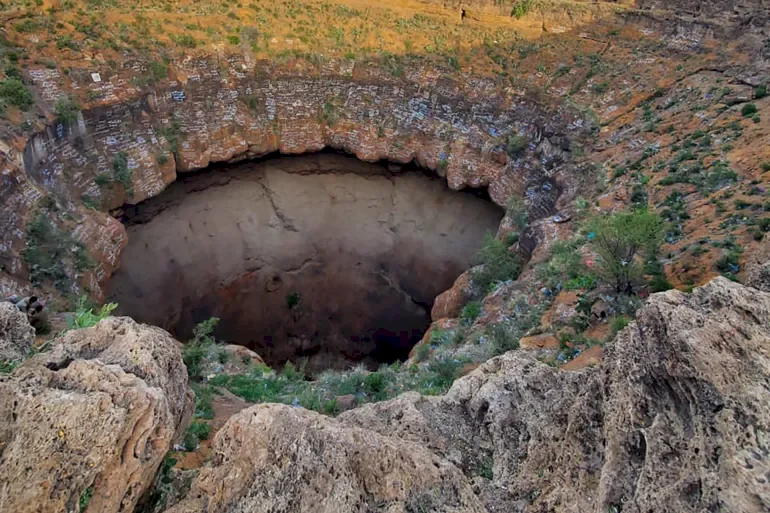
SadaNews - For a year and a half, the young man Al-Qaqa'a Antar Muqbil Nasir Al-Absi, nicknamed "Spider-Man of Yemen", practiced the profession of climbing passionately driven by the harshness of life, using the mouth of a dormant volcano in the city of Damt, known for its thick lava and rugged terrain, as a stage for an adventure that no one dared to undertake before.
Al-Qaqa'a (17 years old) would descend into the depths of "Harda Damt" to perform acrobatic moves that observers described as frightening and would write the names of visitors at the bottom of the crater for small sums that helped his family survive. However, this extraordinary bravery ended in a sudden tragic demise; while the young man was returning from the bottom of the crater after a year and a half of daily death-defying challenges, he was suddenly caught by the abyss, turning his source of income into his final resting place.
A heavy sadness hangs over the home of the deceased, in the "Al-Bakili" neighborhood of the Damt area in Al-Dhali Governorate. His father, Antar Muqbil Al-Absi (50 years old), spoke with a tone mingled with anguish and regret, recalling his desperate attempts to save his son from this fate.
He said, "By God, I tried with him until I was exhausted; I hit him more than once and kept him locked in the house so he wouldn't go to Harda." The grieving father could not continue his words after he was choked by tears, settling for phrases that encapsulate helplessness and pain in the face of relentless poverty: "Thank God for everything, I tried with him a lot but he didn't listen to me."
Helplessness and Necessity
This helplessness and necessity were also confirmed by Aseel Mujahid Muqbil, the cousin of Al-Qaqa'a and the closest person to him, shedding light on the hidden side of the late young man's life by saying: "He was a spontaneous, kind, and passionate person. Previously, he used to play football, but after he started going to Harda, he took climbing there as his source of income."
Regarding the financial motives that overcame fear, Aseel clarified: "The conditions are very harsh, honestly; there are 7 children in my uncle Antar's family including Al-Qaqa'a, 4 boys and 3 girls," pointing out that Al-Qaqa'a had to bear family responsibilities far beyond his age, affirming: "He would hand over what he earned to his mother."
These details were also confirmed by Al-Qaqa'a's mother, hinting at her internal struggle between fear and necessity. She said that she was upset about what he was doing, yet climbing was considered a source of income for him.
Aseel Muqbil continued to explain the pressures that the family exerted to deter the young man to no avail, adding: "Everyone tried to prevent him from going to Harda; his father beat him and imprisoned him at home for a week before his death more than once in the hope that he would reconsider. Even on the days of Eid, he was locked inside the house so he wouldn't go out. By God, even his older brother fired shots at him to scare him, but to no avail."
He confirmed that the family lived in constant distress due to this adventure, but Al-Qaqa'a saw the dangerous edge as their only source of income, adding: "He always asked us: If I abandon it, who will provide for my family? Should I die of hunger or extend my hand to people?"
Grief and Discontent
Regarding the dramatic turn in the young man's life, before finding the abyss as a refuge to secure a livelihood, Al-Qaqa'a worked as a goalkeeper without pay, but he left the goal after realizing he could earn a living through climbing and support his family.
Aseel added: "Sometimes he would earn 15,000 riyals, and sometimes 16,000; whatever he earned from Harda, he would immediately give to his mother as household expenses. Sometimes, he would go without a riyal, descending for free and entertaining visitors with the stunts he performed during the climb."
The tragedy of Al-Qaqa'a did not stop at the geographical borders, as it sparked wide controversy on social media and extended its sparks to Yemeni and international media, reflecting a state of public sorrow mixed with discontent; Yemenis expressed their "outrage at the lack of job opportunities and securing the future of Yemen's youth in a country that has been ravaged by war for a decade."
Yemeni Twitter users shared the phrase: "We become famous only after our death," alluding to the youth being forced to engage in dangerous professions to survive, often ending their lives with tragic conclusions.
Regarding the rescue operation, Abdu Muhammad Al-Qanis, a civil defense diver in Al-Dhali Governorate, revealed the behind-the-scenes of the final moments of retrieving Al-Qaqa'a's body, saying: "We received an official report in the evening of the incident to move towards Harda Damt and retrieve the body," explaining that the team descended using ropes and iron baskets amidst very difficult obstacles; the most prominent being the accumulation of debris at the bottom and the sharp increase in water temperature.
He pointed out the complex topography of the site, clarifying: "The terrain in Harda gradually descends at a 90-degree angle to a depth of 31 meters," confirming that the body rolled from the point of fall to settle at that harsh angle, where iron nets - that had previously fallen into Harda - prevented it from sinking into a deeper area, ultimately enabling the team to locate and retrieve it.
Attempts to contact the local authority in Damt District to investigate "the reasons for the absence of security barriers or preventive and developmental measures" received no response until this report was written.
A Wider Tragedy
The story of "Spider-Man of Yemen" appears to be just a chapter in a wider book of tragedy that affects thousands of young people driven by need to their deaths in dangerous professions. In a country where youth unemployment rates exceed 60%, and over 80% of its population lives below the actual poverty line due to the ongoing armed conflict, nearly 85% of young laborers are pushed towards the "informal sector" and hazardous freelance professions that lack even the most basic occupational safety standards.
Local hospitals record hundreds of deaths and disabilities annually due to falls from heights like treetops, construction buildings, or construction workshops.
In the same vein, the young man Mahaib Faisal (30 years old), from Ibb Governorate and nicknamed "Spider of Yemen", emerged as a companion of Al-Qaqa'a in the same profession. He spoke with a tone filled with despair and necessity: "By God, providing for my children is essential. For them, I would cross the sea and the sky, and I wish people would know the situation we live in."
Mahaib’s story reveals the "illusion of digital fame that has not provided him with a lifeline"; he bitterly states that the public engagement and millions of views garnered by his videos on social media have not enabled him to pay his overdue rent for five months.
He questioned: "What did we gain from fame? My videos on YouTube and social media, and I couldn't even pay my rent," he continued sadly regarding his lost hope for a safe alternative: "I am tired of waiting for someone to support me or say come work with me instead of risking your life and orphaning your children, but no one has come or called."
The climber Mahaib confirmed that he continues to engage in this dangerous adventure which he has been practicing for seven years in the very crater that "devoured his friend days ago", explaining: "It is essential that I provide for my children; by God, I did not risk my soul except for them... If I had another job, I would not go down to Harda anymore."
In Taiz city, worker Abd al-Karim Al-Haddad (45 years old) also talked about the absence of the most basic standards of occupational safety for workers in Taiz and Yemen in general, saying: "There are no safety belts or helmets to protect us... We literally throw ourselves to doom for a bite of bread."
He added, recalling a harsh experience he went through in Dahi: "I used to work as a daily wage laborer, and I fell from a high scaffold due to the lack of any safety harness to prevent my fall." He confirmed that his colleagues work on major projects, such as the Minaret of Al-Saeed Mosque, and ascend high heights amidst grave dangers and without any safety procedures in place.
In turn, young worker Abdu Saleh (25 years old) summarizes the dual reality of suffering between unemployment and risks, telling Al-Jazeera Net: "We sit here for long hours without work, and if we get a chance, it is usually fraught with danger; my friend recently fell from the seventh floor of a building under construction and did not survive."
Source: Al-Jazeera
 Follow the latest Sada News via Google News
When Risk Becomes a Necessity.. Yemeni Youth Engage in Dangerous Jobs Leading to the Abyss

From Muscle Building to Cancer Fighting.. A New Discovery About Creatine

Jordan Loses to Algeria 2-1 in the 2026 World Cup

Saudi Green Clings to Hope.. Scenarios for Qualification to the Round of 32 in Group Eight

How is Austria's coach planning to dethrone Messi and his team?

Hydration Breaks: A Tactical Weapon Shifting the Balance of Matches in the 2026 World Cup

Egypt Achieves Historic Victory Over New Zealand in World Cup, Approaching Round of 32
