

Al-Abyad in the Eye of the Storm: Could the Capital of North Kordofan Become a Second "Fasher"?
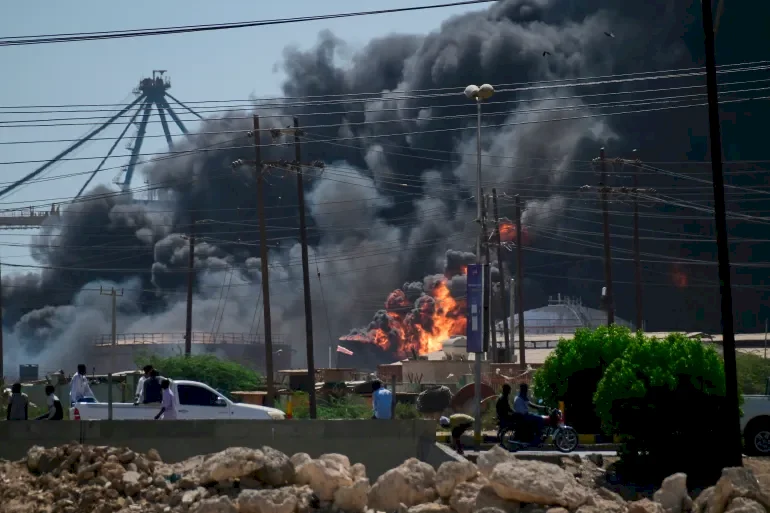
SadaNews - The city of Al-Abyad, the capital of North Kordofan State in Sudan, is facing the threat of a potential ground attack and ongoing shelling from the Rapid Support Forces, coupled with airstrikes from the Sudanese army, amid international warnings that it could become a "second Fasher."
This military escalation has ignited a fierce conflict and complete division in field narratives and political analysis regarding the actual situation on the ground and the chances for a solution.
According to the editor-in-chief of Al-Wasat newspaper, Fathi Abu Ammar, Al-Abyad is more significant than Fasher as it is the capital of Greater Kordofan and the border between the east and the west, as well as the capital of gum Arabic, accounting for 80% of the world’s production.
The Kordofan region comprises three states: North Kordofan (with Al-Abyad as its capital), South Kordofan (with Kadugli as its capital), and West Kordofan (with Al-Foula as its capital).
On his part, Cameron Hudson, former U.S. National Security Council officer for African affairs, believes that controlling the city during the winter gives the Rapid Support Forces a significant military and strategic advantage, especially with ongoing attempts to hold political talks for a ceasefire.
In contrast, political analyst Abdurrahman Abdel-Majid asserts that Al-Abyad is completely safe and even safer than Omdurman, noting that the rebels are more than 200 kilometers away from it, emphasizing that their supply lines have been entirely cut off within two days.
Scenarios for Al-Abyad
Abdel-Majid points out that the only threat to Al-Abyad is drone fire led by the Sudan People’s Liberation Movement from the eastern mountains with the help of foreign experts.
He firmly stated that Al-Abyad will not become another Fasher, "without a doubt," because Fasher fell due to an unbearable siege and hunger, while the roads to Al-Abyad are completely open from Kosti and Tendelti, and citizens are living securely.
He also criticized international reports and organizations, describing them as lacking professional integrity for having fled from Khartoum at the beginning of the war, considering the international community a "global family" that merely watched Fasher fall.
In contrast, Abu Ammar believes that the Rapid Support Forces will not relent on besieging Al-Abyad due to their ability to maneuver and cut off roads, in addition to the absence of a peace horizon and the rigidity of the army's position, citing the statement of the chairman of the Transitional Sovereignty Council, Abdel-Fattah al-Burhan, who conditioned the surrender of his opponent and the laying down of arms.
He regarded the talk of the city's safety as similar to what was said about Fasher before its fall, noting that the battle of Fasher witnessed the disappearance of 45,000 fighters supporting the army, calling for a transparent investigation to determine the violations attributed to both sides, especially with the killing of 1,000 people by drones, most of which are affiliated with the army.
The fall of Fasher marked a chain of atrocities committed by the Rapid Support Forces in the war that erupted in April 2023, and a UN mission confirmed in February 2026 that these violations bore the hallmarks of genocide.
International Inability
Regarding the dimensions of the solution, Cameron Hudson describes the international community as "paralyzed" due to its lack of effective coercion tools and inability to send peacekeeping forces, affirming that the centers of power have shifted to regional countries such as the UAE, Saudi Arabia, Turkey, and Egypt.
In this context, Abu Ammar points out that the Egyptian tone has changed by calling for a quick truce, which could bring Al-Abyad into the circle of political negotiations to spare it from war.
Source: Al-Jazeera
 Follow the latest Sada News via Google News
Al-Abyad in the Eye of the Storm: Could the Capital of North Kordofan Become a Second "Fas...

Russia Temporarily Closes Moscow Airports After Wave of Ukrainian Drones

Qatar: 54 Injured and 18 Missing in Explosion at a Factory in Ras Laffan

Ukraine Strikes Russian Oil Refinery Over Two Thousand Kilometers from Its Border

7 Killed in Two Explosions Along a Road in Northwestern Pakistan

Recovery of 16 Bodies of Migrants from Capsized Boat off the Coast of Libya

Britain Tests Long-Range Weapons for Delivery to Ukraine
