

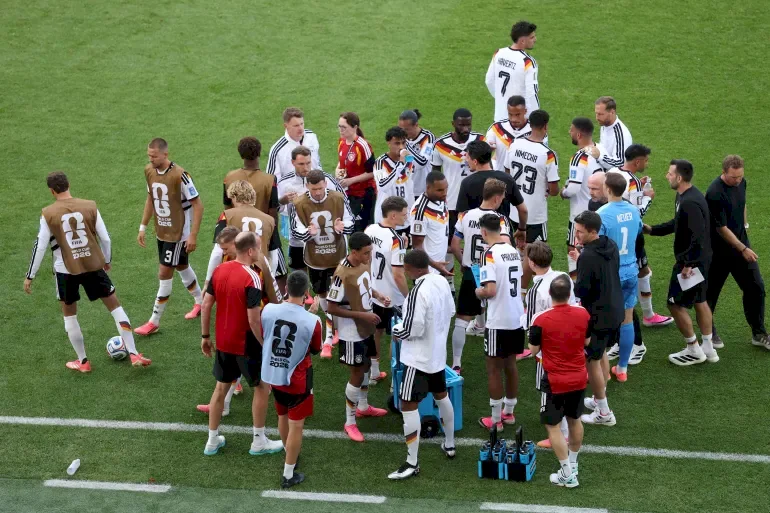
Hydration Breaks: A Tactical Weapon Shifting the Balance of Matches in the 2026 World Cup
SadaNews - "Hydration breaks" have evolved from a mere preventive medical measure endorsed by FIFA to ensure player safety; they have transformed in the 2026 World Cup into a flexible and smart "timeout," utilized by coaches to reorganize their formations and correct tactical errors.
Technical analyses of recent matches confirm that the flow of play and attacking momentum shift drastically once the three minutes of the break are over, turning it into a dual strategic weapon that disrupts the rhythm of the dominating team and provides the defending team with a lifeline to rearrange their tactics.
Offensive Turnaround After Breaks
Data and statistics from global analysis platforms like Opta and ESPN reveal a significant offensive advantage and a noticeable rise in the level of matches immediately following hydration breaks, as illustrated by the following indicators:
Goals surge in the first half: Among the goals scored in the first half of matches, only 14 occurred before the 22nd minute, whereas that number leaped to 19 goals in the period immediately following the break until the end of the half.
Crucial game-changing goals: Statistics show that 11 goals scored after water breaks (in both halves) were pivotal in altering the match situation, either by breaking the deadlock or by taking the lead.
Explosion of shot attempts: The tournament recorded only 115 shots before the first-half break, compared to 170 shots from the 25th minute until the whistle signaling the end of the half; proving the immediate impact of tactical instructions.
Among the 48 teams participating in the World Cup, 26 teams reported a qualitative increase in their danger levels and shot attempts after returning from the break, while only 11 teams experienced a decline in offensive performance compared to before the break.
Live Examples: Breaks That Turned the Tide of the World Cup
1. Australia vs. Turkey (2 - 0)
Before the break, the Turkish team dominated possession and the run of play, with the Australians mustering only a single shot before the 22nd minute.
Australian coach utilized the three minutes for a hydration break to reorganize his defense and shift to rapid counterattacks; the outcome resulted in Australia scoring two winning goals immediately after both the first and second-half breaks, along with launching three decisive shots after the stoppage.
2. Morocco vs. Brazil (1 - 1)
Before the break, the Moroccan team showcased their fierce offensive style, establishing complete control over midfield.
At the 22nd minute, Brazilian coach Carlo Ancelotti gathered his players, issuing strict instructions to close spaces and implement reverse pressure; momentum completely flipped in favor of the "Seleção," which managed to impose their rhythm and equalize the score.
3. Germany vs. Curacao (7 - 1)
Before the break, the Curacao team surprised the German "machines" with an unexpected tactical layout that threw off the visitors early in the match.
Coach Julian Nagelsmann took advantage of the break to explain positioning adjustments and how to breach the defensive line; the Germans returned with total dominance culminating in a historic seven-goal victory.
He stated: "Curacao played with a diamond formation today, and we adjusted our attacking style before the hydration break. However, it still took time in some moments because, after all, you rarely face a team with a diamond formation these days. It's almost uncommon. Very few teams do that now, and we needed some time. The hydration break was beneficial to confirm what we had adjusted earlier."
4. Japan vs. Netherlands (2 - 2)
The Netherlands dominated the game and seemed on course to secure the win, while the Japanese attack managed only two shots amidst overwhelming difficulty in breaking through.
The Japanese coach executed a significant adjustment in the attacking setup during the second-half hydration break (67th minute); this sparked the "Blue Samurai" to equalize, showing a leap in shot attempts to 5 dangerous efforts due to the new tactical layout.
These findings indicate that modern football is often decided by the details of these timeouts; and that the smart coach is the one who can transform the mandatory medical breaks into a strategic gain that flips the tables against their opponent.
Stars and Coaches Voice Criticism
FIFA's decision to enforce mandatory hydration breaks in all matches, regardless of weather conditions, has sparked widespread debate and sharp division among football stakeholders:
Virgil van Dijk, the captain of the Netherlands, harshly criticized the concept in his remarks to the official ITV website following the draw with Japan (2 - 2), saying: "I really don’t like these breaks, and for viewers behind the screens, it’s not good due to the excessive commercial advertisements."
He added: "If the weather is very hot, that’s acceptable, but each match should be assessed individually rather than making it mandatory."
Meanwhile, Kylian Mbappé, the star of the French team, reportedly showed signs of discontent during the stoppages, especially against Senegal.
When asked for his opinion on the hydration breaks, he replied: "What do I think about hydration breaks? Don’t ask us players for our opinions, as we react quickly. If we are dominating the match tomorrow at the 25th minute, and then a hydration break comes, we will be frustrated because it disrupts our balance; however, if the weather is hot or we are losing, I would be happy."
Quick attackers view the break as a golden opportunity for tired defenders to catch their breath and reorganize defensively, which undermines the "attacking momentum" and closes off the spaces that attackers create by continuous running.
From the coaches' perspective, Argentine coach Lionel Scaloni believed that hydration breaks "benefit the weaker teams."
He stated: "It may help the theoretically weaker team because they get time to rest." Adding that it practically divides matches into "four quarters."
Mauricio Pochettino, the coach of the US team, took a decisive stance: "I don’t favor this decision; I only prefer it in extreme conditions. In good conditions, it’s unnecessary."
Coaches believe that turning the match into "four quarters" provides them with tactical flexibility and greater control to fix flaws early without waiting until the end of the half."
 Follow the latest Sada News via Google News
Saudi Green Clings to Hope.. Scenarios for Qualification to the Round of 32 in Group Eight

How is Austria's coach planning to dethrone Messi and his team?

Hydration Breaks: A Tactical Weapon Shifting the Balance of Matches in the 2026 World Cup

Egypt Achieves Historic Victory Over New Zealand in World Cup, Approaching Round of 32

World Cup: Morocco achieves the first Arab victory while Turkey loses for the second time,...

"Google" Launches "Android 17" with App Bubbles and Stronger Data Protection

"Electronic Nose" Detects Food Spoilage and Allergens Using Artificial Intelligence
