

Smart Bandage Monitors Diabetic Wounds and Warns of Amputation Risk
SadaNews - Researchers at the Korea Advanced Institute of Science and Technology have developed an innovative smart bandage capable of instantaneously monitoring diabetic foot wounds without the need for painful procedures.
They explained that this technology could help reduce the serious complications that can lead to limb amputation in diabetic patients. The results were published on Thursday in the journal "Advanced Functional Materials."
Diabetic foot ulcers are among the most severe chronic complications associated with diabetes, often arising from poor blood flow and nerve damage in the feet, which decreases the patient's ability to feel wounds or infections in their early stages. The condition can begin with a simple wound or minor ulcer but can quickly worsen due to slow tissue healing and a high risk of infection, which may lead, in advanced cases, to tissue damage or amputation if medical intervention is not timely.
In light of these risks, researchers worked on developing a technology that allows continuous and accurate monitoring of wounds without the need for surgical procedures or painful tests.
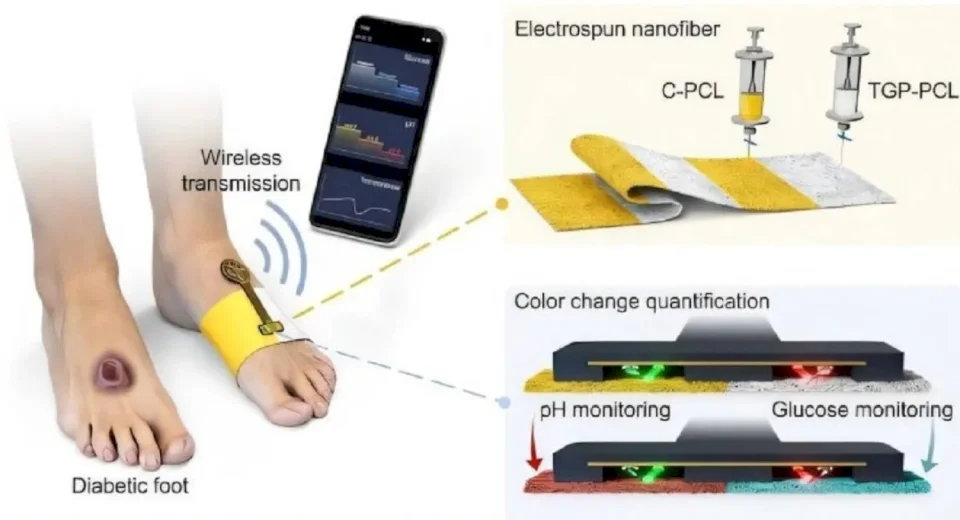
The new bandage combines an advanced electronic optical sensor with a functional bandage made of ultra-fine nanofibers capable of measuring several vital signs simultaneously, including glucose levels, pH level, and the temperature of the wound. This allows for immediate analysis of the injury through a smartphone application.
The team relied on advanced technology to produce the nanofibers used in the manufacture of the bandage, as they change colors automatically when glucose levels rise or when changes in pH occur, which are indicators usually associated with the worsening of diabetic foot ulcers.
The researchers indicated that this color change allows for easy detection of warning signs with the naked eye, helping to identify the deterioration of the wound's condition early before it reaches critical stages such as tissue damage or necrosis, and without needing to draw blood samples or perform surgical tests.
To enhance diagnostic accuracy, the team integrated an electronic optical system within the smart patch consisting of a light-emitting diode and a photodetector that measures the reflected light resulting from the color change of the bandage, then converts these signals into accurate electronic data.
Results showed that this technology provides more stable and accurate data compared to traditional imaging methods based on cameras, as it is less affected by changes in surrounding lighting.
One of the most prominent advantages of this innovation is that it operates without a battery, relying on near-field communication technology. The patch receives power wirelessly when a smartphone is brought close to it and then sends the data directly to the designated application. Thus, patients and doctors can monitor the state of the wound instantly using only their phones.
According to the researchers, this technology holds significant clinical value as it combines easy visual indicators and accurate electronic data, while reducing the physical burden on patients. It may also improve the quality of life for those with diabetes by providing continuous monitoring of wounds without the need for repeated finger pricks or blood sample withdrawals.
 Follow the latest Sada News via Google News
FIFA Referees Committee, Led by Colina, Clarifies Cases from Egypt vs. Argentina Match

The Egyptian Federation Files Official Complaint Against Referee Letexier

Do You Know How to Comfort Someone Who is Crying? Here's What to Say and Do in Tough Momen...

"Backrooms": From Digital Legend to Cinematic Phenomenon

Prediabetes.. The Silent Bomb Carried by Millions Without Their Knowledge

From Sweden 1958 to the Epic of Egypt 2026.. Argentina's History with World Cup Comebacks

After the South Africa Precedent.. Nigeria Investigates the Encroachment of Technology Com...
