

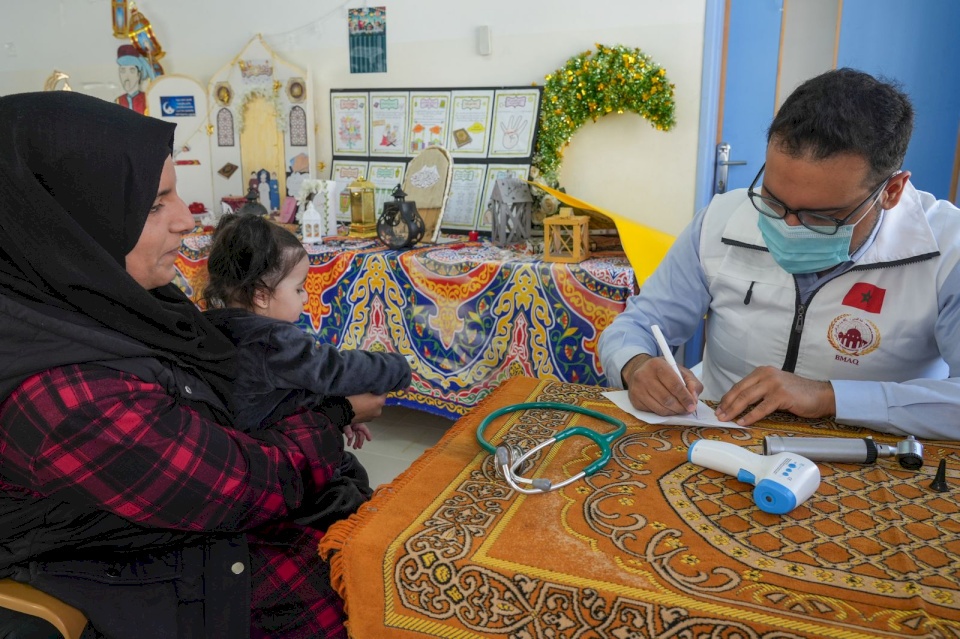
The "Bayt Mal Al-Quds" Medical Campaigns Break Isolation and Bring Healthcare to Remote Villages in Jerusalem
SadaNews - In the Bedouin communities and remote villages surrounding Jerusalem, medical services are either absent or hard to reach, making access to treatment a daily challenge for the residents, especially the elderly and children, amid difficulties in crossing military barriers, high transportation costs, and complexities in reaching medical facilities.
In embodying its steadfast humanitarian role and with the support of the Kingdom of Morocco, the Bayt Mal Al-Quds Agency did not wait for patients to arrive burdened by their suffering; instead, it proactively reached them through comprehensive free medical campaigns launched during the holy month of Ramadan as part of its annual humanitarian and social assistance program.
Today, the medical caravans arrived in Sheikh Saad village, located southeast of Jerusalem, which encapsulates the bitter story of isolation; it is surrounded by the apartheid wall on all sides, and its approximately 3,500 residents can only breathe through a single military checkpoint that controls every detail of their daily lives.
The arrival of the mobile medical laboratory and the specialized medical team in fields such as general medicine, internal medicine, pediatrics, and ophthalmology provided a lifeline to the villagers, especially for those who cannot leave the village due to restrictions imposed by the occupying forces on vehicle movement and the need for citizens to walk to meet their basic needs.
The head of the Sheikh Saad village council, Jamal Aziatar, confirmed that the measures of the occupation isolate the village and limit the ability of citizens to access medical institutions within Jerusalem, making such campaigns, especially medical ones, an utmost necessity to compensate for this deficiency.
Aziatar added that the limited health services in the village increase the suffering of the residents, as there is only one medical clinic that operates one day a week due to the difficult circumstances the village is facing, which does not meet the minimum needs of the people.
He noted that these campaigns leave a positive impact among the citizens, expressing hope that they will be repeated in the future and that the agency can provide medicinal treatment alongside examination and diagnosis.
Aziatar expressed his deep appreciation for the Bayt Mal Al-Quds Agency, praising the continuous Moroccan support and the stand of the Kingdom of Morocco, its king, government, and people alongside the Palestinian cause and their constant solidarity with the residents of Jerusalem in Sheikh Saad village and elsewhere.
For his part, citizen Muhammad Musa Allan confirmed that this medical campaign holds exceptional importance for the village, which has turned into a large prison due to the military checkpoint, the distance from medical centers, and the difficulty of movement.
He added that the arrival of institutions to the village is not an easy matter, hence the residents value any entity that comes to provide its services, especially given the large number of elderly people and those with chronic diseases such as hypertension and diabetes, who require continuous periodic follow-ups and examinations that the only clinic in the area cannot meet.
Citizen Jamal Allan emphasized that the village is in urgent need of such initiatives, indicating that anyone needing treatment has to head to Al-Eizariya town, which is about ten kilometers away, accompanied by numerous difficulties related to transportation due to the obstacles imposed by the occupation and the overwhelming financial costs.
On her part, Dalia Jaradat from "Astra Lab" laboratories, a partner in implementation, clarified that these medical campaigns target all age groups—from children, women, and men to the elderly—and the services provided are adapted to meet the needs of each geographic area visited.
She added: "Our services are not limited to general check-ups; they also include specialized fields such as internal medicine, ophthalmology, and laboratory tests, in addition to the immediate coordination to transfer critical cases that require surgical interventions or specialized follow-up in hospitals."
She emphasized that the areas targeted by the medical campaigns are in urgent need of continuity and repeated visits to ensure wider coverage and provide sustainable healthcare for the residents.
The trajectory of these campaigns since their inception reveals a clear strategic vision targeting the most marginalized areas, starting from Khan Al-Ahmar, the Jahalin and Muntar gatherings, reaching to Jaba, Hizma, Rafat, Qalandia camp, and the villages northwest of Jerusalem such as Qatanna, Bedouin, and Sheikh Saad.
Ongoing medical campaigns have resulted in approximately 1,200 citizens benefiting so far, with an average of 150 beneficiaries in each campaign. These efforts, in addition to diagnosing health conditions, have transferred 15 cases to hospitals for continued treatment, including open-heart cases and catheterization that required urgent medical intervention.
The implementation of the medical campaign program is set to continue, reaching 24 campaigns covering 31 areas, considering the integration of more than one area within a single campaign according to population density. The program, in its final stages, also includes providing beneficiaries—especially children—with medical glasses based on medical reports, alongside providing necessary medications, ensuring the sustainability of the health impact of these initiatives.
 Follow the latest Sada News via Google News
More than 37,000 travelers crossed the Al-Karama crossing last week

Weather Conditions: Extremely Hot Weather

Civil Defense Reinforces Its Field Crews to Support the Villagers of South Nablus

Third Assault by Settlers in a Week Temporarily Halts Water Pumping from Ein Samia Wells

Tens of thousands of worshippers perform Friday prayer at Al-Aqsa

"Fatah" and "Hamas" and Other Factions: What Happened in Nablus is a Bloody Massacre

SadaNews Publishes the Results of the General Secondary Education Exams in Palestine 2026
