

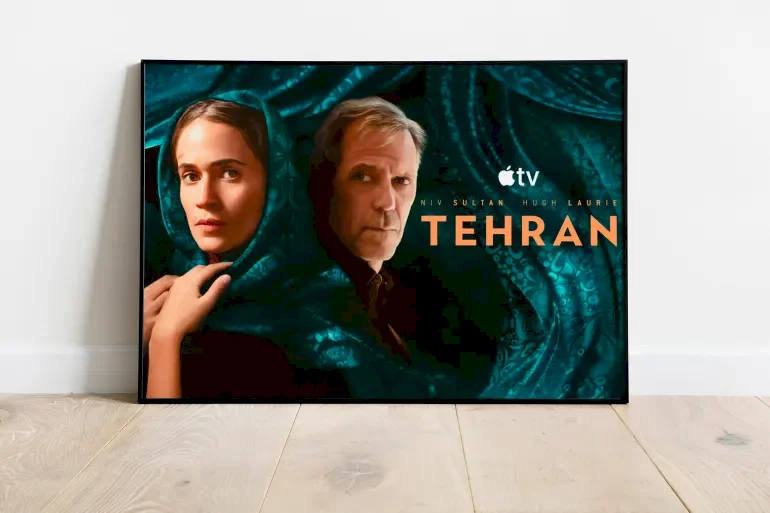
After the Death of the Israeli Producer.. Is the Series "Tehran" a Dramatic Weapon or an Artistic Work?
Sada News - The incident of the death of Dana Eden, the producer of the Israeli espionage series "Tehran", in her room at a hotel in the Greek capital Athens on the evening of February 15, 2026, was not merely a fleeting arts news item placed in the obituary sections by news agencies, but rather a revealing moment of the immense power that drama exerts over the public imagination in an age of information fluidity.
At the moment her life ended, a "new life" for the event began on social media platforms and in political analysis corridors, where the threads of virtual reality intertwined with those of the intelligence work she had been producing for years.
Eden's presence in Athens was justified, as the Greek capital, which is used visually as an alternative to the city of Tehran, has transformed in digital imagination from merely a "shooting plateau" to a supposed crime scene.
The slip from drama to reality is what gave the news its global momentum. The viewer, who was accustomed to seeing Mossad agents infiltrating the streets of Athens, considering it "Tehran" in the series, found it extremely difficult to separate the actual producer’s corpse from the assassination plot that the work is famous for.
Although Greek police reports, which were relayed by global news agencies such as Reuters and the Associated Press, classified the incident under "suspected suicide" based on the discovery of medication in the room and the absence of signs of violence, the global audience preferred to immediately adopt the assassination scenario.
This contradiction, recurring despite its strangeness, raises questions about why the narrative of the potential assassination has overridden the official statements issued by the authorities of a European country like Greece. The answer lies in the nature of the series "Tehran" itself, as the work, which won the International Emmy Award in 2021, is not merely entertainment television production but is an integral part of the "war of narratives" raging in the Middle East.
When the work touches upon sensitive issues surrounding allegations of the Iranian nuclear program, its creators in the eyes of the public become political targets rather than mere artists, making any sudden departure of one of them seem like an additional chapter not written by anyone but executed by fate or politics in that gray area where art meets security.
A Dramatic Weapon
The series "Tehran" has not been viewed in Iranian official and media circles as a dramatic production, but rather as part of a "soft war" and cultural penetration system.
With the announcement of the death, media platforms close to the conservative current in Tehran rephrased the narrative. The Kayhan newspaper published a commentary hinting at what it described as the moral and professional fall of the producers of illusions, considering the series an Israeli attempt to portray fictitious penetrations within the Iranian depth.
Analysis from media institutions affiliated with the Revolutionary Guard stated that those who feed on stories of assassinations and seditions live in an environment of constant psychological tension, and that the mysterious circumstances surrounding the departure of the producer, whether it was suicide or otherwise, reflect the bitterness of the reality they try to falsify through screens, portraying Iran as an exposed battleground.
As for the Israeli and international stance, it was marked by a high tone of sorrow for Eden’s creative vision. The Israeli Ministry of Culture and the official broadcasting authority "Kan" mourned the producer, describing her as an icon who transferred local drama to the global level and opened new horizons for television production in the region.
The "Apple TV" platform issued a statement affirming its deep sorrow for the passing of the creative vision that boldly shaped the identity and conflict in "Tehran," noting that her commitment to storytelling aimed to reveal the human difficulties behind rigid political headlines.
Shula Spiegel, her producing partner, attempted to clarify security hypotheses by emphasizing that Dana was a devoted artist suffering from professional pressures, and that what is rumored about assassinations or political motives for her death is a continuation of the illusion that the company tries to combat through art, calling on the audience and media to respect the family’s privacy away from the conflicts of nations and their intelligence agendas.
Dana Eden left behind a remarkable legacy. Since her engagement in the television industry in the mid-1990s, she has always sought to transcend narrow local boundaries, succeeding through a deal with Apple.
The series that tells the story of Tamar Rabinian, a Mossad agent of Iranian descent, places the viewer before a double mirror; Iran in the series is not merely an "enemy" but the lost homeland with its aesthetics and history, and Israel is not just a fortress but rather a heavy obligation tearing apart personal identity.
This precise dramatic balance is what made the departure of the creator of this balance in Athens, which played the role of Tehran, raise all these existential and political questions, making it difficult for the ordinary follower to accept the idea of a natural or personal death in an environment saturated with the scent of espionage.
A Lesson in Audience Psychology
The incident of Dana Eden's death remains a profound lesson in the psychology of crowds and how art intertwines with politics to the extent of complete fusion in a charged area like the Middle East, where neither the producer nor the writer can be neutral in the eyes of opponents, no matter how much they try to cling to human dimensions.
The Greek investigations included a thorough review of hotel surveillance cameras, an autopsy, and collecting testimonies from the production crew, which may result in a criminal file closed with the word "suicide" due to psychological or medical pressures; yet, the "dramatic truth" in the minds of millions will remain suspended between two contradictory narratives: an Israeli and Western narrative seeing it as a victim of the pressures of creativity and the difficult psychological reality, and an Iranian narrative viewing her as a victim of the environment of conspiracies that she contributed to shaping the public’s consciousness of and eventually became a trap that consumed her.
Eden was overseeing preparations for the fourth season, and her passing poses a significant moral and artistic challenge for the show's creators to continue producing work that breathes politics while political imaginations and expectations consume its makers.
The suspicious death of Israeli producer Dana Eden in the city that played the role of Tehran, and the series that has turned into a subject of espionage, analysis, and suspicion, confirms that art in our current age is no longer merely a simulation of reality or an escape from it, but has become the fuel for the engine of international politics, and its imagined narrative is sometimes stronger and more enduring than the official statement and forensic evidence.
The incident opens the door wide to deeper questions about the cost of creativity when it approaches the "forbidden areas" in international conflicts, and how the artist transforms from an observer documenting the conflict to a participant in it against their will.
Official investigations refer to what relates to physical evidence, while social media platforms echo fears and political expectations, leading fate to give the producer an end that is no less mysterious or exciting than the series itself, leaving "Tehran" the series, "Tehran" the city, and "Athens" the appointment, a triangle that will continue to stir debate about the boundaries of art and the dangers of reality in a world where distances between screen and truth are disappearing.
Source: Al Jazeera + Foreign Press
 Follow the latest Sada News via Google News
World Cup: Morocco achieves the first Arab victory while Turkey loses for the second time,...

"Google" Launches "Android 17" with App Bubbles and Stronger Data Protection

"Electronic Nose" Detects Food Spoilage and Allergens Using Artificial Intelligence

6 Foods That Enhance Your Health as You Age

Why Don't We Feel Full Sometimes Despite Eating?

It's Not Walking... A Study Reveals the Most Effective Exercise for Protecting Women's Hea...

Chewing Gum After These Foods Lowers Blood Pressure
