

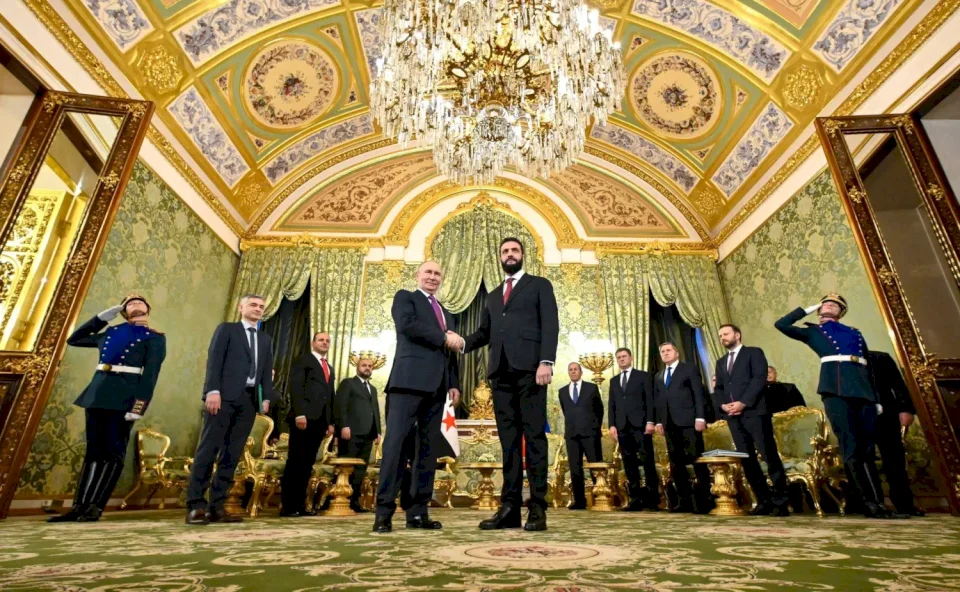
Putin and al-Shara Meeting... Postponing "Contentious Points" and "Developing Relations"
SadaNews - The second meeting in the last three months, which brought together Syrian President Ahmad al-Shara and his Russian counterpart Vladimir Putin on Wednesday, reflected an increase in the level of trust between the two sides and a strong desire to accelerate the process of rebuilding relations between the two countries.
In contrast to the focus of the two leaders during their first meeting in October of last year on "the historical legacy of relations" and the necessity for a comprehensive review of the situation that prevailed during the reign of ousted President Bashar al-Assad, both sides appeared more comfortable during al-Shara's second visit to the Russian capital. Putin received him in the Kremlin along with a high-level Russian delegation, emphasizing his praise for the "successes" achieved by the Syrian leadership in the process of rebuilding the new Syria and unifying it while extending government control over all its regions. Al-Shara responded with similar remarks when he spoke of the "effective Russian role in maintaining stability in Syria."
A Delegation Reflecting Interest
The Russian delegation included Defense Minister Andrei Belousov, Deputy Prime Minister Alexander Novak, Foreign Minister Sergey Lavrov, Finance Minister Anton Siluanov, and Housing and Construction Minister Erik Fayzulin, in addition to Presidential Assistant Yuri Ushakov, Deputy Head of the Presidential Administration Maxim Oreshkin, First Deputy Defense Minister Yunus-Bek Yevkurov, and Director of the Federal Military-Technical Cooperation Dmitry Shugayev.
Admiral Igor Kostyukov, head of the Main Directorate of the General Staff of the Russian Armed Forces, who had previously attended Russian-Syrian discussions, also took part in the talks and recently led the Russian delegation during the tripartite discussions held in Abu Dhabi between Russia, the United States, and Ukraine.
This composition of the Russian delegation reflected the Kremlin's level of interest in the visit and the breadth of the agenda discussed.
Al-Shara was accompanied by Foreign Minister As'ad al-Shabani and Defense Minister Marhaf Abu Qasra, along with the Secretary-General of the Presidency Maher al-Shara.
Putin opened the meeting by discussing developments in bilateral relations and stated that the two countries had succeeded, in complex circumstances, in advancing economic cooperation.
Economic Growth and Reconstruction Projects
The Russian president noted that "a growth rate exceeding 4 percent may not be as ambitious as we wish, but nonetheless constitutes significant progress, and we must definitely maintain this distinguished path."
He added that relations between Moscow and Damascus "have seen tangible development, thanks to the personal efforts of President al-Shara."
Putin congratulated his guest on the "increasing momentum in the process of restoring the unity of Syrian territories."
He described the progress of government forces in northeastern Syria as "a critical and significant step" and stated that Russia was closely monitoring the diligent efforts being made by the Syrian leadership to restore the unity of Syrian territories.
Addressing al-Shara, he said: "I know there is much to be done in terms of reconstruction and rehabilitation (...) and our economic institutions, including those operating in the construction sector, are fully prepared for this joint work."
For his part, al-Shara thanked his Russian counterpart for "Moscow's involvement in stabilizing conditions," noting that "Russia plays an extremely important role in this process."
He expressed hope for productive discussions with Putin, asserting that the two sides had "many common topics."
Al-Shara stated that Syria "overcame stages and obstacles last year, the latest of which was the challenge of unifying Syrian territories." He added that Damascus was counting on transitioning from a state of destruction in the region to stability and peace.
In a nod to the strides made in Russian-Syrian relations over the year, the Syrian president reminded his host that "tomorrow marks the first anniversary of the visit of the first Russian delegation to Syria after the new era," referring to Deputy Foreign Minister Mikhail Bogdanov's visit a year ago that paved the way for launching dialogues between Damascus and Moscow and set in motion the process of rebuilding relations.
In terms of bilateral issues, the two presidents discussed the increased joint activity between the relevant ministries in areas such as industry and humanitarian affairs, including sports, medicine, and construction.
Avoiding Contentious Points
It was notable that the two presidents avoided discussing any potentially contentious or unresolved points during the open part of the meeting, such as the status of Russian military bases in Syria. However, the Kremlin had preemptively indicated that this file would be on the agenda for discussion between the two presidents.
Al-Shara and Putin also did not address the situation on the Syrian coast, which is another contentious issue, against the backdrop of accusations against some remnants of the previous regime present on Russian territory of attempting to stoke tensions in the region. It appeared that this file was also present during the closed discussions, particularly since matching Russian and Syrian sources had previously informed "Asharq Al-Awsat" that al-Shara might request the handover of some second- and third-tier leaders who were proven to be involved in attempts to incite unrest and instability in the coastal region.
In a parallel context, other sources discussed lists prepared by the Syrian leadership of certain figures associated with the former regime who could potentially be reconciled with, recognizing that this had been a Russian demand during previous visits of Syrian delegations to Moscow.
Sources did not rule out that the situation in northeastern Syria could play a fundamental role in the discussions, especially in light of Russia's withdrawal from Qamishli airport two days before the visit, reportedly in response to a request from Damascus.
Russian Role in Negotiations with Israel
A source that spoke to "Asharq Al-Awsat" indicated that the situation in this area would be a topic of discussion, adding: "What seems to be more important is that al-Shara may seek to discuss the situation in southern Syria with Putin, amid increasing Syrian interest in having Moscow play a role in this matter that enhances its position in the ongoing negotiations with Israel."
This topic had been touched upon previously during reciprocal visits, referencing the possibility that Moscow might play a role in conducting patrols in southern Syria to curb Israeli incursions and seek to play a guarantor role between Damascus and Tel Aviv similar to the roles it had played in southern Syria in the past. However, interestingly, some sources noted that Israel does not seem enthusiastic about activating a Russian role in this area.
Regarding Russian military bases in Syria, estimates indicate that both sides might initiate discussions about a new arrangement for Russian presence that allows Moscow to retain its presence at the Tartus base, which provides extremely important logistical facilities for Russia's supplies to the African continent and plays a vital role in servicing Russian ships and fleets in the Mediterranean. While sources expect discussions regarding the Hmeimim airbase to focus on establishing a new framework for joint cooperation aimed at rehabilitating the Syrian army.
 Follow the latest Sada News via Google News
Trump: We will make great progress with Beirut.. Aoun: It is time for Lebanon to be stable

The Lebanese Army Deploys in the South and Comes Under Gunfire; Israel Clarifies

Bezhkian: Directives from the Leader to End the State of No War, No Peace

Saudi Arabia condemns the Houthi threats to navigation and pledges to protect its ships

Global Warning to Americans Due to Rising Tensions in the Middle East

Houthi Movement Announces Ban on Maritime Navigation Against Saudi Arabia

Earthquake of 5.5 Magnitude Hits Western Iran
