

From Davos: How Do Three Decision Makers View the Future of the Global Economy?
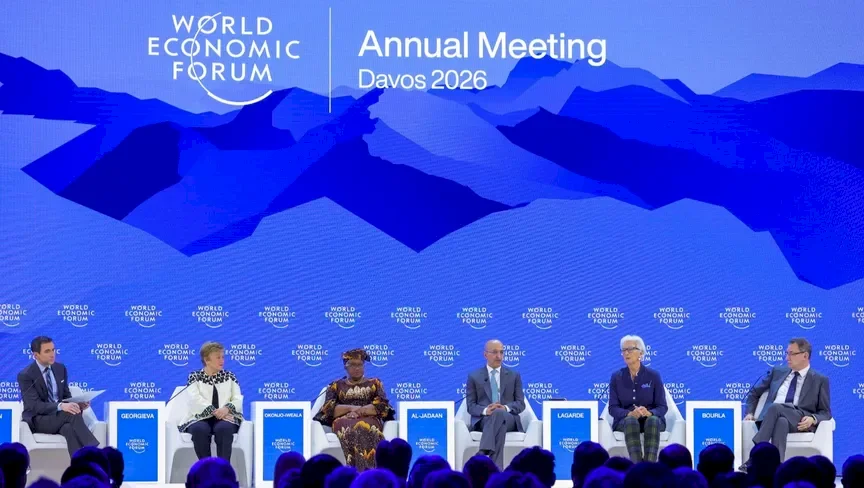
SadaNews - At the conclusion of the World Economic Forum in Davos, while many were preoccupied with the sensational headlines about tariffs and artificial intelligence, three of the most prominent women in the global economy agreed on a single message: the importance of a close reading of the figures and economic transformations, at a time when there is much talk about the collapse of the global economic system.
The President of the European Central Bank, Christine Lagarde, the Managing Director of the International Monetary Fund, Kristalina Georgieva, and the Director-General of the World Trade Organization, Ngozi Okonjo-Iweala, presented during the closing session at the economic forum in Davos titled "Global Economic Outlook," a coherent reading of a rapidly changing world, which has not yet lost its foundations, according to them.
Lagarde: Between Noise and Truth
Lagarde rejected the characterization of what the world is witnessing as a collapse of the existing system, considering that the global economic system is undergoing clear transformations and rearranging of relationships, with a greater focus on vulnerabilities and interdependence between economies.
She also stressed that one of the biggest challenges today is the confusion between genuine signals and noise, whether in figures or political narratives, pointing out that many of the circulating growth rates are nominal figures that do not necessarily reflect actual improvement after accounting for inflation. She emphasized that credibility and honesty in the use of data have become essential elements in maintaining trust in economic policies.
Regarding artificial intelligence, Lagarde stated that the discussion should not be limited to the size of investment or funding, but should extend to deeper questions about governance and regulation, and the impact of technology on the social fabric, warning against repeating mistakes seen with social media platforms.
Georgieva: "Beautiful" Growth but Not Enough
For her part, Georgieva saw that the world has actually entered a new phase characterized by being more vulnerable to shocks, whether geopolitical, technological, or climate-related, within a multipolar global system.
Despite the International Monetary Fund raising its forecasts for global growth, Georgieva stressed that this improvement should not lead to complacency, as growth at levels close to 3%, in her view, is insufficient to bear the burden of sovereign debts approaching 100% of GDP in many countries. She cautioned against excessive celebration over the upgrade in forecasts, describing the improvement in growth figures as "beautiful, but not enough."
Georgieva's most prominent warning came regarding the impact of artificial intelligence on the labor market, as she predicted that about 60% of jobs in advanced economies would be affected by this technology, whether through enhancement, transformation, or elimination. Despite the potential for productivity gains, she believed that the real danger lies in widening gaps within societies, increasing pressure on the middle class, and the difficulty for youth to enter the labor market.
Okonjo-Iweala: Trade Is Not Dead... But It Has Changed
As for Okonjo-Iweala, she attempted to dismantle the common notion that globalization or multilateral trade has ended. Despite what she described as the largest disruption to the global trading system in eight decades, the Director-General of the World Trade Organization confirmed that about 72% of global trade is still conducted according to the organization's rules.
Okonjo-Iweala stated that the trading system has shown some resilience, but at the same time, it is in urgent need of reform, especially in light of the rise of unilateral measures and excessive reliance on specific markets or supply chains. She called on governments and companies to diversify their trade partnerships, emphasizing that diversifying partners and supply chains has become essential to avoid shocks.
Regarding artificial intelligence, she viewed this technology as capable of lowering trade costs and raising productivity, but she warned that its gains will remain unbalanced unless its spread is accompanied by more equitable practices; otherwise, it could deepen existing gaps between economies.
 Follow the latest Sada News via Google News
The World Bank Warns: "The Worst-Case Scenario" for Global Growth is Approaching

Trump Prepares to Impose New Tariffs on Dozens of Economies

Gold Surpasses $4,100 as Selling Pressure Eases

Oil Rises for the Fourth Day as Supply Risks Escalate

An Additional $8 Billion.. A New Account from the Pentagon on the Cost of the War with Ira...

London Stock Exchange Enters the Era of 24/7 Trading

Shamaran Petroleum: Suspension of Oil Production in Duhok Fields in the Kurdistan Region o...
